

Many of us grew up with sardines on the table every week. Today, between quick lunches and long days at a screen, oily fish can go missing for a month without anyone noticing. Here is what omega 3 fish oil studies really measured, how much EPA and DHA the EU links to the heart, brain and vision, and how to take it so it counts.
There is a family of fats our body needs to function — yet is incapable of manufacturing itself. Marine omega-3s, EPA and DHA, belong to these so-called essential nutrients: essential in the strictest sense, meaning their only possible source is food. For millennia, humans obtained them from oily fish, seafood and, broadly speaking, diets rich in marine produce. Our contemporary lifestyle has quietly distanced many of us from these sources.
In Morocco the subject comes up increasingly often. In conversations among Casablanca executives concerned about their heart health, among parents worried about their children’s concentration, and among those who notice their eyes tiring at a screen — omega-3 resurfaces as a recurring keyword. Our team receives questions about it every week. Is there real substance here? What does research say? Should people eat more fish or take a supplement? This article answers those questions, drawing on the positions of scientific authorities and one straightforward principle: we promise nothing that science does not support.
By Houda Khaldi, Editorial Adviser in Natural Nutrition · Published 17 June 2026 · 18 min read
Contenu de la page
- 1 Key Takeaways
- 2 Omega-3: What Exactly Are We Talking About
- 3 What a Good Fish Oil Really Contains
- 4 The Science: What Authorities Actually Say
- 5 Omega-3, Ginkgo, Moringa: How to Navigate
- 6 Omega-3 in Morocco: A Real Need, A Particular Context
- 7 How to Use Omega-3 Properly
- 8 The Alphavital Answer
- 9 Three Readers Share Their Experience
- 10 Omega 3 fish oil benefits: what the studies actually measured
- 11 Omega 3 dosage: how many capsules for which goal
- 12 How to take fish oil so it counts
- 13 Frequently Asked Questions About Omega-3
- 13.1 What exactly are EPA and DHA?
- 13.2 What are the recognised benefits of omega-3 in Morocco?
- 13.3 Omega-3 reviews and results: how soon do effects appear?
- 13.4 What dosage and intake are recommended for Omega-3 capsules in Morocco?
- 13.5 Is Alphavital Omega-3 suitable for people with allergies?
- 13.6 Should I choose Omega-3 alone or the complete programme?
- 13.7 How does delivery and payment work in Morocco?
- 13.8 Is it better to take omega 3 in the morning or at night?
- 13.9 Can I get enough omega 3 from sardines alone?
- 13.10 Does omega 3 fish oil have side effects?
- 14 In Summary
Key Takeaways
- Omega-3s are essential fatty acids: the body cannot synthesise them and must obtain them through food, primarily oily fish.
- Two marine omega-3s concentrate scientific interest: EPA and DHA, among the most documented nutrients in the public scientific literature.
- European authorities recognise that EPA and DHA contribute to normal cardiac function, and that DHA contributes to the maintenance of normal brain function and normal vision.
- The benefits of supplementation are expressed through regular intake over several weeks, not within a few days.
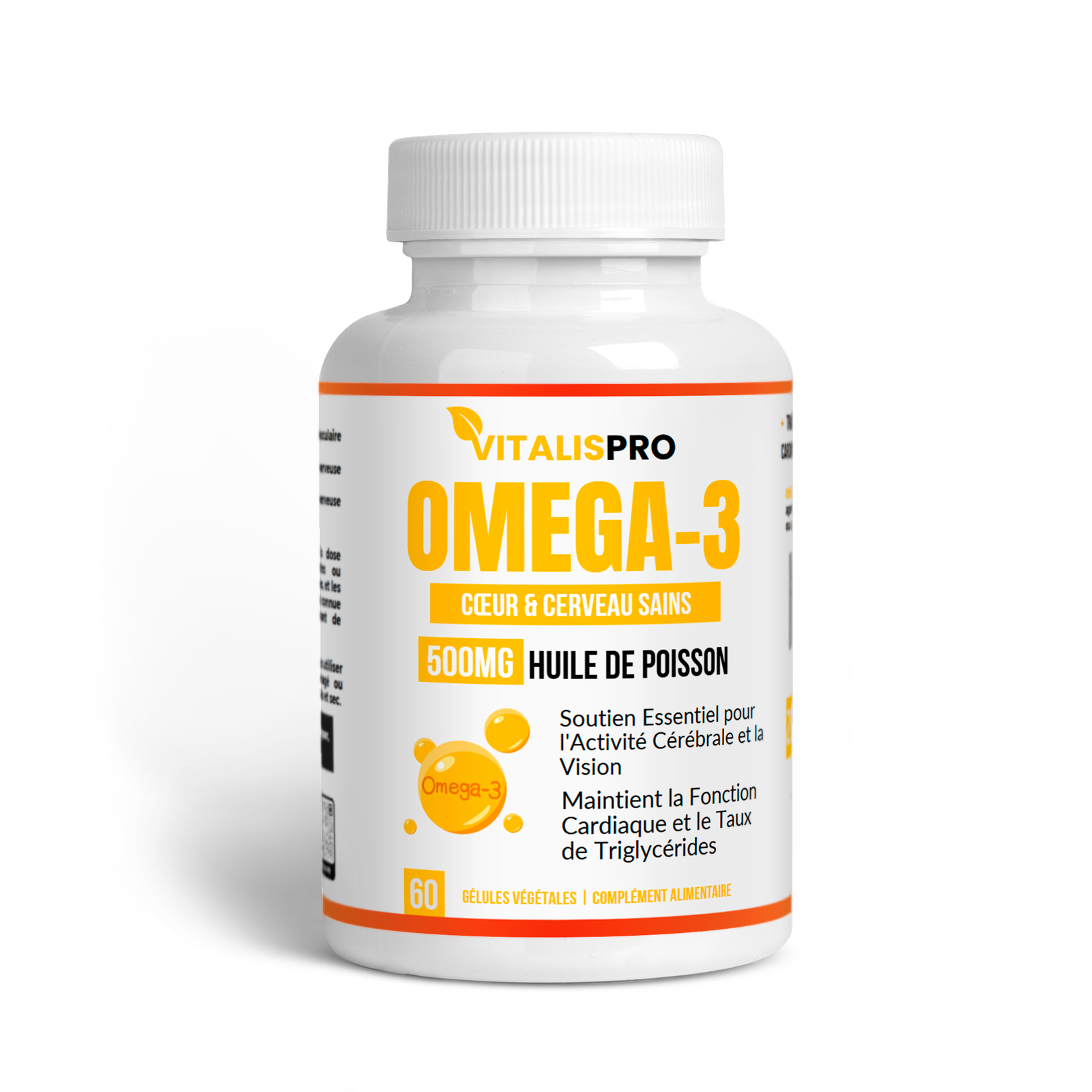
- Alphavital offers a fish oil dosed at 500 mg per capsule, of which EPA 120 mg and DHA 180 mg, at one to two capsules per day after a meal, verified batch by batch.

Omega-3: What Exactly Are We Talking About
Before being a supplement, omega-3s are first and foremost a family of fats. The word “fat” often triggers unwarranted alarm: certain fats are indispensable to the proper functioning of the body. Omega-3s belong to this category of beneficial fats — polyunsaturated fatty acids — that the body uses daily as a building material for its cells.
Not all omega-3s are equal. On one side stands ALA (alpha-linolenic acid), of plant origin, found in certain oils and seeds. On the other side are the two long-chain marine omega-3s, EPA and DHA, found in oily fish and certain algae. It is these last two that concentrate the bulk of scientific research and official recognition, because they are the forms the body uses most directly.
Omega-3s are not a passing trend. They are essential nutrients, among the most thoroughly studied compounds in all of modern nutrition.
This dual identity — an ancient essential fat and a subject of contemporary science — explains the sustained enthusiasm around omega-3s. They belong to the broad family of brain and heart nutrients, alongside other active compounds our team has detailed, as in its file on ginkgo biloba, memory and circulation.
Why the Body Cannot Do Without Them
One point deserves clarification, because it underpins everything else. EPA and DHA are not a nutritional luxury: they enter into the very composition of our cell membranes, particularly those of the brain and retina. DHA in particular is one of the most abundant fatty acids in brain tissue and in the eye. Without a regular supply, the body is forced to draw from limited reserves.
The problem is that the human body manufactures EPA and DHA in only very small amounts from plant-derived ALA. This conversion is so inefficient that it generally does not cover requirements. That is why direct sources — oily fish or fish oil supplements — remain the most reliable route. In the marketplace, the difference between an oil concentrated in EPA and DHA and a diluted blend is considerable, even when both labels carry the same name. This is precisely the boundary our team monitors closely at the sourcing stage.

What a Good Fish Oil Really Contains
Behind the name “omega-3” lies precise chemistry. What matters is not only the quantity of fish oil stated on the label, but the actual content of EPA and DHA — the two fatty acids that do all the work. Understanding this distinction helps separate a serious oil from a mere capsule with an evocative name.
EPA, or eicosapentaenoic acid, is the omega-3 most associated with supporting cardiac function. DHA, or docosahexaenoic acid, is the omega-3 of the brain and eye par excellence. A quality fish oil supplies both in readable proportions, and it is this pair — not an isolated molecule — that gives marine omega-3s their distinctive profile.
The public scientific literature on EPA and DHA is among the most extensive in all of nutrition. It is accessible through this EPA, DHA and omega-3 search indexed on PubMed1. The researchers’ message is consistent: the quality of an oil depends on its actual richness in EPA and DHA, its freshness and the consistency of results from one batch to the next — all of which justifies a rigorous production approach.
The Notion of Transparent Dosing
The term may sound technical, but it is at the heart of the matter. Transparent dosing means the EPA and DHA figures are displayed clearly, not buried in a global mention of “fish oil.” Without this precision, two capsules carrying the same “omega-3” label may deliver very different amounts of active compounds.
This is why our team refuses to reason purely in terms of the oil milligrams shown. A large number for an oil poor in EPA and DHA is worth less than a controlled, readable dosage. The actual fatty acid content and batch-to-batch consistency matter as much as the number on the label. We apply this traceability philosophy to every product in our range, as we explained in our product page for the Propolis, Royal Jelly, Probiotics and Omega-3 complex.
The Science: What Authorities Actually Say
This is where everything is decided. The internet overflows with spectacular claims about omega-3. Our role is to be honest about what authorities recognise, what research suggests, and what remains to be confirmed. CoQ10 addresses a complementary dimension — cellular energy production within the cardiac muscle itself. Explore our complete guide to Coenzyme Q10 for heart health and energy in Morocco. Below, in plain language, are the domains where the data are most robust.

Heart: Normal Cardiac Function
This is the most established ground, and the one that attracts the most attention. EPA and DHA have been studied for decades for their role in the cardiovascular system. European authorities have recognised a specific health claim on this subject: EPA and DHA contribute to normal cardiac function, at a reference daily intake.
This official opinion can be consulted via this EFSA evaluation of EPA, DHA and normal cardiac function2. It is important to read these words carefully. Contributing to the maintenance of a normal function is not promising to treat or prevent a disease. It is supporting healthy physiological functioning. This nuance is one Alphavital respects scrupulously across all its communications.
Omega-3s do not invent new health. They help the body maintain functions it already possesses.
This distinction is essential, and it structures our communication. Supporting a function is not promising a transformation. This is why Alphavital speaks of contributing to normal cardiac function, never of a cure. This honesty is, in our view, the hallmark of a brand worthy of trust.
For a clear explanation of these mechanisms, this French-language video reviews what research says about omega-3 for the heart, and the caution that remains warranted.
Brain: Normal Brain Function
Here is the second major chapter, perhaps the most fascinating. DHA is one of the most abundant fatty acids in brain tissue. It participates in the very structure of neuronal cell membranes, which explains the attention researchers devote to it. European authorities recognise that DHA contributes to the maintenance of normal brain function.
This opinion is detailed in this EFSA evaluation of DHA and normal brain function and vision3. In Morocco, where screen time is surging and the daily cognitive load weighs on concentration, this structural role of DHA resonates particularly. It is a foundational supply, not an instant boost.
Our team presents it as supporting cognitive capital through this structural role of DHA. It does not replace sleep, regular intellectual activity or a diet rich in quality nutrients. It is a complement to a lifestyle that takes care of the brain — never a shortcut.

Vision: Normal Visual Function
This is the third pillar, often the least well known. DHA is also one of the major fatty acids in the retina, the fine membrane at the back of the eye that captures light. European authorities recognise that DHA contributes to the maintenance of normal vision, again at a reference daily intake.
In a world where eyes are engaged from morning to night by screens, this role of DHA deserves to be known. Again, honesty demands precision: it is about supporting the maintenance of normal vision, not correcting a visual disorder. DHA is a nutrient of the retina, among other factors in good visual health.
Antioxidant Properties, Balance and Everyday Wellbeing
Beyond these three recognised pillars, omega-3s are being studied for further avenues still in exploration: blood lipid balance, joint comfort, mood. These areas are the subject of active research, but conclusions remain cautious and sometimes contradictory across studies. Our editorial stance is constant: we present these subjects as fields of investigation, without turning them into commercial promises. A serious nutrient deserves a serious narrative.
What Remains to Be Confirmed
Honesty requires stating this clearly. Omega-3s are also associated with avenues still under exploration: certain metabolic parameters, mood wellbeing, joint comfort. These fields are being studied, but conclusions remain cautious. Our stance is unchanged: we rely on the functions recognised by the authorities — heart, brain and vision — and present the rest as fields of study. An honest promise is worth more than a spectacular one.
Omega-3s are not alone in the universe of heart and brain support. Other active compounds share this space, and our team is regularly asked about their differences. Rather than setting them against each other, it is more accurate to understand each one’s speciality.
| Active Compound | Origin | Primary Domain |
|---|---|---|
| Omega-3 (EPA/DHA) | Fish oil | Normal cardiac, brain and visual function |
| Ginkgo biloba | Leaf, China | Memory, concentration, microcirculation |
| Moringa | Leaf, India | Vitality, micronutrient supply |
| Lion’s mane | Mushroom | Concentration, mental clarity |
Each of these compounds has its own history and profile. Omega-3 provides EPA and DHA, whose contribution to cardiac, brain and visual function EFSA recognises. Ginkgo biloba targets memory and microcirculation. Moringa delivers micronutrient richness. Lion’s mane distinguishes itself through mental clarity.
These compounds do not compete. They complement each other, each illuminating a different facet of heart and brain health.
It is precisely this complementarity logic that guided our team when it developed a dedicated programme for concentration and memory, in which omega-3 finds its full place. The idea is not to accumulate promises, but to cover the full terrain. This holistic approach lies at the heart of our thinking on overall body balance.

Omega-3 in Morocco: A Real Need, A Particular Context
Why this growing Moroccan interest in omega-3? The answer lies in several realities of our lifestyle. Despite an extensive maritime coastline, regular consumption of oily fish remains uneven from one household to another. The relentless pace of large cities, sometimes unbalanced diets, extended screen time — all of these weigh on intakes that are already fragile.
A seasonal dimension adds to this. Ramadan, with its complete upheaval of meal schedules, profoundly alters nutritional intakes, and many look at that time for a structural prop to support heart health and vitality. Exam periods mobilise students and families around a shared objective: holding out intellectually over the long run, where DHA plays its structural role for the brain.
The ageing of the population plays its part too. With age, caring for one’s heart, memory and eyesight becomes a concern for many Moroccan families. Omega-3 — a structural nutrient rather than a momentary stimulus — finds its place here. Our team often emphasises this: an EPA and DHA supply works over time, helping the body maintain its functions, rather than artificially pushing it beyond its limits.
A Nutrient — Not a Magic Wand
One point our team repeats constantly deserves to be stated plainly. Omega-3s are not a medicine, and they do not by themselves correct an unbalanced lifestyle. A capsule, however well dosed, does not replace sleep, physical activity or a varied diet. It is part of a whole.
This is precisely what the most robust data show: benefits appear when supplementation accompanies a healthy lifestyle, not when it claims to compensate for one. Public health resources make clear that a food supplement is not a substitute for treatment or a balanced diet, a framework well summarised by the dietary supplements section of MedlinePlus6. Omega-3s are support — a foundation — not a quick fix. This nuance makes all the difference between an honest message and an empty promise.

How to Use Omega-3 Properly
A few practical guidelines prevent the most common mistakes and allow you to get the most from a course of supplementation. Correct use matters as much as the product itself.
Omega-3: Dosage and Intake in Morocco
Omega-3s are taken with a meal, which facilitates absorption of these healthy fats. Alphavital recommends one to two capsules per day, dosed at 500 mg of fish oil of which EPA 120 mg and DHA 180 mg, with a large glass of water and preferably after eating. Consistency comes before everything else: daily repetition over several weeks is what establishes the benefits documented in research.
How Long Does an Omega-3 Course Last
Omega-3s are structural nutrients. Their benefits, especially for the brain and vision, are conceived on a long-term basis rather than in a few days. A typical course runs for two to three months, renewable, to give the body time to incorporate these fatty acids into its membranes. There is no universally magic duration: listening to your body and the advice of a health professional remain the best guides.
Omega-3: Precautions and Good Sense
Omega-3s are generally well tolerated, but certain precautions apply. Do not exceed the recommended dose. Pregnant or breastfeeding women, people following a treatment — in particular anticoagulants or blood thinners — or those with a medical condition should seek the advice of a health professional before starting. This product is not intended for children under 18, and it should be kept out of their reach. This caution is not a formality: it is a condition of responsible use.

To complete this reading, this French-language video presents omega-3: its sources, its roles and what research establishes about its effects on heart, brain and vision.
The Alphavital Answer
Diet, physical activity and sleep first — always. But when natural support makes sense, a serious formulation is still needed. This is exactly the philosophy that guided our team’s work on Omega-3.
Alphavital Omega-3: Dosed and Transparent
Alphavital offers a fish oil dosed at 500 mg per capsule, of which EPA 120 mg and DHA 180 mg. The capsule shell is composed of gelatine, glycerine and purified water, and the formula is free from gluten, milk, soy, egg and wheat. Three requirements guided its development: a clear, readable EPA and DHA dosage; a single daily capsule that is easy to integrate; and genuine batch-by-batch quality control. The composition matches what is stated on the label: by displaying EPA and DHA milligrams honestly, Alphavital lets you know precisely what you are taking.
This formula sits within our Cardiovascular Health range, conceived as a coherent whole. For those starting out, Omega-3 alone is often the best entry point: it allows you to address your intake, observe your own response and build on a solid foundation.
A good omega-3 is not about a large oil figure on the label. It brings together a readable EPA and DHA dosage, a clean formula and genuine control.
The Complete Cognitive Programme, for Going Further
For those seeking broader support for concentration and memory, our team also offers a complete programme that combines omega-3 with two other pillars: ginkgo biloba and moringa. The idea is to cover the full cognitive terrain by bringing together compounds with complementary actions rather than multiplying them at random.
This programme is aimed at those who want a structured, coherent, holistic approach. It extends naturally from the discovery of Omega-3 alone and upholds the same quality standards. To explore the full offering, our Brain Health category brings together all our natural solutions dedicated to mental clarity.

The feedback our team receives is worth more than any amount of discourse. Here are three testimonials, shared with the permission of their authors.
When I reached fifty, I wanted to take care of my heart naturally, alongside improving my lifestyle. I added one Omega-3 capsule each day after lunch for three months. Without claiming any effective, what I valued most was the simplicity of the gesture and the clarity of the displayed dosage. — Karim, Casablanca
I spend my days at a screen and was feeling my concentration fray by the end of the day. I took Omega-3 on its own — one capsule every morning with breakfast. What struck me was being able to stay consistent with a product whose composition I understand precisely. — Salma, Rabat
I chose the complete programme to cover several fronts at once: heart, memory, vitality. Three months on, I feel steadier through my days, and I’ve built the habit of this daily ritual. — Nadia, Marrakech
These accounts illustrate a simple truth: the most lasting results come from combining lifestyle choices and, when useful, a well-chosen supplement. Have a question before you start? Our team responds directly via the Alphavital contact page.
Omega 3 fish oil benefits: what the studies actually measured
Omega-3 research is huge, and headlines often mix very different studies. Here are four landmark trials, with who took part, how much they took, and what was really found.
| Study (author, year) | Who, how much, how long | What was found |
|---|---|---|
| Flock, 2013 | 115 healthy adults, 0 to 1,800 mg EPA+DHA a day, about 5 months | Blood omega-3 levels rose step by step with the dose. Body weight was the next biggest factor. |
| Yurko-Mauro, 2010 | 485 healthy adults aged 55+ with mild memory slips, 900 mg DHA a day, 24 weeks | Fewer errors than placebo on a visual learning and memory test; blood DHA doubled. Working memory did not change. |
| Manson, 2019 (VITAL) | 25,871 adults aged 50 or 55 and over, 1 g of omega-3 a day, about 5 years | No significant drop in major cardiovascular events, the main goal of the trial. No excess bleeding. |
| DREAM group, 2018 | 535 people with moderate to severe dry eye, 3,000 mg EPA+DHA a day, 12 months | No better than an olive oil placebo on symptoms or on eye-surface tests. |
Three lessons stand out. First, what you take shows up in your blood in proportion to the amount, and larger bodies need more to reach the same level7. Second, DHA was linked to better scores on a learning and memory test in older adults who already noticed small slips8. Third, two very large trials did not find what many people expect: 1 g a day did not lower major cardiovascular events in a general population9, and 3 g a day did not beat placebo for dry eye10.
What this does not show. Each trial answers one question, in one group, at one dose. The memory trial involved people over 55, not students or young parents. The large heart trial looked at disease events, not at the normal day-to-day work of the heart. The dry eye trial says nothing about the role of DHA in normal vision; it only says that high doses did not relieve an established eye condition. This is why the EU sticks to modest, precise wording: EPA and DHA contribute to the normal function of the heart, and DHA to the maintenance of normal brain function and normal vision. Those roles, at the daily amounts below, are what a fish oil can honestly claim.
Omega 3 dosage: how many capsules for which goal
The EU attaches each approved role to a daily amount. For normal heart function, the condition is 250 mg of EPA + DHA a day. For normal brain function and normal vision, it is 250 mg of DHA a day. The Alphavital Omega-3 EPA/DHA softgel provides 500 mg of fish oil, of which 120 mg is EPA and 180 mg is DHA. Here is what one or two a day add up to.
| Capsules a day | EPA + DHA | DHA |
|---|---|---|
| 1 | 300 mg: heart reference of 250 mg met | 180 mg |
| 2 | 600 mg | 360 mg: brain and vision reference of 250 mg met |
So the choice is simple. One capsule a day covers the amount linked to normal heart function. Two a day also cover the DHA amount linked to normal brain function and normal vision. That second option suits periods of heavy mental load: exam season for students, demanding months at work, or later in life when people want to look after memory and eyesight. Weeks when you eat sardines or mackerel once or twice already bring a good share of these fats from food. If you also take the Focus & Memory programme, its omega-3 capsule counts toward these totals.
Patience is part of the dose. In the Flock trial, blood levels were measured after about five months of daily intake. Plan a course of at least three months before judging, and keep the same number of capsules every day.
How to take fish oil so it counts
- Take it with your main meal that contains fat. In a classic absorption study, EPA from fish oil was better absorbed with a high-fat meal (90%) than with a low-fat one (69%)11. A lunch with olive oil, a tagine or fish works better than a quick tea and bread.
- Two a day? Split them between two meals, for example lunch and dinner.
- During Ramadan, take it with iftar or with suhoor, whichever meal is richer in fat.
- Avoid the fishy aftertaste by taking the capsule at the start of the meal rather than on an empty stomach, and by keeping the box in a cool, dark place, never in a car in summer.
- Trust your nose. A capsule that smells sharp or rancid when opened has oxidised; do not take it.
Who should check with a doctor first
Beyond the precautions already listed above, two situations deserve a word. People with a heart rhythm disorder: in large heart trials, omega-3 supplements were linked to more atrial fibrillation, and the risk was clearly higher above 1 g a day than below12. One or two capsules a day stay well under that amount, but anyone with an irregular heartbeat should ask first. And anyone with planned surgery or dental work should tell the doctor that they take fish oil.
Frequently Asked Questions About Omega-3
What exactly are EPA and DHA?
EPA (eicosapentaenoic acid) and DHA (docosahexaenoic acid) are long-chain marine omega-3 fatty acids that the body does not produce in sufficient quantities. They rank among the most thoroughly documented nutrients in the public scientific literature. Alphavital provides them via a fish oil dosed at 500 mg per capsule, of which 120 mg EPA and 180 mg DHA.
What are the recognised benefits of omega-3 in Morocco?
European authorities recognise that EPA and DHA contribute to normal cardiac function, and that DHA contributes to the maintenance of normal brain function and normal vision. These physiological roles concern the maintenance of healthy functions, not the treatment of a disease. In Morocco, they address dietary intakes that are often insufficient in oily fish.
Omega-3 reviews and results: how soon do effects appear?
Omega-3s are structural nutrients. Their benefits, particularly for the brain and vision, are conceived on a long-term basis rather than within a few days. A typical course extends over two to three months of regular intake, renewable. Daily consistency is decisive for assessing one’s own response.
What dosage and intake are recommended for Omega-3 capsules in Morocco?
Alphavital recommends one to two capsules per day, dosed at 500 mg fish oil of which EPA 120 mg and DHA 180 mg, preferably after a meal with a large glass of water. This omega-3 capsule dosage, available in Morocco, relies on consistency rather than quantity. A typical course spans several weeks.
Is Alphavital Omega-3 suitable for people with allergies?
The formula is free from gluten, milk, soy, egg and wheat as stated on the label. The capsule shell is composed of gelatine, glycerine and purified water. As this is a fish oil, it is not suitable for people with fish allergies. In case of doubt or a known allergy, advice from a health professional is essential.
Should I choose Omega-3 alone or the complete programme?
Omega-3 alone is often the best entry point for addressing your intake and observing your own response. The complete programme, combining omega-3, ginkgo and moringa, is aimed at those seeking broader support for concentration and memory. Both uphold the same quality and transparency standards.
How does delivery and payment work in Morocco?
Delivery reaches anywhere in Morocco within 24 to 48 hours, with payment on delivery. Delivery is free from 170 MAD; below this threshold, a 30 MAD contribution applies. A multi-box course makes it straightforward to reach the free delivery threshold.
Is it better to take omega 3 in the morning or at night?
The time of day matters less than the meal. Take your fish oil with the meal that contains the most fat, often lunch in Morocco, because fats are absorbed better that way11. If you take two capsules, split them between two meals. Choose a time you can keep every day.
Can I get enough omega 3 from sardines alone?
On weeks when you eat oily fish such as sardines or mackerel once or twice, you can reach the EU reference of 250 mg of EPA + DHA a day on average. The difficulty is keeping that pace every week. A daily capsule covers the weeks when fish does not make it to the table.
Does omega 3 fish oil have side effects?
At one or two capsules a day, the most common ones are minor: a fishy aftertaste, burps or a slightly upset stomach, which usually ease when the capsule is taken with a meal. At much higher daily amounts, above 1 g, large trials found more episodes of irregular heartbeat12. Do not exceed the recommended amount.
In Summary
Omega-3s are essential fatty acids the body cannot produce on its own, and Moroccan diets often provide them in insufficient quantities. Modern science recognises three key roles for EPA and DHA: contributing to normal cardiac, brain and visual function. The benefits are real but gradual — they emerge over time, and sit squarely within the framework of a healthy lifestyle.
Quality makes all the difference. A readable EPA and DHA dosage, a clean formula and genuine control separate a good fish oil from a mere capsule. This is the path Alphavital has chosen, with an approach that is transparent and faithful to the science. Taking care of one’s heart, brain and vision is not following a trend: it is a structural investment in one’s vitality.
About the author. Houda Khaldi is Editorial Adviser in Natural Nutrition at Alphavital. She translates scientific research into clear, actionable guidance for everyday Moroccan life.
Disclaimer. The information presented is provided for informational purposes, based on sourced research (PubMed, EFSA). The Alphavital team does not include healthcare professionals. Consult a qualified health professional before any use, in case of ongoing treatment (in particular anticoagulants), pregnancy or breastfeeding, or any medical condition. Food supplements are not a substitute for a varied, balanced diet or a healthy lifestyle.
Sources and References
- EPA, DHA and marine omega-3s — public scientific literature (mechanisms, cardiac, brain and visual function). PubMed (National Library of Medicine)
- EPA and DHA — contribution to normal cardiac function, evaluated health claims. EFSA Journal (European Food Safety Authority)
- DHA — contribution to the maintenance of normal brain function and normal vision. EFSA Journal (European Food Safety Authority)
- Authorised health claims for EPA and DHA (EU Regulation 432/2012). EUR-Lex (Official Journal of the European Union)
- Omega-3 (EPA/DHA) — nutrient information sheet and intakes. Office of Dietary Supplements (NIH)
- Dietary supplements: public health guidance. MedlinePlus (National Library of Medicine)
- Flock MR, et al. Determinants of erythrocyte omega-3 fatty acid content in response to fish oil supplementation: a dose-response randomized controlled trial. J Am Heart Assoc. 2013;2(6):e000513. PubMed 24252845
- Yurko-Mauro K, et al. Beneficial effects of docosahexaenoic acid on cognition in age-related cognitive decline. Alzheimers Dement. 2010;6(6):456-64. PubMed 20434961
- Manson JE, et al. Marine n-3 Fatty Acids and Prevention of Cardiovascular Disease and Cancer. N Engl J Med. 2019;380(1):23-32. PubMed 30415637
- Dry Eye Assessment and Management Study Research Group, Asbell PA, et al. n-3 Fatty Acid Supplementation for the Treatment of Dry Eye Disease. N Engl J Med. 2018;378(18):1681-1690. PubMed 29652551
- Lawson LD, Hughes BG. Absorption of eicosapentaenoic acid and docosahexaenoic acid from fish oil triacylglycerols or fish oil ethyl esters co-ingested with a high-fat meal. Biochem Biophys Res Commun. 1988;156(2):960-3. PubMed 2847723
- Gencer B, et al. Effect of Long-Term Marine Omega-3 Fatty Acids Supplementation on the Risk of Atrial Fibrillation in Randomized Controlled Trials of Cardiovascular Outcomes: A Systematic Review and Meta-Analysis. Circulation. 2021;144(25):1981-1990. PubMed 34612056
Food supplements do not replace a varied, balanced diet or a healthy lifestyle. The Alphavital team is not made up of healthcare professionals. Consult a qualified healthcare professional before use.