
Many people feel their body burns less than it used to, especially after a few years of desk work or a busy family life. It is a common worry, and often a wrong one. The largest study on daily energy use points to something more useful: what you do each day matters more than your age. Here is what really moves your metabolism, and what is mostly marketing.
For those on the opposite end — naturally lean people who struggle to gain mass despite eating — our companion guide covers gaining weight naturally when you are too thin, including the role of caloric density, protein timing, and natural supports.
Search “natural weight loss” in any search engine and you will be overwhelmed. Fat-burning teas, effective capsules, crash diets promising ten kilograms in a month: the slimming market runs on disappointed hopes. In Morocco, the phenomenon is especially vivid. Between aesthetic pressure, the prevalence of excess weight, and a flood of “solutions” sold across social media, many people navigate without a compass — spending, giving up, starting over.
Our team receives the same questions every week. Which product really works? Does green tea help? How do I jumpstart a “slow” metabolism? This article answers with a firm starting point: affirm nothing that research does not support, and name clearly the boundary between what a lifestyle change can accomplish and what no capsule will ever do on your behalf. The truth, less marketable but far more useful, is that lasting weight loss does not happen in a bottle. It is built through habits, sustained by a body that has the energy required to maintain them.
By Houda Khaldi, Editorial Adviser, Natural Nutrition · Updated June 12, 2026 · 19-min read
Contenu de la page
- 1 Key Takeaways
- 2 Weight Loss: The Only Equation That Does Not Lie
- 3 The Myth of the “Slow Metabolism”
- 4 The Four Pillars That Actually Work
- 5 Natural Actives: What Science Says — and Does Not Say
- 6 Comparison: Placing Each Active Where It Belongs
- 7 Weight Loss in Morocco: A Specific Context
- 8 How to Integrate Daily Support Properly
- 9 The Alphavital Approach
- 10 Three Readers Share Their Experience
- 11 How to boost metabolism: what the studies actually measured
- 12 How to boost metabolism day to day: the levers in order
- 13 Where a metabolism booster fits, and how to take SlimPlus
- 14 Frequently Asked Questions on Natural Weight Loss
- 14.1 Is there a supplement that causes weight loss on its own?
- 14.2 How do I jumpstart a “slow” metabolism in Morocco?
- 14.3 Does green tea genuinely help with weight loss?
- 14.4 What is the recommended dose of SlimPlus in Morocco?
- 14.5 Does SlimPlus have any contraindications?
- 14.6 How long before seeing results on the scale?
- 14.7 Can poor sleep slow your metabolism?
- 15 In Summary
Key Takeaways
- Lasting weight loss rests on a moderate, sustained energy deficit: fewer calories absorbed than expended, without extreme deprivation that triggers rebound.
- The science-validated pillars are four: quality nutrition, regular physical activity, adequate sleep, and stress management. No supplement replaces this foundation.
- The “slow metabolism” myth is widespread: real differences between individuals exist but are modest. The most actionable lever is movement and building muscle mass.
- Certain micronutrients contribute to normal energy metabolism and the reduction of tiredness (vitamins B6 and D, magnesium, iodine) — functions recognised by the European authority EFSA.
- Alphavital offers SlimPlus, a ten-ingredient formula that supports energy metabolism and accompanies a holistic approach — never a substitute for food and movement.

Weight Loss: The Only Equation That Does Not Lie
Before discussing plants, supplements, or metabolism, we need to establish the foundational principle confirmed by every study and which no marketing can bypass. Weight loss obeys an energy balance. When the body expends more energy than it receives, it draws on its reserves, and weight decreases. That is the basis — simple and inescapable.
Simple, however, does not mean easy. Because this balance depends on a tangle of factors: what we eat, how much we move, how we sleep, stress levels, hormones, and even gut microbiota. Reducing weight loss to “eat less” is just as misleading as reducing it to “take a fat burner.” The reality is a system, and it is that system that must be addressed — not a single isolated lever.
Lasting weight loss is not a sprint toward a number on the scale. It is the patient construction of a balance the body can maintain.
Public-health authorities are unanimous on this point. Approaches that work over the long term are those that modify habits in depth, rather than imposing a brutal, unsustainable restriction. The synthesis of recommendations on overweight and obesity, available through the World Health Organization’s reference fact sheet on obesity and overweight1, states it plainly: the combination of balanced nutrition and regular physical activity remains the foundation of any serious approach.
Why Crash Diets Almost Always Fail
The scenario is familiar to everyone. Severe restriction, a few kilograms lost quickly, then the rebound — often beyond the starting point. This phenomenon, sometimes called the yo-yo effect, is not a failure of willpower. It is a biological response. Faced with sudden deprivation, the body reacts as though under threat: it slows certain expenditures, amplifies hunger signals, and favours fat storage as soon as caloric intake rises again.
This is why our team defends an approach that runs counter to quick-fix promises. A moderate deficit, progressive weight loss, habits that take root: this is what endures over time. We apply the same philosophy of consistency to how we approach digestive balance and everyday immunity, because the body functions as a system, never in isolated compartments.
The Myth of the “Slow Metabolism”
“I have a slow metabolism.” Our team hears this constantly. It often serves as an explanation for difficulty losing weight, and it contains a grain of truth mixed with a great many misconceptions. Separating fact from fiction here changes everything, because it shifts attention toward the levers that genuinely matter.

What Metabolism Actually Is
Metabolism refers to the sum of chemical reactions by which the body converts what we eat into energy. Its most important component is the basal metabolic rate: the energy expended at rest simply to keep the heart, brain, and organs functioning and to maintain body temperature. This expenditure accounts for the largest share of our daily needs.
This basal rate depends primarily on factors we do not choose: height, age, sex, genetics, and — decisively — the amount of muscle mass. Muscle is an energetically expensive tissue; the more of it one carries, the more one burns at rest. This is why the idea of a “broken” or “blocked” metabolism that a capsule could restart belongs largely in the realm of fantasy. Real differences between individuals exist, but they are more modest than popular discourse suggests.
You do not “fix” a metabolism with a capsule. You maintain it with muscle, movement, and quality sleep.
The Real Levers on Energy Expenditure
If the basal metabolic rate is largely outside our control, other components of expenditure depend directly on us. The first is physical activity — obviously — but also all the movements of daily life: walking, climbing stairs, gardening, standing. The second is the thermic effect of food, the energy spent on digestion, which is higher for proteins. The third, and the key over the long term, is building muscle mass, which raises resting expenditure durably.
This is where genuine agency lies. Moving more, incorporating some resistance training, attending to protein intake: these are concrete, free levers far more powerful than any bottled “metabolism activator.” For structuring the energy needed for this activity, the B-vitamin group plays a recognised role, as detailed in our article B Complex: the fuel for energy and recovery.
The Four Pillars That Actually Work
If decades of research could be summarised in four words, they would be: eat, move, sleep, calm down. These four pillars form the foundation of every lasting weight-loss effort. They are neither spectacular nor easy to market, but they are what produces results you keep.
The Plate: Quality Before Quantity
Everything starts on the plate, but not in the way most people assume. Obsessively counting calories exhausts and discourages. The approach that holds over time bets on quality: more vegetables, fibre, quality proteins, good fats, and less ultra-processed food, fast sugars, and sweetened drinks. This shift toward nutrient-dense, satisfying foods naturally reduces caloric intake without the sensation of deprivation.
Fibre, in particular, plays an underappreciated role. It slows digestion, extends satiety, and feeds the gut microbiota, whose role in weight regulation is the subject of rapidly expanding research. A plate built around plant foods is not a constraint: it is the most powerful and natural tool to support weight loss in Morocco and everywhere else.

Movement: Less Forced Cardio, More Muscle
Common wisdom holds that weight loss requires hours of cardio. The reality is more nuanced. Physical activity helps, of course, but its value is not limited to calories burned during effort. Resistance training — often neglected — builds the mass that raises resting expenditure and protects against muscle loss during a caloric deficit.
The most effective strategy combines two things: regular activity one genuinely enjoys and sustains — brisk walking, cycling, swimming, team sports — and a modest amount of resistance training two or three times a week. Consistency outranks intensity. Twenty minutes every day beats an exhausting session abandoned after two weeks.
The best exercise for weight loss is not the hardest. It is the one you will still be doing six months from now.
Sleep: The Lever Everyone Forgets
This is the most neglected pillar, and perhaps the most decisive. Sleep deprivation disrupts hunger and satiety hormones, increases appetite for sugary and fatty foods, and saps the willpower needed for good choices. Sleeping poorly means rowing against the current of all your other efforts.
Numerous studies establish a link between sleep debt and weight gain. The synthesis available through this full-text scientific article on sleep and weight regulation, indexed on PubMed Central2, shows how sleep restriction disrupts glucose metabolism and hormonal balance. Protecting your sleep is not a luxury in a weight-loss effort: it is a priority. Our team has devoted a full feature to stress, sleep, and natural serenity.
Stress: The Silent Enemy
The fourth pillar closes the loop. Chronic stress chronically elevates cortisol, a hormone that, over time, promotes fat storage — particularly visceral fat — and drives cravings for comforting, calorie-dense foods. Many people who “do everything right” fail because unmanaged stress sabotages the entire system.
Calming the nervous system — through sleep, physical activity, breathing, and social connection — is therefore not a wellness indulgence. It is a metabolic lever in its own right. The four pillars are not a menu of options: they form an ensemble in which each one supports the others.
Natural Actives: What Science Says — and Does Not Say
Let us address the question that drives most internet searches on this topic. Are there plants, nutrients that help? The honest answer is nuanced. Certain actives are studied for their role in energy metabolism. But none of them “causes weight loss” on their own — and this is precisely where marketing goes off the rails. Here is a sober overview.

Green Tea and Catechins
Green tea (Camellia sinensis) is arguably the most documented active in this category. It contains antioxidant compounds called catechins, along with a natural amount of caffeine. Research has examined their role in energy metabolism, with real but modest results that should not be over-interpreted. The available literature is accessible through this PubMed search on green tea catechins and metabolism3.
The researchers’ message is consistent: green tea is not a magic fat burner. It functions as supplementary support within the context of a balanced diet and regular activity. Its antioxidant benefits, moreover, extend beyond weight management to overall wellbeing.
Guarana and Natural Caffeine
Guarana (Paullinia cupana), an Amazonian vine, is a natural caffeine source that releases it more gradually. Caffeine is studied for its role in alertness, energy, and to a lesser degree energy metabolism. Again, the effect is real but moderate, and it is most meaningful paired with genuine physical expenditure: caffeine supporting the energy for a workout is worth far more than caffeine compensating for inactivity.
Micronutrients: The Often-Overlooked Foundation
This is where the most solid — and the most neglected — ground lies. Several vitamins and minerals have a role recognised by the European authority in normal energy metabolism and the reduction of tiredness. Vitamin B6 contributes to normal energy metabolism and the normal functioning of the nervous system. Vitamin D contributes to normal muscle function. Magnesium contributes to normal energy metabolism and the reduction of tiredness. Iodine contributes to normal energy metabolism. These functions are listed in the official register of health claims, accessible through the EFSA reference page on health claims4.
Why does this matter? Because a body running on deficiencies operates below its potential. Persistent tiredness erodes the desire to exercise, cook wholesome food, and stick to positive habits. Covering key micronutrient needs is not a shortcut to leanness: it is ensuring the machine has the energy needed to do the work. This is precisely the terrain — and only this terrain — where a supplement has scientific legitimacy.
What No Active Will Ever Do
Honesty requires drawing a clear line. No plant, no nutrient melts fat without an energy deficit. No “burner” exempts anyone from moving or eating well. Serious natural actives play a supporting role: they accompany a process, they do not replace it. Any claim to the contrary, however seductive, belongs to misleading advertising, not science. This is a line our team refuses to cross, out of respect for its readers.
Comparison: Placing Each Active Where It Belongs
Rather than opposing actives or ranking them misleadingly, it is more accurate to understand the terrain each one covers. Here is a sober reading of the main ingredients studied in the field of energy metabolism.
| Active | Source | Studied terrain |
|---|---|---|
| Green tea | Leaf, Camellia sinensis | Antioxidant, energy metabolism |
| Guarana | Seed, Amazonia | Energy, alertness (caffeine) |
| Vitamin B6 | Micronutrient | Energy metabolism, nervous system |
| Magnesium | Mineral | Energy metabolism, reduction of tiredness |
| Iodine | Marine algae | Normal energy metabolism |
Each of these ingredients illuminates a different facet. Antioxidants such as green tea and pomegranate support cellular wellbeing. Guarana’s caffeine provides an energy lift. Micronutrients form the foundation: they allow energy metabolism to function normally. This logic of complementarity guided our team when designing a comprehensive formula, rather than staking everything on a single overhyped ingredient.
These actives do not compete. Each one covers a different piece of the daily energy puzzle.
Weight Loss in Morocco: A Specific Context
Why does weight loss occupy such a prominent place in Moroccan concerns? The answer lies in several realities of our way of life. Rapid urbanisation, sedentary work, long commutes in large cities, easy access to ultra-processed products and sweetened drinks: these are all factors that weigh on the energy balance, sometimes from an early age.
There is also a rich and ambivalent cultural dimension. Moroccan cuisine, generous and convivial, is a treasure — but generous portions, sugar, and fried foods, within a now largely sedentary lifestyle, change the equation. The rhythm of Ramadan, with its complete overhaul of meal and sleep schedules, also puts the body to the test and calls for particular attentiveness to food quality and hydration.
In this context, many seek a solid foundation capable of sustaining lasting change rather than masking the problem with a single product. Our team repeats it: a weight-loss effort in Morocco gains enormously by taking root in time, drawing on local resources — fresh-produce markets, outdoor walking, home cooking — far more than on imported and oversold solutions.

A Process, Not a Magic Wand
Let us be clear on a point our team emphasises without exception. No supplement, however well formulated, corrects on its own a lifestyle that disrupts the energy balance. Even a serious formula cannot replace the plate, movement, or sleep. It is part of an ensemble.
This is precisely what public-health resources remind us: a food supplement is not a substitute for a balanced diet or a healthy lifestyle. This framing is well summarised by the dietary supplements section of MedlinePlus5. SlimPlus is a support for energy metabolism, an aid — not a quick fix. This distinction makes all the difference between an honest message and an empty promise.
How to Integrate Daily Support Properly
A few practical guidelines help avoid the most common mistakes and make the most of a holistic approach. Using a supplement well matters as much as choosing it wisely.
SlimPlus: Dosage and Correct Use
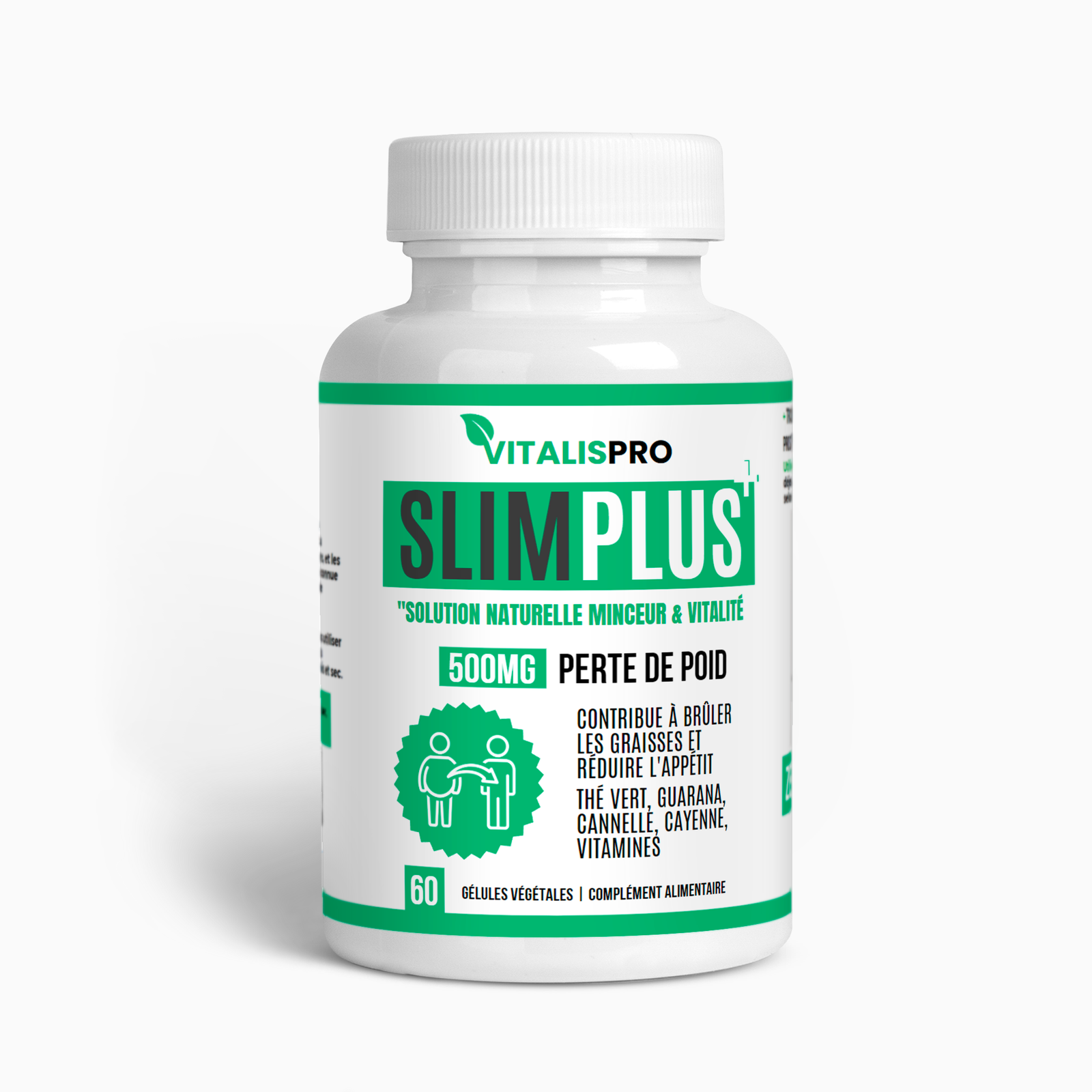
SlimPlus is straightforward to take: Alphavital recommends 2 to 3 capsules a day after meals, with a large glass of water, or, for a stronger effect, 30 minutes before the time you usually get hungry. A 60-capsule pack covers about three to four weeks. Consistency is paramount: daily repetition, combined with a balanced diet and an active lifestyle, is what gives a metabolic support supplement its full value.
How Long to Sustain an Effort
Lasting weight loss is measured in months, not days. A substantive course is logically planned over at least two months, allowing time for new habits to settle. There is no universal magic duration: listening to one’s body, exercising patience, and — when in doubt — seeking the advice of a qualified health professional remain the best guides. The scale is just one indicator among several: energy levels, sleep quality, and waist circumference often tell a richer story.
Precautions and Contraindications
SlimPlus is intended for adults. It is not recommended for pregnant or breastfeeding women, or for people sensitive to caffeine in the evening, given the presence of green tea and guarana. The iodine content calls for particular caution in the case of thyroid disorders: the advice of a health professional is essential before starting, as with any chronic condition or ongoing treatment. This caution is not a formality: it is a condition for responsible use.
To visualise the mechanics of metabolism and understand why movement and muscle take precedence, this video explains in straightforward terms how the body spends its energy on a daily basis.
The Alphavital Approach
Plate, movement, and sleep first — always. But when metabolic energy support makes sense, a serious formula is still needed: one that is transparent about what it does and does not do. This is exactly the philosophy that guided our team’s work on SlimPlus.
SlimPlus: Ten Ingredients Designed as a System
Alphavital offers a formula of ten ingredients assembled according to a logic of complementarity: green tea extract, guarana extract, cinnamon extract, capsaicin, vitamins D3 and B6, marine algae extract as an iodine source, pomegranate extract, black pepper extract, and magnesium of plant origin. The idea is not to stack promises but to cover the terrain of energy metabolism: the micronutrients that support it, the antioxidants that accompany cellular wellbeing, and a measure of natural energy for movement.
Three requirements guided its formulation: traceable raw materials, manufacturing under the ISO 22000 food safety framework, and batch-by-batch quality control for consistent quality from one bottle to the next. Every batch is verified before packaging, and we refuse any compromise on purity.
A sound formula is not reduced to a promise on the label. It brings together coherent actives, a controlled dosage, and genuine traceability.
A Formula in the Service of a Process
SlimPlus only makes sense within a broader whole. Our team always presents it as the support of an active lifestyle, never as a shortcut. This is why this article devotes the bulk of its content to the plate, movement, and sleep: they are what do the work. The formula, for its part, supports energy metabolism and helps reduce tiredness, so that the energy needed for change is present when it is most required. To explore our full range of natural solutions, our Detox & Wellbeing category brings together the supplements dedicated to everyday balance.
The feedback our team receives is worth more than any speech. Here are three testimonials, shared with their authors’ consent.
I wanted to regain my energy and get back to walking. I changed my diet, I walk every morning, and I added SlimPlus to my routine. What struck me most was having the energy to sustain my new habits over the long term. — Salma, Casablanca
I spent years looking for the effective product, without success. This time, I accepted that everything comes down to lifestyle. The supplement helps me stay active, but consistency has been what changed everything. Three months later, I feel lighter and, above all, less tired. — Karim, Rabat
After several failed crash diets, I chose a slow approach. Sleep, vegetables, a little exercise, and daily energy support. The results came gradually, but this time they are holding. — Nadia, Marrakech
These stories illustrate a simple truth: the most lasting results come from the combination of lifestyle changes and, where useful, a well-chosen support. A question before you start? Our team responds directly through the Alphavital contact page.
How to boost metabolism: what the studies actually measured
“Boosting your metabolism” sounds like one switch. In reality, the energy your body uses each day has several parts: what it burns at rest, what it spends digesting food, and what it spends moving. The studies below measured those parts directly. Here is who took part, what was tested, and what was really found.
| Study (author, year) | Who, how much, how long | What was found |
|---|---|---|
| Pontzer, 2021 | Thousands of people aged 8 days to 95 years; energy use measured with the doubly labelled water method | Once adjusted for body size, energy use stays stable from 20 to 60 and only declines after 60. |
| Levine, 1999 | 16 adults fed 1,000 extra kcal a day; 8 weeks | Two-thirds of the rise in energy use came from everyday movement: standing, walking, fidgeting. It predicted who stored the least fat. |
| Westerterp, 2004 (review) | Studies of the energy spent on digesting food | Digestion uses 5 to 15% of daily energy, more with protein-rich meals, which also keep you full longer. |
| Spiegel, 2004 | 12 healthy young men; 2 nights of short sleep vs 2 nights of long sleep | After short nights, the hunger hormone ghrelin rose 28% and appetite for sweet, starchy food rose. |
| Jurgens, 2012 (Cochrane review) | Green tea preparations in adults with excess weight; 12 to 13 weeks | A small effect on weight, not statistically significant outside Japan and judged not clinically important. |
The first finding surprises most people: in a huge study using the reference method, energy use adjusted for body size did not drop between 20 and 60. The slowdown people blame on their thirties or forties shows up only after 606. The second is that everyday movement outside sport matters a lot: when volunteers overate for eight weeks, those who moved more without thinking about it stored far less fat7. Third, what is on the plate changes how much energy digestion takes, and protein costs the body the most to process8. Fourth, two short nights were enough to raise the hunger hormone and the appetite for sweet and starchy food9. Fifth, green tea preparations alone gave only a small effect on weight over three months10.
What this does not show. No single study here tested a full daily routine from start to finish. The sleep study was tiny and measured hunger, not energy use. The movement study was done under overeating, not dieting. And green tea’s weak result in long trials does not cancel what it does in the short term; it simply shows that no single ingredient carries the result on its own. The lesson is practical: your metabolism is less “slow” than you think, and the levers that move it most are free.
How to boost metabolism day to day: the levers in order
- Move more between workouts. Walk after lunch or after iftar, take the stairs, stand during phone calls, get off the bus one stop early. These small moves add up over a week more than a single gym session. In summer heat, choose the early morning or the evening.
- Put protein at every meal. Eggs at breakfast, lentils or chickpeas at lunch, fish or chicken at dinner. Your body spends more energy digesting them, and you stay full for longer.
- Protect your sleep. Short nights make you hungrier the next day and drain the energy you need to move. A good night is the cheapest support for everything else on this list.
- Keep the tea, cut the sugar. Moroccan mint tea is made with green tea, so the leaves are already there. The spoons of sugar are what tip the balance. Reduce them a little each week, so the taste has time to adjust.
Where a metabolism booster fits, and how to take SlimPlus
A supplement comes after these levers, not before. Two ingredients often found in metabolism formulas have measurable, if modest, effects. In a respiratory-chamber study, a green tea extract raised 24-hour energy use by 4% compared with placebo in ten healthy men, while the same amount of caffeine alone did not11. A review of 20 trials found that chilli compounds called capsaicinoids raised energy use by about 50 kcal a day and reduced appetite12. These are small numbers. They help when the rest of the routine is already in place.
SlimPlus brings these two together with guarana, cinnamon, pomegranate, black pepper, marine iodine, vitamins B6 and D3 and magnesium. Practical points:
- If you use the before-hunger timing, the usual moments are before lunch or before the late-afternoon snack.
- Not too late in the day. Green tea and guarana contain caffeine. If you drink several glasses of tea or coffee, count them in.
SlimPlus suits people at different stages: parents getting back into a routine, people with desk jobs who move little, or anyone who wants steady energy while changing habits. For a wider comparison of natural options, see our guide to natural weight-loss supplements. If appetite and snacking are your main issue, our article on natural appetite control with SlimPlus and moringa goes into that in detail.
Frequently Asked Questions on Natural Weight Loss
Is there a supplement that causes weight loss on its own?
No, and any claim to the contrary is misleading advertising. No plant or nutrient melts fat without an energy deficit achieved through diet and movement. Certain actives — such as vitamins B6 and D, magnesium, or iodine — contribute to normal energy metabolism and the reduction of tiredness: they support a process, they do not replace it. Lasting weight loss is built through habits.
How do I jumpstart a “slow” metabolism in Morocco?
The idea of a “blocked” metabolism that a capsule could restart is largely a myth. The most effective lever is building muscle mass, which raises resting expenditure, combined with regular physical activity and adequate sleep. Covering key micronutrient needs helps the body have the energy it requires, but does not substitute for movement.
Does green tea genuinely help with weight loss?
Green tea, rich in antioxidant catechins and natural caffeine, is studied for its role in energy metabolism, with real but modest effects. It is not a magic fat burner. Its benefit emerges within the context of a balanced diet and regular activity, never as a replacement for them.
What is the recommended dose of SlimPlus in Morocco?
Alphavital recommends 2 to 3 capsules a day after meals, with a large glass of water, or, for a stronger effect, 30 minutes before the time you usually get hungry. A 60-capsule pack covers about three to four weeks. The formula relies on consistency, integrated within a varied diet and an active lifestyle. A substantive course should be planned for at least two months to allow new habits to take hold.
Does SlimPlus have any contraindications?
SlimPlus is intended for adults and is not recommended for pregnant or breastfeeding women. Because it contains green tea and guarana, people sensitive to caffeine should avoid taking it late in the day. The presence of iodine calls for specific caution with thyroid disorders: the advice of a health professional is essential before starting, as with any chronic condition or ongoing treatment.
How long before seeing results on the scale?
Healthy weight loss is gradual and is measured in months. The first sensations — more energy, less tiredness, better sleep — often precede visible changes on the scale. Patience is an ally here: slow, consistent loss is far more durable than rapid weight reduction, which is almost always followed by rebound.
Can poor sleep slow your metabolism?
Short sleep mainly changes appetite. After two short nights, healthy young men had more of the hunger hormone ghrelin, less of the fullness hormone leptin, and more appetite for sweet and starchy food9. The study did not measure energy use, but more hunger and less energy the next day is enough to work against your efforts.
In Summary
Natural weight loss holds no well-kept secret and no effective recipe. It rests on a moderate energy deficit, sustained by four pillars: a quality plate, regular movement, adequate sleep, and calmed stress. The “slow metabolism” is largely a myth; the real power to act lies in muscle, activity, and everyday habits.
Natural actives play a sincere but bounded supporting role. Certain micronutrients contribute to normal energy metabolism and the reduction of tiredness, which helps the body have the energy it needs for change. It is on this terrain — and only this terrain — that a formula like SlimPlus finds its place: in support of a process, never as a substitute. Taking care of your weight is not about chasing a number: it is an investment in a vitality you keep.
About the author. Houda Khaldi is Editorial Adviser, Natural Nutrition at Alphavital. She translates scientific research into clear, actionable guidance for everyday Moroccan life.
Disclaimer. The information provided is for general guidance purposes, based on sourced research (WHO, EFSA, PubMed). The Alphavital team is not composed of healthcare professionals. SlimPlus is a food supplement that supports energy metabolism; it does not replace medical follow-up or a healthy lifestyle, and does not act on weight independently. Consult a qualified health professional before use, if you are undergoing treatment, are pregnant or breastfeeding, or have a health condition. Food supplements do not substitute for a varied, balanced diet and a healthy lifestyle.
To support a sensible approach alongside diet and movement, Alphavital offers SlimPlus, a metabolism and weight-management formula designed to fit into a balanced routine.
Sources and References
- World Health Organization — Overweight and obesity: determinants and prevention. WHO
- Sleep, glucose metabolism, and weight regulation — full-text review. PubMed Central
- Green tea catechins and energy metabolism — scientific literature. PubMed
- European Food Safety Authority — health claims (B6, D, magnesium, iodine: energy metabolism, reduction of tiredness). EFSA
- Dietary supplements: public-health reference. MedlinePlus (National Library of Medicine)
- Pontzer H, Yamada Y, Sagayama H, et al. Daily energy expenditure through the human life course. Science. 2021;373(6556):808-812. PubMed 34385400
- Levine JA, Eberhardt NL, Jensen MD. Role of nonexercise activity thermogenesis in resistance to fat gain in humans. Science. 1999;283(5399):212-214. PubMed 9880251
- Westerterp KR. Diet induced thermogenesis. Nutr Metab (Lond). 2004;1(1):5. PubMed 15507147
- Spiegel K, Tasali E, Penev P, Van Cauter E. Brief communication: Sleep curtailment in healthy young men is associated with decreased leptin levels, elevated ghrelin levels, and increased hunger and appetite. Ann Intern Med. 2004;141(11):846-850. PubMed 15583226
- Jurgens TM, Whelan AM, Killian L, et al. Green tea for weight loss and weight maintenance in overweight or obese adults. Cochrane Database Syst Rev. 2012;12:CD008650. PubMed 23235664
- Dulloo AG, Duret C, Rohrer D, et al. Efficacy of a green tea extract rich in catechin polyphenols and caffeine in increasing 24-h energy expenditure and fat oxidation in humans. Am J Clin Nutr. 1999;70(6):1040-1045. PubMed 10584049
- Whiting S, Derbyshire E, Tiwari BK. Capsaicinoids and capsinoids. A potential role for weight management? A systematic review of the evidence. Appetite. 2012;59(2):341-348. PubMed 22634197
Food supplements do not replace a varied, balanced diet or a healthy lifestyle. The Alphavital team is not made up of healthcare professionals. Consult a qualified healthcare professional before use.