

In Morocco, many men search for a supplement to support their prostate and urinary comfort. Let us establish one honest principle from the outset: no traditional plant acts as a prostate medication, and no health authority has validated any health claim in this regard. What we can do, however, is understand why urinary comfort becomes a daily concern for mature men, what research has genuinely explored around certain plants, and how Alphavital approaches this terrain with pure, traceable products. Here is a complete guide — free of empty promises.
There comes a moment, often after forty, when one’s relationship with the body changes quietly. You wake up one more time at night. You linger a little longer than you used to. Nothing dramatic, but a persistent discomfort that is rarely discussed, even with those close to you. In Morocco, this subject remains private, and it is precisely this silence that pushes so many men to search for answers online, half-guardedly, in the search bar.
“Prostate supplement Morocco,” “urinary comfort men,” “natural prostate plant”: these queries reflect a genuine concern, sometimes tinged with a little embarrassment. Our team receives the same questions every week. Is there a credible plant? What does research actually say? And above all, how can one proceed without falling into empty promises? This article answers with a strict rule: affirm nothing that science does not support, remain on the side of honest information, and present these plants as a traditional support — never as a remedy. To set the scene, you may also read our page dedicated to Saw Palmetto (Doum), the most emblematic plant on this terrain.
By Houda Khaldi, Natural Nutrition Editorial Advisor · Published 17 June 2026 · 18 min read
Contenu de la page
- 1 Key Takeaways
- 2 The Prostate and Urinary Comfort: Understanding Before Seeking a Plant
- 3 What Science Actually Says About Plants for Urinary Comfort
- 4 Comparing Male Comfort Plants Without Overstating Any
- 5 Urinary Comfort in Morocco: A Real Need in a Particular Context
- 6 Day-to-Day: Healthy Habits and Good Reflexes
- 7 The Alphavital Response
- 8 Three Readers Share Their Experience
- 9 Frequently Asked Questions About Urinary Comfort and the Prostate
- 9.1 Is there a natural supplement for the prostate in Morocco?
- 9.2 Which plants are associated with male urinary comfort?
- 9.3 How should Doum be taken for urinary comfort?
- 9.4 When should one consult a doctor rather than take a plant?
- 9.5 Are Alphavital male comfort products available in capsule form?
- 9.6 How much do these products cost in Morocco and how are they delivered?
- 10 In Summary
Key Takeaways
- Urinary comfort in mature men is a common daily concern after forty; it deserves an honest conversation, never recommended promises.
- No health authority (EFSA, ANSES) has validated any health claim relating traditional plants to the prostate: we are speaking of traditional use, never a medical intervention.
- Several plants are documented on PubMed in relation to male comfort: saw palmetto (Doum), pumpkin seeds, and stinging nettle; research exists, but conclusions remain cautious and sometimes contradictory.
- A prostate supplement does not replace medical advice or monitoring: any persistent urinary symptom requires a healthcare professional, never a plant bought online.
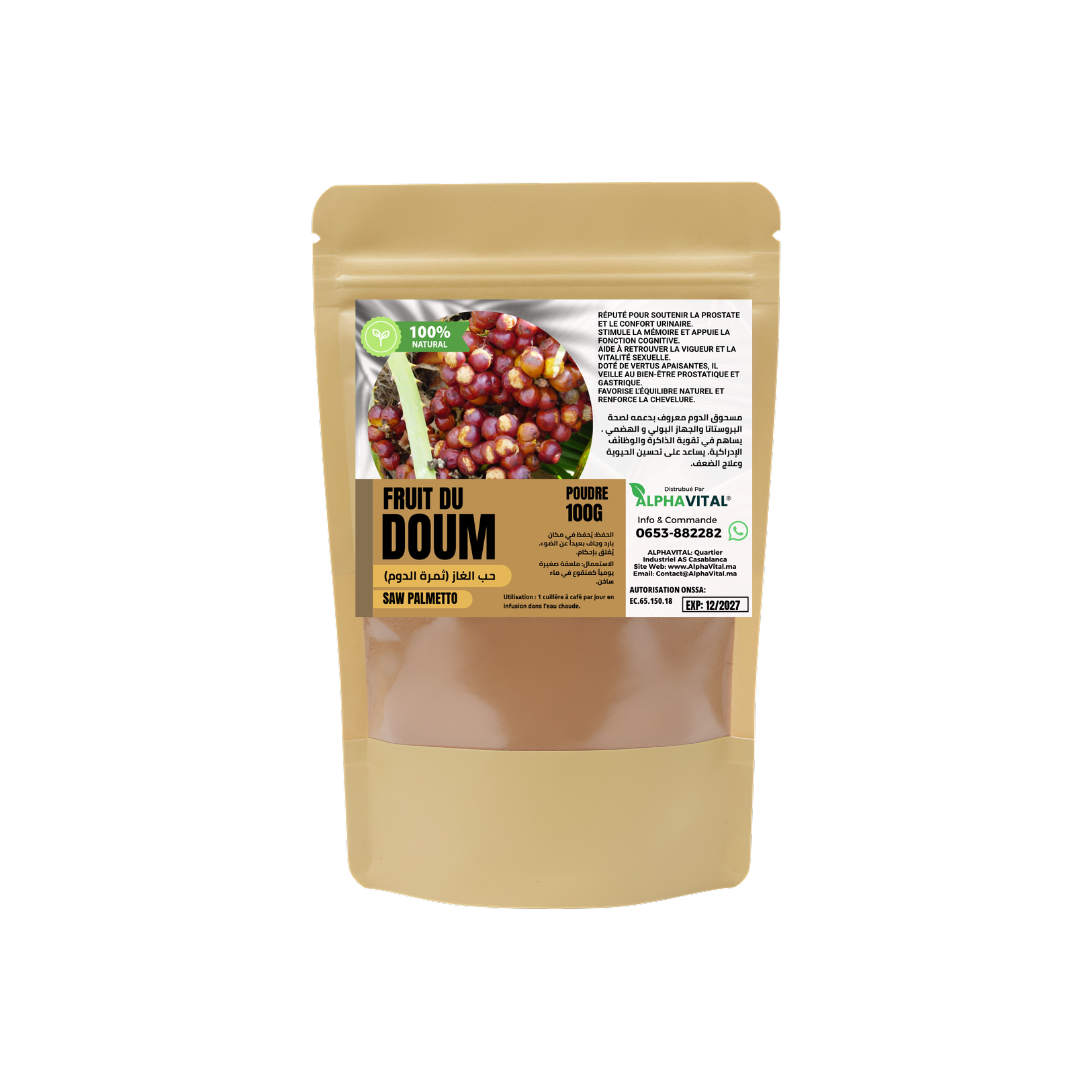
- Alphavital approaches this terrain with pure and traceable products: Doum powder made from 100% saw palmetto, pumpkin seed oil, and a holistic approach brought together in the Triple Action Programme.
The Prostate and Urinary Comfort: Understanding Before Seeking a Plant
Before discussing any supplement, it is important to understand the subject. The prostate is a small gland unique to men, located beneath the bladder and surrounding the urethral canal. With age, it is common for its volume to change gradually. This age-related phenomenon is so widespread that it is considered an ordinary part of male ageing. It is not a dramatic inevitability, but it does explain why urinary comfort becomes a daily topic past a certain age.
What many men experience are small changes in habit: more frequent trips, a recurring night-time need, a sense of not having fully finished. These common, widespread sensations are enough to explain the massive interest in natural solutions. But one thing must be clear from the start: these signals, once they settle in, warrant the opinion of a healthcare professional, and no plant replaces that step.
Urinary comfort in the mature man is not a shameful illness. It is an ordinary health matter, deserving an adult and honest conversation — never promises.
Why the Subject Remains Taboo in Morocco
There is a cultural reality it would be dishonest to ignore. In Morocco, questions touching on male intimacy and ageing are often addressed obliquely. They are rarely discussed over coffee, seldom at home, and almost never without a measure of embarrassment. This silence is not trivial: it pushes many men to search alone, online, for answers they do not dare voice out loud.
It is in this context that traditional plants find a particular resonance. Discreet, available without a prescription, and rooted in a collective memory where the plant world has always had its place, they address a need to approach the subject without crossing certain thresholds. Our team sees it every day: behind an innocuous query often lies a man who simply wants to understand, without feeling judged.
What Science Actually Says About Plants for Urinary Comfort
This is where we must be most rigorous. Several plants are regularly associated with male urinary comfort, and the internet overflows with spectacular claims about them. Our role is not to relay those promises, but to present what research has actually observed — with all its nuances. And the first nuance is crucial: European health authorities have validated no health claim linking these plants to the prostate. Everything that follows therefore falls within ongoing research and traditional use, not an established benefit. One of the most studied plant-derived actives in this area is pumpkin seed oil: our dedicated guide explores pumpkin seed oil for urinary comfort and prostate in depth.

Saw Palmetto (Doum, Serenoa repens)
This is the most emblematic plant in this field, and the most studied. Numerous studies have explored the role of saw palmetto in the urinary comfort of ageing men. The literature is extensive, but also nuanced: some older reviews described encouraging results, while more recent, better-controlled studies observe no clear difference compared to a placebo.
A large synthesis by the Cochrane Collaboration, the world reference for medical evaluation, reviewed the available trials on Serenoa repens and male urinary comfort. It is accessible via this systematic review on Serenoa repens referenced on PubMed1. Its conclusion calls for caution, and that is precisely why Alphavital never presents Doum as a solution, but as a traditional plant. Honesty takes precedence over commercial argument. Our team detailed this plant in its complete dossier on Saw Palmetto, hair and male comfort.
Pumpkin Seeds (Cucurbita pepo)
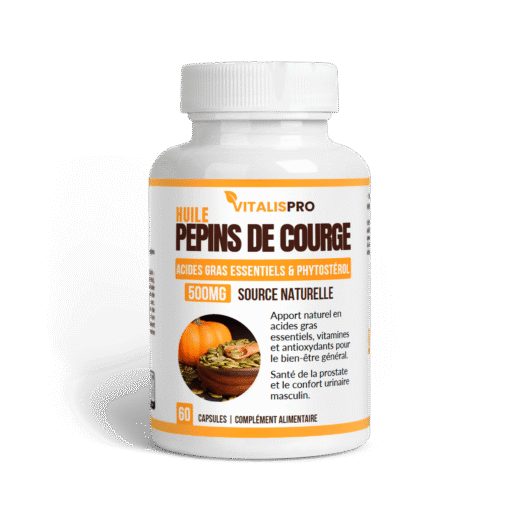
The other major plant on this terrain is the pumpkin seed. Rich in fatty acids and zinc, it has a long-standing place in traditional uses for male urinary comfort. Research has examined these seeds and their oil: one finds on PubMed a literature base on Cucurbita pepo and lower urinary tract comfort2. As with saw palmetto, the data remain heterogeneous and do not allow a guaranteed benefit to be concluded. Here again, we are speaking of traditional use and an open field of study — never a promised effect.
The NIH reference file on Saw Palmetto on the NCBI Bookshelf3 summarises the abundant literature surrounding these plants. The scientists’ message is consistent: it is the totality of plant compounds, not a single isolated molecule, that characterises these fruits and seeds. That is also why a product’s quality depends first and foremost on the purity and maturity of the raw material used.
The Notion of Purity Rather Than Promise
On this terrain, the most valid question is not “which plant works miracles,” but “which raw material, in what honest form.” A powder made from whole berries, or a cold-pressed seed oil, with no additives or excipients, states clearly what it is: a product whose exact composition is known. That transparency — not a claim — is what separates a serious product from a mere marketing promise.
That is the philosophy our team has adopted for this terrain. Rather than wrapping these plants in prohibited claims, Alphavital offers them in their purest and most traceable form. You know exactly what you are putting in your cup or on your spoon. We apply this transparency about raw materials across the entire range, as we explained in our guide to plant proteins for athletes.
Comparing Male Comfort Plants Without Overstating Any
Saw palmetto is not alone in the field of mature male comfort. Other traditional plants share this space, and our team is regularly asked about their differences. Rather than setting them in opposition, it is more accurate to understand the role of each, without overstating any or presenting one as “better” than another.
| Traditional plant | Part used | Area of traditional interest |
|---|---|---|
| Saw Palmetto (Doum) | Saw palmetto berry | Mature male comfort |
| Pumpkin seeds | Seed and oil | Urinary comfort, zinc intake |
| Stinging nettle (root) | Root | Day-to-day male comfort |
| Brewer’s yeast | Whole yeast | Zinc and selenium intake |
Each has its own history and profile. Pumpkin seed oil provides fatty acids and zinc and fits the same comfort logic. Brewer’s yeast enriched with zinc and selenium covers the trace-element intake useful for mature men. Saw palmetto, meanwhile, remains the most emblematic traditional plant on this terrain. These plants do not compete; each illuminates a different facet of the same need.
These plants do not oppose one another. Each, in its own way, covers a different facet of the comfort of the ageing man.
It is this complementary logic that guided our team when it brought several of these active ingredients together in a holistic approach. The idea is not to accumulate promises, but to offer a coherent accompaniment to male comfort, to be integrated into a healthy lifestyle. To explore the subject more broadly, our team detailed this approach in its dossier on pumpkin seeds, urinary comfort and heart health.
Urinary Comfort in Morocco: A Real Need in a Particular Context
Why this Moroccan interest in male comfort plants? The answer lies in several realities. First, a cultural familiarity: the doum palm is part of the landscape and collective memory, making the plant immediately legitimate in many people’s eyes. Next, a sought-after discretion: subjects related to male comfort are often approached obliquely, and a traditional plant, available without a prescription, meets this need to address the topic without crossing certain thresholds.
A generational dimension adds to this. Men in their forties, fifties and beyond, conscious of their comfort, readily turn to natural solutions they can incorporate into their own routine. Preparing a decoction in the evening, the way one makes tea, is something reassuring and familiar. It is a gesture, not merely a product.
The country’s pace also plays a role. Long days, urban stress, a diet that is sometimes unbalanced, irregular hydration: all factors that invite one to take care of oneself holistically. In this context, these plants find their place not as a effective remedy but as a traditional support, to be included in an attentive lifestyle. Our team is fond of repeating: a plant accompanies a healthy way of life, it never replaces it.
A Traditional Plant, Not a Magic Wand
Let us be clear about a point our team repeats constantly. These plants are not medicines, and none of them alone corrects a lifestyle that exhausts the body. A berry or a seed, however respected by tradition, does not replace sleep, physical activity, a balanced plate or proper hydration. It fits into a whole, or it serves little purpose.
Reference authorities are clear on this: a food supplement is not a substitute for medical monitoring or a balanced diet. That is precisely the framework set out by the EFSA in its dossier on food supplements4 and reiterated by ANSES5. These plants are a traditional support to be integrated intelligently, never a solution that would make everything else unnecessary. That nuance makes all the difference between honest information and an empty promise.
Day-to-Day: Healthy Habits and Good Reflexes
Before even thinking about a plant, several simple actions support urinary comfort every day. They cost nothing, promise nothing, and form the foundation of everything. Our team highlights them systematically, because they often matter more than any supplement.
Hydration, Diet, Activity
Regular hydration spread throughout the day is better than large amounts all at once, particularly in the evening. A varied diet rich in vegetables, good fats and zinc naturally provides part of what one sometimes seeks in a supplement. As for physical activity, even moderate — such as a daily walk — it remains one of the best allies of comfort for the mature man. These habits are not spectacular, but they are the foundation on which everything else rests.
The Decoction Gesture
For those who wish to incorporate a traditional plant such as Doum, the preparation gesture matters as much as the product itself. The traditional way to prepare saw palmetto is as a decoction: one teaspoon of powder per cup of water, brought gently to a simmer for five to ten minutes, then strained and drunk warm. For those who prefer a no-cook method, a cold infusion left to steep for several hours in cold water works perfectly. Alphavital recommends, as a traditional use, one to two cups per day, in short cycles rather than continuously.
When to Consult — Without Delay
This is the most important point in this entire article. No supplement, no traditional plant replaces medical advice. A urinary change that settles in, a discomfort that persists, an unusual sign: all of that requires a healthcare professional, and that professional alone. A plant may accompany day-to-day comfort within a healthy lifestyle, but it poses no diagnosis and replaces no monitoring. Consulting in time is never a weakness; it is the healthiest reflex there is.
The Alphavital Response
A healthy lifestyle first — always — and medical advice as soon as a symptom takes hold. But when one wishes to reconnect with a traditional plant to accompany daily comfort, a trustworthy raw material is essential. That is precisely the philosophy that guided our team’s work.
Pure and Traceable Plants
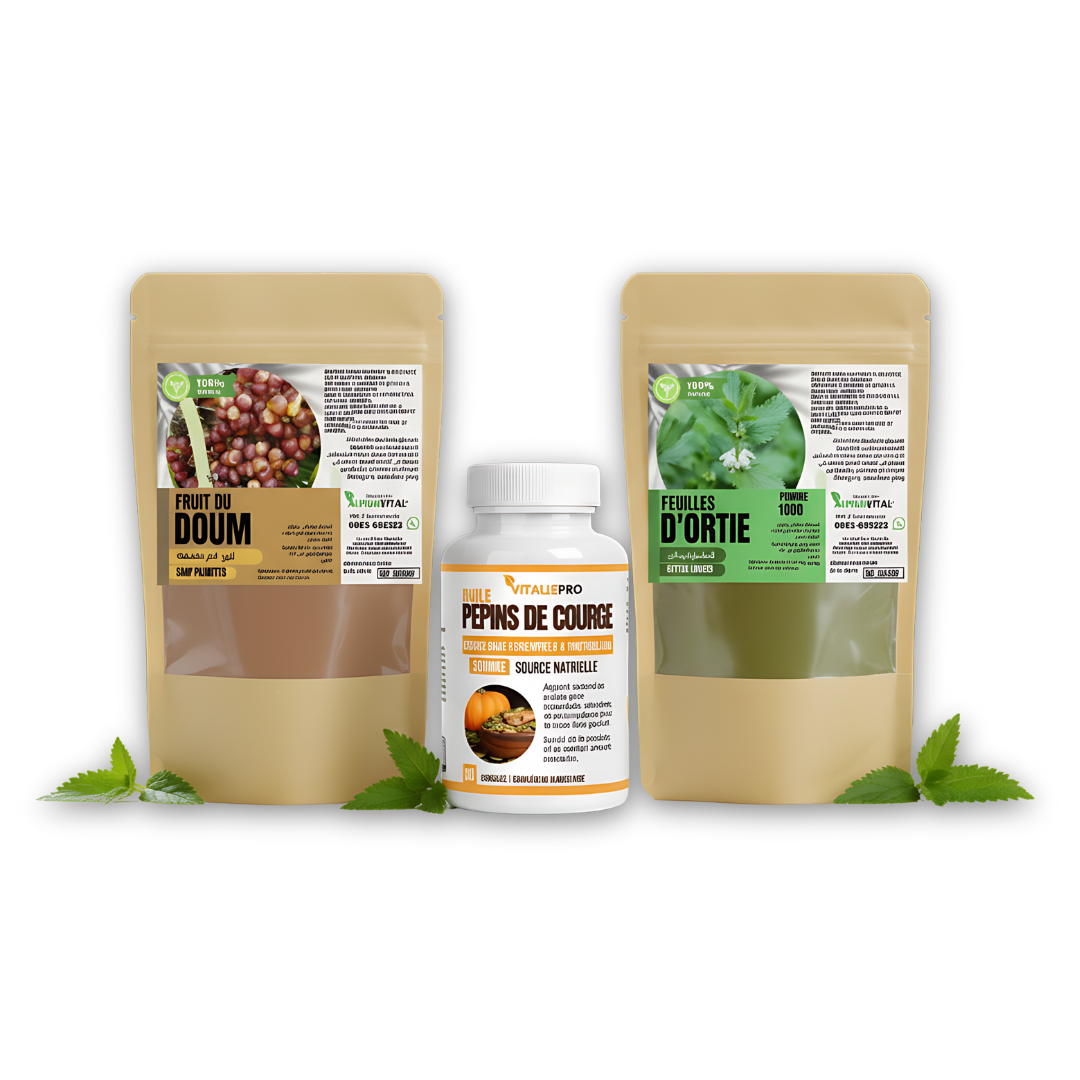
Alphavital offers these plants in their simplest and most honest form. Doum comes as a 100% pure saw palmetto powder, with no additive, no excipient and no added flavouring: a single ingredient, declared as such. Pumpkin seed oil is derived from the Cucurbita pepo seed. Three requirements guide these choices: a quality raw material, total transparency about the composition, and genuine traceability, batch by batch.
Each product holds ONSSA authorisation, and every batch is controlled before packaging for consistent quality. For those discovering this terrain for the first time, these pure formats are the best starting point: they allow a return to the traditional gesture and observation of one’s own routine, without superfluous formulas or hollow claims.
A good male comfort product is not reduced to a name on a sachet. It brings together a quality raw material, total transparency about its composition and genuine traceability.
For Male Comfort, a Holistic Approach
For men seeking broader support for their daily comfort, our team has brought together several traditional plants in a coherent approach: the Triple Action Programme. The idea is not to multiply products, but to combine complementary active ingredients around a shared comfort objective, to be integrated into a healthy lifestyle. This approach is aimed at those who already know these plants and want a structured path rather than a scattered one.
It naturally extends the discovery of individual plants, with the same level of quality and transparency requirements. Alphavital offers it as a traditional support for the comfort of the mature man, never as a medical intervention, and always within the framework of an attentive lifestyle and medical follow-up when necessary.
The feedback our team receives is worth more than any sales pitch. Here are three testimonials, shared with their authors’ permission, kept entirely clear of any health claim.
At fifty-three, what I mainly wanted was to take care of myself without overdramatising things. Preparing my Doum decoction in the evening has become a small calming ritual, and I appreciate knowing exactly what I am drinking: one single ingredient, nothing else. — Rachid, Casablanca
What I appreciated was the transparency and the fact that no one promised me the moon. My doctor remains my reference, and these plants simply accompany my daily life. The quality of the powder is visible and tangible. — Brahim, Fez
I chose the holistic approach to follow a quiet, long-term routine without thinking about each product separately. The idea of reconnecting with plants from our land, as part of a healthy lifestyle, appeals to me greatly. — Mostafa, Marrakech
These accounts illustrate a simple truth: the value of these plants lies as much in the gesture and tradition as in the product itself. A question before you begin? Our team replies directly through the Alphavital contact page.
Frequently Asked Questions About Urinary Comfort and the Prostate
Is there a natural supplement for the prostate in Morocco?
To be clear: no supplement or traditional plant acts as a prostate medication, and no health authority has validated any health claim in this regard. These plants — such as saw palmetto or pumpkin seeds — are part of a traditional use for mature male comfort. Any urinary symptom that takes hold requires a healthcare professional.
Which plants are associated with male urinary comfort?
The most documented are saw palmetto (Doum, Serenoa repens), pumpkin seeds (Cucurbita pepo) and stinging nettle root. Research exists on these plants, but its conclusions remain cautious and sometimes contradictory. They are presented as traditional plants to be integrated into a healthy lifestyle — never as remedies.
How should Doum be taken for urinary comfort?
As a decoction: one teaspoon of saw palmetto powder in a cup of water, gently simmered for five to ten minutes, then strained and drunk warm. As a cold infusion: leave the powder to steep for several hours in cold water, then strain. Traditional use is conceived in short cycles, at a rate of one to two cups per day.
When should one consult a doctor rather than take a plant?
As soon as a urinary change takes hold or a discomfort persists. No plant poses a diagnosis or replaces medical advice: a lasting symptom is a matter for a healthcare professional, without delay. A traditional plant may accompany daily comfort within a healthy lifestyle, but it is never an answer to a health problem.
Are Alphavital male comfort products available in capsule form?
Alphavital Doum is presented as a 100% pure saw palmetto powder, single ingredient, to be prepared as a decoction. Pumpkin seed oil is derived from the Cucurbita pepo seed. Every product is ONSSA certified and every batch is controlled before packaging for total transparency about the composition.
How much do these products cost in Morocco and how are they delivered?
The price of each format is displayed in the offer panel at the top of each product page. Delivery is available throughout Morocco within 24 to 48 hours, with payment upon delivery, and is free from 170 MAD. The details of each offer are viewable on the relevant product page.
In Summary
Urinary comfort in the mature man is an ordinary, common daily concern that deserves an adult conversation rather than promises. No traditional plant acts as a prostate medication, and no authority has validated any health claim in this regard: saw palmetto, pumpkin seeds and the other plants in this field are traditional supports to be integrated into a healthy lifestyle, never remedies. Science has explored these plants extensively without always reaching conclusions, and that honesty is precisely what should guide the choice.
Purity and traceability make all the difference. A quality raw material, a transparent composition and batch-by-batch control separate a serious product from an anonymous promise. That is the path Alphavital has chosen, with an approach faithful to tradition and to science alike, and always respectful of one simple principle: a symptom that settles in is a matter for the doctor, not a plant. Taking care of one’s comfort means first taking care of one’s lifestyle, and consulting in good time.
About the author. Houda Khaldi is Natural Nutrition Editorial Advisor at Alphavital. She translates scientific research into clear, actionable insights for everyday Moroccan life.
Disclaimer. The information presented is provided for informational purposes, based on sourced research (PubMed, NIH, EFSA, ANSES). No health claim relating to the prostate has been authorised by European authorities for these traditional plants: no recommended benefit is asserted here. The Alphavital team does not consist of healthcare professionals. Any urinary symptom or change that takes hold requires a qualified healthcare professional without delay. Consult a healthcare professional before any use, in cases of ongoing treatment, illness or specific medical history. Food supplements are not a substitute for a varied and balanced diet or a healthy lifestyle.
Sources and References
- Tacklind J. et al. — Serenoa repens and urinary symptoms in men: systematic review. Cochrane / PubMed
- Literature on Cucurbita pepo (pumpkin seeds) and lower urinary tract comfort. PubMed
- Saw Palmetto (Serenoa repens) — composition, uses and literature. StatPearls, NCBI Bookshelf (NIH)
- Food supplements: regulatory framework and good practice. EFSA (European Food Safety Authority)
- Food safety and food supplements. ANSES (French Agency for Food, Environmental and Occupational Health & Safety)
Food supplements do not replace a varied, balanced diet or a healthy lifestyle. The Alphavital team is not made up of healthcare professionals. Consult a qualified healthcare professional before use.