

Wanting something sweet in the late afternoon is not a lack of willpower. It often follows a rushed lunch, a short night or a long gap between meals. Chromium picolinate is sold as the answer to that moment. This page puts five human studies side by side, so you can see what chromium does, what it does not do, and how to use it sensibly.
It is around four in the afternoon. Lunch was four hours ago, concentration is fraying, and suddenly a fixed idea takes hold: something sweet. A biscuit, a heavily sugared tea, a square of chocolate — anything, as long as it is sweet. Thousands of Moroccans experience this scene every day, at the office and at home. There is nothing intrinsically alarming about it, but it does raise a legitimate question: why does the body call for sugar when it has just been fed?
Behind this everyday question lies a fascinating universe: the world of glucose metabolism and the way our bodies handle the sugar we give them. And at the heart of this mechanism sits a quiet actor, almost forgotten by modern diets: chromium. Our team receives questions about it every week. Does chromium really help? What do the studies say? And what can be stated honestly, without drifting into empty claims? This article answers each of these questions, drawing exclusively on authoritative sources and one guiding principle: assert only what the science and health authorities support. For a broader view of the subject, you can also consult our comprehensive guide on blood sugar and metabolism.
By Houda Khaldi, Natural Nutrition Editorial Adviser · Published 17 June 2026 · 18 min read
Contenu de la page
- 1 Key Takeaways
- 2 Chromium: an essential trace mineral we almost forgot
- 3 What the science says about chromium and blood sugar
- 4 Sugar cravings: understanding before acting
- 5 Chromium in Morocco: a distinctive dietary context
- 6 How to use chromium picolinate effectively
- 7 Chromium, berberine, moringa: finding your bearings
- 8 The Alphavital approach
- 9 Three readers share their experience
- 10 Chromium picolinate: what five human studies actually measured
- 11 Chromium picolinate dosage: how to read the label
- 12 How to fit chromium into a day that tends to end in sugar
- 13 Who should ask before taking chromium
- 14 Frequently asked questions about chromium picolinate
- 14.1 What exactly is chromium picolinate?
- 14.2 Does chromium genuinely help with blood sugar?
- 14.3 Does chromium suppress sugar cravings?
- 14.4 How should chromium picolinate be taken in Morocco?
- 14.5 How long before something is noticeable?
- 14.6 Can chromium and berberine be taken together?
- 14.7 What are the side effects of chromium picolinate?
- 14.8 Does chromium picolinate help with weight loss?
- 14.9 How much chromium picolinate per day?
- 14.10 Can I take chromium if I already take medicine for blood sugar?
- 15 In summary
Key Takeaways
- Chromium is an essential trace mineral: the body cannot produce it and must obtain it through food. Chromium picolinate is one of the most extensively documented forms in the publicly available scientific literature.
- Only two health claims are officially authorised in Europe: chromium contributes to normal macronutrient metabolism and to the maintenance of normal blood glucose levels. These are the only formulations we use.
- Sugar cravings are first and foremost a lifestyle phenomenon: relentless pace, irregular meals, insufficient sleep, chronic stress. Chromium is not an appetite suppressant; it plays a supporting role within a broader approach.
- The modern Moroccan diet, rich in fast-acting sugars and white bread, places a heavy demand on glucose metabolism — which is one of the contexts in which adequate chromium intake regains its relevance.
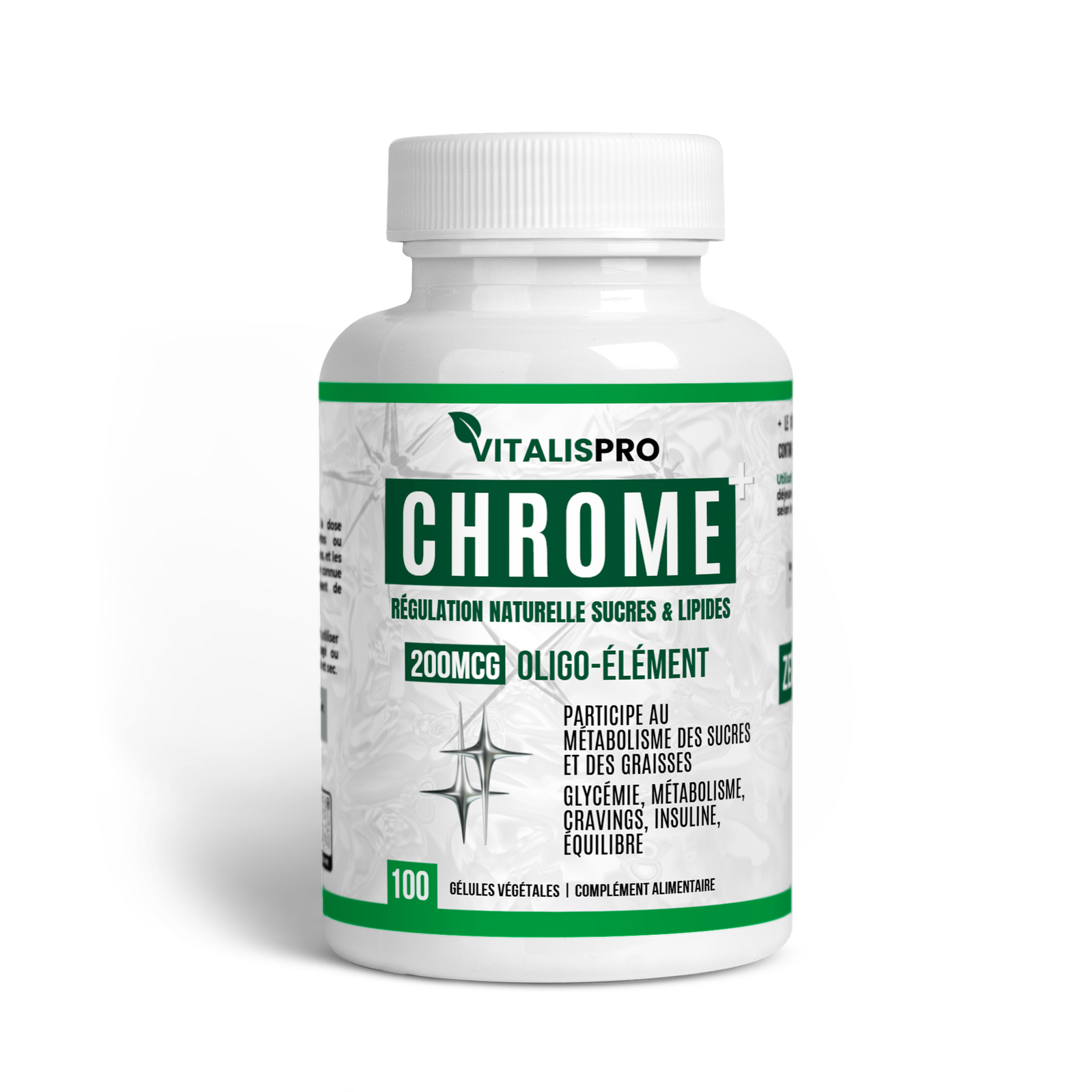
- Alphavital offers Chromium Picolinate at 200 µg per vegetable capsule, in a 100-capsule bottle, free from gluten, dairy and soya, in a deliberately simple and fully traceable formula.

Chromium: an essential trace mineral we almost forgot
Before it is a supplement, chromium is a nutrient. It belongs to the family of trace minerals — those minerals the body needs in tiny quantities, but whose absence makes itself felt. Iron, zinc, selenium, and iodine all belong to the same family. Chromium occupies a distinctive place within it: long neglected, it is now recognised as a player in energy metabolism, meaning the process by which the body converts what we eat into usable fuel.
The key characteristic of chromium is that the body cannot synthesise it. It must therefore be supplied through food — certain wholegrains, vegetables, nuts, and sometimes brewer’s yeast. The problem is that the modern diet, more refined and processed than its predecessors, typically provides less of it than in earlier eras. The milling processes that produce white bread, white sugar and fine flours tend to deplete foods of trace minerals. This is why the topic of chromium is resurfacing today, as more people question the balance of their plates.
Chromium is not a trend. It is an essential trace mineral, present in minute amounts, yet necessary for the normal functioning of sugar metabolism.
This rediscovery is far from anecdotal. In Morocco as elsewhere, the dietary transition has profoundly altered our intake patterns: more refined products, sugary drinks and fast food, and fewer wholegrains and legumes. Our team has examined this shift and its implications for blood sugar balance in detail in its dossier on metabolism and natural weight management.
Picolinate, yeast, polynicotinate: a question of form
One point deserves clarification, because it directly conditions the quality of the finished product. Chromium never exists in isolation in a supplement: it is always bound to a molecule that facilitates its absorption. This is what is referred to as its form. Among the available forms, chromium picolinate is one of the most widely represented in the publicly available scientific literature, where it is extensively studied for its bioavailability — that is, the proportion actually absorbed by the body.
This is the form that Alphavital selected, at a full dose of 200 µg per capsule. The choice was not arbitrary: the goal is to offer a well-documented chromium at a clear, consistent dosage, rather than a vague powder of indeterminate composition. This demand for purity and traceability is applied to every product, as we explain throughout the Weight Management and Metabolism range.

What the science says about chromium and blood sugar
This is where the real substance lies, and where rigour is non-negotiable. The internet overflows with spectacular promises about chromium: it “melts fat”, “kills cravings”, “supports” this or that condition. Our role is precisely the opposite: to distinguish what scientific authorities permit us to affirm from what amounts to marketing. On this front, the framework is unambiguous.
In Europe, health claims that may be associated with a nutrient are strictly regulated. They appear in an official register, populated through assessments by the European Food Safety Authority. For chromium, only two claims are authorised, and these are the only two we use. They are accessible via the EFSA scientific opinion on health claims related to chromium1.
Claim 1: normal macronutrient metabolism
The first authorised claim is that chromium contributes to normal macronutrient metabolism. Behind this technical term lies a simple idea. Macronutrients are the three major food families that make up our meals: carbohydrates (sugars), lipids (fats) and proteins. Metabolism is the set of reactions that convert these nutrients into energy usable by cells.
To say that chromium contributes to normal macronutrient metabolism is to acknowledge its role as a cog in this machinery. It is not a spectacular effect, but a background function — that of a trace mineral participating in the proper unfolding of essential processes. This nuance is pivotal: we are talking about supporting a normal function, never about treatment.
Claim 2: maintenance of normal blood glucose levels
The second authorised claim is that chromium contributes to the maintenance of normal blood glucose levels. Blood glucose is simply the concentration of sugar in the blood. After a meal, this level rises naturally, then the body brings it back towards its baseline. This ongoing fluctuation is what we call glycaemic balance.
Acknowledging that chromium contributes to the maintenance of normal blood glucose levels means attributing to it a role in this balancing mechanism, in a person in good health. Both claims are listed in the EU Register of Health Claims (Regulation EU 432/2012)2, which is the definitive reference. This framework, and this framework alone, guides our communications.
Chromium is not a medicine. It contributes, in a person in good health, to the maintenance of normal blood glucose levels and to normal macronutrient metabolism.
This honesty structures everything we say. Where others promise miracles, Alphavital holds to what the authorities permit. As for the picolinate form, it is one of the most widely represented in the public bibliographic base on chromium, accessible through the peer-reviewed literature indexed on PubMed3. What matters to us is clarity: an essential nutrient, properly dosed, within a respected regulatory framework.
Sugar cravings: understanding before acting
Let us turn to the heart of the matter — the question that brings most readers here. Those sudden, overwhelming urges for something sweet, which appear at predictable moments of the day. Where do they come from? And what can reasonably be said about them? To be clear from the outset: chromium is not an appetite suppressant, and no supplement makes a craving vanish overnight. Understanding the phenomenon is far more useful than searching for a magic solution.
Sugar cravings are, above all, a lifestyle matter. Several factors, often in combination, explain them day to day:
- Irregular or overly spaced meals: when the body runs short of fuel, it reaches for what acts fastest — sugar.
- A diet rich in fast-acting sugars: white bread, pastries and sugary drinks cause a rapid rise in blood sugar, followed by a descent that reignites the craving.
- Insufficient sleep: fatigue disrupts appetite regulation and pushes the brain towards quick rewards.
- Stress and emotions: sugar is also comfort — a learned response to tension or boredom.
It is clear from this: a craving is not a weakness, it is a signal. Rather than fighting it head-on, the more effective approach is to address the underlying conditions — more regular meals, more fibre and protein, adequate sleep, and a plate that avoids sharp glycaemic spikes. Within this holistic logic, chromium finds its place as one support among several, within a broader programme. It does not replace the plate, the sleep, or the movement.

The role of stable blood sugar in managing cravings
To understand the mechanics, we need to return to blood glucose. When a highly sugared, low-fibre food is consumed, blood sugar climbs rapidly. The body responds to bring it back down, and this descent can be steep. It is often at this moment that the craving returns: the body seeks to recover energy fast. A cycle sets in — sugar, spike, drop, new craving for sugar.
Breaking this cycle begins with the plate: favouring foods that release their energy slowly, rich in fibre, protein and healthy fats, which sustain satiety and blunt the peaks. It is within this context of balance that chromium’s role — as a contributor to the maintenance of normal blood glucose levels in a healthy person — takes on its full meaning: not as a craving switch, but as a trace mineral that participates in the normal functioning of sugar metabolism.
A craving is not a weakness to punish — it is a signal to heed. The real lever is the underlying environment: the plate, sleep, movement.
When berberine and chromium come together
Chromium is not alone in the field of glycaemic and metabolic balance. Berberine, a plant-derived compound with an extensive research record, acts through a different pathway: it activates the AMPK enzyme — a master regulator of energy metabolism — and supports insulin sensitivity. Where chromium is an essential trace mineral recognised for its contribution to the maintenance of normal blood glucose levels, berberine brings a complementary mechanism.
This complementarity is precisely what guided our team when it designed a combination of the two. The aim is not to stack claims, but to bring together two well-documented approaches to the same terrain: blood sugar balance. For an in-depth look at berberine’s mechanism, our comprehensive guide on berberine and blood sugar goes into full detail on the studies and the AMPK pathway.

Chromium in Morocco: a distinctive dietary context
Why does the topic of chromium and blood sugar resonate so strongly in Morocco? The answer lies in our relationship with sugar — deeply embedded in the culture — and in the pace of dietary transition. Sweet mint tea, the pastries of grand occasions, bread at every meal: these are pleasures and traditions that enrich the Moroccan table, while at the same time placing a considerable demand on glucose metabolism.
Add to this a lifestyle reality. The relentless pace of major cities, long working days, exhausting commutes, insufficient sleep — all of these factors encourage sugary snacking and irregular meal timing. Many people seek to regain control of their balance without resorting to harsh measures, working from the inside out rather than depriving themselves abruptly.
The month of Ramadan illustrates this particular relationship with sugar vividly. Breaking the fast typically involves dates, juices and honey-based pastries, and the complete reversal of meal timings puts the metabolism under significant strain. It is a period in which attention to dietary quality and blood sugar balance becomes especially meaningful. In this context, adequate intake of trace minerals such as chromium regains relevance — not as a quick fix, but as one structural support within a more balanced way of life.

A trace mineral, not a magic wand
One point our team emphasises repeatedly deserves to be stated plainly. Chromium is not a medicine, and it does not, on its own, correct an unbalanced diet or a lifestyle that exhausts the body. A trace mineral, however essential, replaces neither the fibre in a thoughtful plate, nor sleep, nor physical activity. It belongs within a wider whole.
This is also what public health authorities make clear: a food supplement is never a substitute for a varied, balanced diet or a healthy lifestyle — a principle well summarised by the dietary supplements section of MedlinePlus4. Chromium is a support, not a ready-made solution. This distinction makes all the difference between an honest statement and an empty promise.
How to use chromium picolinate effectively
A few practical benchmarks help avoid the most common mistakes and allow you to get the most from a programme. Good usage matters as much as the product itself.
Chromium picolinate: dosage in Morocco
Alphavital recommends one 200 µg capsule a day, after lunch or dinner, with a large glass of water. Taking chromium with a meal makes sense: this is when dietary sugars and fats arrive, and it is the metabolism of these nutrients that chromium accompanies. Consistency takes precedence above all else: it is daily repetition over time that establishes a meaningful routine. The recommended dose should not be exceeded.
How long should a chromium programme last?
A foundational programme is best thought of over the medium term — generally two to three months, enough time to establish a genuine routine within a balanced lifestyle. At one capsule per day, a single bottle lasts well over a month, making it a logical basis for a first programme. Chromium does not act within a few days: it is a structural support to be integrated over time, alongside a thoughtful diet and regular physical activity.
Chromium: precautions and common sense
Chromium, at the standard doses used in food supplements, is generally well tolerated. As with any supplement, certain precautions apply: observe the recommended dose, do not exceed it, and keep the product out of the reach of young children. Pregnant or breastfeeding women, and anyone following a treatment — particularly one related to blood sugar — should seek advice from a healthcare professional before starting. Public resources such as the LiverTox database on NCBI Bookshelf (NIH) on chromium5 underline the importance of reasonable use. This caution is not a formality: it is a condition for responsible use.

Chromium, berberine, moringa: finding your bearings
Chromium does not stand alone in the universe of glycaemic and metabolic balance. Other actives share this territory, and our team is regularly asked about the differences between them. Rather than setting them in opposition, the more useful approach is to understand each one’s speciality.
| Active | Nature | Primary terrain |
|---|---|---|
| Chromium (picolinate) | Essential trace mineral | Macronutrient metabolism, maintenance of normal blood glucose levels |
| Berberine | Plant-derived compound | AMPK activation, insulin sensitivity |
| Moringa | Plant (leaves) | Nutritional density, overall vitality |
Each of these actives has its own history and profile. Chromium is the essential trace mineral of sugar metabolism. Berberine acts on AMPK and insulin sensitivity. Moringa brings remarkable nutritional density and broad-spectrum vitality support. Combined with discernment, these actives cover the entire metabolic terrain.
These actives do not compete. They complement one another, each illuminating a different facet of metabolic balance.
This logic of complementarity guided our team when it designed a programme bringing these three actives together. The objective: to cover the full metabolic terrain, from blood sugar balance to vitality, by uniting complementary approaches rather than multiplying them haphazardly. This holistic perspective is at the core of our dossier on metabolism and natural weight management.

The Alphavital approach
Diet and lifestyle first, always. But when a chromium intake makes sense, a serious formula is required. This is exactly the philosophy that guided our team’s work on chromium picolinate.
Alphavital Chromium Picolinate: fully dosed, deliberately simple
Alphavital offers chromium in picolinate form, dosed at 200 µg per vegetable capsule, in a 100-capsule bottle. The formula is intentionally simple: chromium as the active ingredient, at a clear and consistent dosage, without superfluous additives. The product is free from gluten, dairy, soya and common allergens, according to the label. Three requirements guided its development: a well-documented form, a clear and consistent dosage, and genuine lot-by-lot traceability.
This chromium belongs to our Weight Management and Metabolism range, conceived as a coherent whole. For those just beginning the journey, chromium alone is often the best starting point: it integrates simply into mealtimes and builds on a clear foundation.
A good chromium is not reducible to a number on the label. It combines a well-documented form, a controlled dosage and genuine traceability.
The complete programme, for those who want to go further
For those seeking broader support for the metabolic terrain, our team also offers a complete programme that pairs chromium with two other pillars: berberine and moringa. The aim is to cover the entire terrain, from blood sugar balance to vitality, by bringing together actives with complementary mechanisms rather than multiplying them arbitrarily.
This programme is designed for those already familiar with these actives who want a structured, coherent, comprehensive approach. It follows naturally from an initial discovery of chromium alone, and upholds the same quality standards. Have a question before you begin? Our team responds directly through the Alphavital contact page.

The feedback our team receives speaks more powerfully than any sales pitch. Here are three testimonials, shared with the consent of their authors.
I was snacking a lot in the afternoon at the office, always reaching for something sweet. I first worked on my meals, adding more protein at lunch, and integrated chromium into my routine. Without claiming a effective, I found my days more consistent and less subject to energy swings. — Khalid, Casablanca
Between work pace and short nights, I had completely lost track of my eating habits. Getting back to regular meals and adding chromium helped me restore order, step by step. What made the difference was consistency over several weeks. — Nadia, Rabat
I wanted a holistic metabolic approach rather than a single isolated product. I chose the complete programme to address every aspect in parallel with a more balanced diet. Three months in, I feel more stable day to day. — Mehdi, Marrakech
These accounts illustrate a simple truth: the most lasting results come from the combination of lifestyle adjustments and, where useful, a well-chosen supplement.
Chromium picolinate: what five human studies actually measured
Chromium is often sold with big promises about cravings and weight. The trials are more modest, and some found nothing at all. Here they are, side by side, with their real results.
| Study (author, year) | Who, how much, how long | What was found |
|---|---|---|
| Anton, 2008 | 42 women with overweight who reported carbohydrate cravings; 1,000 µg chromium picolinate a day; 8 weeks | Less food eaten, less hunger and fewer fat cravings than with placebo. Weight tended to drop, but not significantly.6 |
| Amato, 2000 | 19 adults aged 63 to 77, not overweight; 1,000 µg chromium picolinate; 8 weeks | No change in insulin sensitivity, blood fats or body composition compared with placebo.7 |
| Lukaski, 1996 | 36 men doing weight training; about 175 µg chromium as picolinate or chloride; 8 weeks | Strength and muscle gains came from training alone. Chromium added nothing.8 |
| Onakpoya, 2013 (meta-analysis) | 11 trials pooled for weight, adults with overweight or obesity; amounts varied | 0.5 kg more weight lost than with placebo. Significant, but clinical relevance uncertain. Some reported watery stools, dizziness, headache or hives.9 |
| Tsang, 2019 (meta-analysis) | 1,316 adults with overweight or obesity in 21 trials; amounts varied | About 0.75 kg more weight lost than with placebo. Clearer at 400 µg a day or less, and over 12 weeks or less.10 |
What this does not show. Chromium is not a weight-loss product and not an appetite suppressant. The craving result comes from one small trial in women, at a high amount, and it still needs to be repeated. In people whose blood sugar handling was already normal, chromium changed nothing measurable. The weight differences in the two meta-analyses are below one kilogram. What does hold is the role recognised in EU law: chromium contributes to normal macronutrient metabolism and to the maintenance of normal blood glucose levels. That is the honest ground this product stands on.
Chromium picolinate dosage: how to read the label
- Micrograms, not milligrams. Chromium is counted in micrograms (µg or mcg), a thousandth of a milligram. A label that says “mg” for chromium deserves a second look.
- Chromium, not the whole compound. Chromium makes up only about 12% of chromium picolinate by weight. The number that matters is the line “of which chromium”.
- Reference points. The EU daily reference intake for chromium is 40 µg. In the US, the adequate intake for adults is 20 to 35 µg a day, depending on age and sex. A supplement serving is usually several times higher, which is why one capsule a day is enough.
More is not better here. In the 2019 meta-analysis, the clearer results came at 400 µg a day or less, not at higher amounts. Alphavital’s advice is one capsule a day, with your main meal and a large glass of water, over a course of two to three months.
How to fit chromium into a day that tends to end in sugar
Chromium supports what happens around a meal, so its place is with food. In many Moroccan homes, lunch is the main meal: that is a good moment for the capsule. During Ramadan, take it with the main part of iftar, after the dates and soup, rather than on an empty stomach.
For many people, sweet mint tea is a large part of the day’s sugar, often more than they think. Cutting it all at once rarely lasts. Removing one sugar cube per teapot each week is easier to keep up, because your taste adjusts step by step. Chromium supports normal glucose metabolism during that change; it does not replace it.
Do not expect a feeling 30 minutes later. Chromium is a slow, background support. The fair test is simple: for two weeks before starting, note each sweet snack between meals and the time it happens. Keep the same note for eight weeks on chromium, with regular meals and some protein at lunch. Compare the two lists, not your impressions.
Some people want more support for blood sugar balance than chromium gives on its own. That is where berberine comes in. In the Berberine and Chromium pack, the two work on the same goal from two sides: berberine acts on how the body handles glucose, while chromium supports normal macronutrient metabolism. Many people notice a first difference with berberine within 24 hours, then a gradual effect. Berberine must never go above 1 g a day, and blood sugar should be checked with a glucose meter, such as the VivaChek Ino sold by Alphavital. Our separate guide to berberine and blood sugar covers its safety in detail.
After a heavy celebration meal, the issue is often both the sugar and the fat on the plate. For those days, the Liver Detox Bundle pairs berberine, which helps the body handle the sugar and fat of the meal, with milk thistle, whose silymarin has documented antioxidant properties. Both are taken together at lunch. For a simple start on chromium alone, the Chromium Picolinate capsule remains the easiest step.
Who should ask before taking chromium
- People taking medicine for blood sugar, tablets or insulin. Chromium could add to their effect. Talk to your doctor first, never change your doses alone, and check your readings with a meter.
- People taking thyroid hormone. Keep a gap of a few hours between the two, and ask your pharmacist for the exact spacing.
- People with kidney or liver problems, and anyone pregnant or breastfeeding: ask a health professional first.
Frequently asked questions about chromium picolinate
What exactly is chromium picolinate?
Chromium is an essential trace mineral: the body cannot produce it and must obtain it through food. Chromium picolinate is one of the most widely documented forms in the publicly available scientific literature for its bioavailability. Alphavital selected it and dosed it fully, at 200 µg per vegetable capsule, in a 100-capsule bottle.
Does chromium genuinely help with blood sugar?
Chromium contributes to the maintenance of normal blood glucose levels and to normal macronutrient metabolism: these are the two health claims officially authorised in the EU register, on the basis of EFSA’s assessment. This refers to supporting a normal function in a person in good health — not to treatment. Chromium does not replace medical follow-up or a prescribed treatment.
Does chromium suppress sugar cravings?
Chromium is not an appetite suppressant and does not make cravings disappear in one step. Sugar cravings are primarily a lifestyle matter: irregular meals, fast-acting sugars, insufficient sleep, stress. The most effective lever remains the foundational environment: regular meals, more fibre and protein, good sleep. Chromium, as a trace mineral contributing to the maintenance of normal blood glucose levels, plays a supporting role within this broader approach — not a replacement for it.
How should chromium picolinate be taken in Morocco?
Alphavital recommends one 200 µg capsule a day, after lunch or dinner, with a large glass of water. Integrate it into a varied diet and an active lifestyle, without exceeding the recommended dose, and maintain the routine over time. At one capsule per day, one bottle covers well over a month.
How long before something is noticeable?
Chromium does not act within a few days: it is a structural support. A programme is best thought of over two to three months, enough time to establish a genuine routine within a balanced lifestyle. Daily consistency, combined with a thoughtful diet and regular physical activity, remains the most decisive factor.
Can chromium and berberine be taken together?
Yes. Chromium is a trace mineral that contributes to the maintenance of normal blood glucose levels, while berberine acts on the AMPK enzyme and insulin sensitivity: two complementary approaches to the same terrain. Alphavital offers a Berberine & Chromium combination designed for this complementarity, as well as a Metabolic Balance Pack uniting chromium, berberine and moringa. Anyone following a treatment should seek advice from their healthcare professional.
What are the side effects of chromium picolinate?
At usual supplement amounts, chromium is generally well tolerated. In the trials pooled in the 2013 meta-analysis, the effects reported included watery stools, dizziness, headaches and hives. Stick to one capsule a day, and stop and seek advice if anything unusual appears.
Does chromium picolinate help with weight loss?
Not in a way you would notice on its own. Two meta-analyses found an average of 0.5 to 0.75 kg more weight lost than with placebo, and both called the clinical relevance uncertain. Chromium is best seen as a support for normal metabolism, alongside regular meals, less fast sugar and daily movement.
How much chromium picolinate per day?
Read the “of which chromium” line in micrograms. The EU daily reference intake is 40 µg, and supplement servings are usually higher. Alphavital’s advice is one capsule a day with your main meal, without exceeding it.
Can I take chromium if I already take medicine for blood sugar?
Only after talking to your doctor. Chromium could add to the effect of tablets or insulin. If you go ahead with medical agreement, check your blood sugar regularly with a glucose meter and never adjust your medicine on your own.
In summary
Chromium is an essential trace mineral — long overlooked — that is regaining its place as more people examine the balance of their diets. Two health claims define what can be said about it: it contributes to normal macronutrient metabolism and to the maintenance of normal blood glucose levels in a healthy person. No more, no less. Sugar cravings, for their part, are first and foremost a lifestyle signal, to be addressed through the foundations: regular meals, fibre, protein, sleep and movement.
Quality makes all the difference. A well-documented form, a controlled 200 µg dosage and genuine traceability separate a good chromium from a vague powder. This is the path Alphavital has chosen, with a transparent approach, faithful to the science and the regulatory framework. Taking care of your glycaemic and metabolic balance is not following a trend: it is a long-term investment in vitality.
About the author. Houda Khaldi is Natural Nutrition Editorial Adviser at Alphavital. She translates scientific research and regulatory frameworks into clear, practical guidance for everyday life in Morocco.
Disclaimer. The information presented is provided for informational purposes only, based on research and authoritative sources (EFSA, EU Register of Health Claims, PubMed). The Alphavital team is not composed of healthcare professionals. Consult a qualified healthcare professional before use, in the case of ongoing treatment, pregnancy or breastfeeding, or any specific health condition. Food supplements are not a substitute for a varied, balanced diet or a healthy lifestyle.
Sources and references
- EFSA — Scientific opinion on health claims related to chromium (normal blood glucose levels, macronutrient metabolism). European Food Safety Authority (EFSA)
- European Commission — EU Register of Health Claims (Regulation 432/2012). EU Register of Health Claims
- Peer-reviewed literature on chromium picolinate (bioavailability, metabolism). PubMed (US National Library of Medicine)
- Dietary supplements: public health reference. MedlinePlus (National Library of Medicine)
- Chromium: profile and use. LiverTox, NCBI Bookshelf (NIH)
- Anton SD, Morrison CD, Cefalu WT, et al. Effects of chromium picolinate on food intake and satiety. Diabetes Technol Ther. 2008;10(5):405-12. PubMed 18715218
- Amato P, Morales AJ, Yen SS. Effects of chromium picolinate supplementation on insulin sensitivity, serum lipids, and body composition in healthy, nonobese, older men and women. J Gerontol A Biol Sci Med Sci. 2000;55(5):M260-3. PubMed 10819315
- Lukaski HC, Bolonchuk WW, Siders WA, Milne DB. Chromium supplementation and resistance training: effects on body composition, strength, and trace element status of men. Am J Clin Nutr. 1996;63(6):954-65. PubMed 8644693
- Onakpoya I, Posadzki P, Ernst E. Chromium supplementation in overweight and obesity: a systematic review and meta-analysis of randomized clinical trials. Obes Rev. 2013;14(6):496-507. PubMed 23495911
- Tsang C, Taghizadeh M, Aghabagheri E, et al. A meta-analysis of the effect of chromium supplementation on anthropometric indices of subjects with overweight or obesity. Clin Obes. 2019;9(4):e12313. PubMed 31115179
Food supplements do not replace a varied, balanced diet or a healthy lifestyle. The Alphavital team is not made up of healthcare professionals. Consult a qualified healthcare professional before use.