

Most people who look up the side effects of berberine are not careless. They have often watched their sugar for months, some already take medicine, and they want to know what could go wrong before they start. That caution is the right reflex. This page sets out what the trials actually recorded, who should not take berberine without a doctor, and how to follow your own readings from the very first day.
Let us say it from the outset: berberine is not a medicine and replaces no treatment or medical follow-up. It is a food supplement that accompanies a coherent lifestyle. Our promise is honesty: we cite our sources, we state the limits, and we recall the importance of advice from a health professional.
Contenu de la page
- 1 Why talk about berberine and blood sugar now in Morocco?
- 2 What is berberine?
- 3 The studied benefits of berberine on metabolism
- 4 Berberine and the lipid profile: beyond sugar
- 5 Berberine in Morocco: a particular way of life
- 6 How does berberine work?
- 7 Berberine’s metabolic levers at a glance
- 8 Berberine dosage and how to use it
- 9 Precautions and contraindications
- 10 Where to buy a quality berberine in Morocco, and at what price?
- 11 How to integrate berberine into a balanced routine
- 12 Common mistakes with berberine
- 13 Berberine and the microbiota: a promising field of research
- 14 On video: berberine explained
- 15 Testimonials from Alphavital customers
- 16 Berberine side effects: what the trials actually recorded
- 17 The side effects people notice, and what to do about each
- 18 Who should check with a doctor first, or skip berberine
- 19 How to use a glucose meter during a berberine course
- 20 Berberine 500 mg: course length and next steps
- 21 Frequently asked questions about berberine and blood sugar
- 21.1 How long before feeling the benefit of berberine?
- 21.2 Can berberine replace a medical treatment?
- 21.3 Are there discomforts to be aware of?
- 21.4 For whom is berberine not indicated?
- 21.5 What dosage of berberine should I choose?
- 21.6 Can berberine be combined with chromium?
- 21.7 Where to buy a quality berberine in Morocco?
- 21.8 Does berberine go by another name?
- 21.9 Is berberine suitable for use during Ramadan?
- 21.10 Should breaks be taken in berberine use?
- 21.11 Can berberine cause low blood sugar?
- 21.12 Can I take berberine with metformin or other medicines?
- 21.13 What is the best time of day to take berberine?
- 21.14 Can I take more than 1 g of berberine a day for a stronger effect?
- 22 Key takeaways
Why talk about berberine and blood sugar now in Morocco?
Three observations converge. First, the urban Moroccan diet — rich in refined starches and fast sugars — places heavy demands on blood sugar regulation. Next, sedentariness is on the rise with motorised travel and screen-based work. Finally, berberine benefits from a particularly substantial scientific record, with thousands of publications indexed on PubMed devoted to its metabolic action.
This terrain explains the growing interest in natural supports for glycaemic balance. Berberine holds a prominent place there, not as a miracle solution, but as a documented support to be placed within an overall approach of measured eating and regular activity. It is precisely this logic that Alphavital set out to serve with a standardised and transparent formula.

What is berberine?
What is this much-discussed molecule? Berberine is a golden-yellow plant alkaloid, found in several plants, notably barberry (Berberis vulgaris) and Berberis aristata. It has been used for centuries in traditional Asian and Middle Eastern medicine. On labels, it appears as “berberine HCl” (hydrochloride) or “berberine sulfate”, two salts of the same active molecule.
What sets berberine apart is the depth of its modern scientific documentation. Where many plants rest mainly on tradition, berberine has been the subject of clinical trials and meta-analyses that have clarified its action on the metabolism of sugar and lipids. This does not turn it into a medicine, but it makes it one of the most serious metabolic actives in the supplement category.
The quality of a berberine lies in the standardisation of its extract: a titrated product ensures a consistent content of the active molecule, whereas a cheap raw powder can be highly variable. Alphavital offers a berberine standardised to 500 mg per serving, declared within the Moroccan regulatory framework, with a transparent composition on its berberine 500 mg product page.
The studied benefits of berberine on metabolism
Let us focus on what the research describes, with restraint. Berberine is studied for its action on two major metabolic axes: glucose metabolism and lipid metabolism.
On sugar metabolism, the meta-analysis by Lan et al. (PubMed), which pools numerous randomised trials, describes an effect of berberine on glycaemic markers. The foundational work of Yin et al. (PubMed) clarified its action on glucose utilisation. On the lipid profile, the review by Dong et al. (PubMed) documented an effect on cholesterol and triglycerides.
These results must be read with nuance. The observed effects are real but are expressed all the better when the diet is balanced and physical activity regular. Berberine dispenses with nothing: it accompanies. And it in no way replaces medical follow-up, in particular for anyone concerned by an imbalance in blood sugar, which must remain the remit of a health professional.
To support specifically the maintenance of normal blood glucose, chromium is a worthwhile cofactor. The EFSA recognises that chromium contributes to the maintenance of normal blood glucose levels and to normal macronutrient metabolism, within the framework of EU Regulation 432/2012. This is why berberine and chromium are often considered together.
Berberine and the lipid profile: beyond sugar
We spontaneously associate berberine with sugar metabolism, but its relevance goes beyond that. Research, notably the Dong et al. review cited above, describes an effect on the lipid profile — cholesterol and triglycerides. This axis is important because metabolic balance is not limited to blood glucose: it encompasses the way the body manages all circulating fats.
This dual action, on sugar and on lipids, explains why berberine is studied as a global metabolic support rather than as a single-target active. In a Moroccan context where festive food is at once rich in sugars and in fats, this versatility finds a concrete echo. Once again, this is a support to be placed within an overall approach, never a medical answer.
One must nonetheless remain measured about the scale of the effects. The variations described in the literature are statistically significant, but they always come as a complement to a suitable diet and regular activity. No supplement on its own corrects an established lipid imbalance: lifestyle remains the central determinant, and follow-up by a health professional takes precedence for anyone concerned.
Berberine in Morocco: a particular way of life
The Moroccan way of life presents specificities that illuminate the relevance of a metabolic support. The traditional breakfast — bread, msemen, harcha, accompanied by sweetened tea — is rich in high-glycaemic-index carbohydrates. Family meals and religious holidays, essential moments of sharing, are often accompanied by an abundance of sweets and rich dishes. This culinary heritage, culturally precious, intensely strains blood sugar regulation.
To this is added the transformation of daily rhythms. Urban sedentariness is increasing: travel by car, days spent seated, screen time. Yet physical activity is one of the most effective levers for glucose utilisation by the muscles. The gap between a dense diet and a reduced expenditure creates a demanding metabolic terrain, on which a natural and documented support finds its relevance.
The heat, finally, influences daily life. During the hottest hours, the urge to move diminishes and hydration becomes a concern. Adapting one’s activity to the cooler moments of the day, tending to one’s water intake and structuring one’s meals are simple gestures that, combined with a support such as berberine, make up a realistic and sustainable approach. Our aim is not to upend culture, but to offer reference points that fit into it harmoniously.
How does berberine work?
How does it act at the cellular level? Berberine’s main biological target is the enzyme AMPK (AMP-activated protein kinase), sometimes described as a “metabolic switch” present in every cell. By modulating AMPK activity, berberine influences the way cells use glucose and manage fats.
Concretely, activation of AMPK favours the utilisation of glucose by the tissues and modulates its production. It is this mechanism, highlighted by the scientific work cited above, that underpins berberine’s metabolic relevance. But a biological mechanism is not a therapeutic promise: it describes a pathway of action, observed in the laboratory and in the clinic, without turning the supplement into a remedy.
A second mechanism concerns the gut microbiota. Research suggests that berberine interacts with the intestinal flora, which could contribute to its metabolic effects. This field remains under exploration, but it illustrates the richness of the molecule’s scientific record. Here too, caution and restraint: these leads feed research, they do not ground any unauthorised health claim.
To grasp the importance of AMPK, an image helps. Picture a cell as a small factory that must decide, at every instant, whether to store energy or to spend it. AMPK is one of the sensors that steer this decision: when activated, the cell tends to use its reserves rather than accumulate them. Berberine influences this sensor, which explains its metabolic relevance. But a cell is not a whole organism: the overall effect depends on a thousand factors, foremost among them diet and movement.
This is why it would be misleading to present berberine as a self-sufficient “burner”. It burns nothing in your place. It acts on cellular levers that, added to a coherent lifestyle, support metabolic balance. This distinction is no mere matter of wording: it separates honest information from misleading marketing, and it is the line we hold firmly.
Berberine’s metabolic levers at a glance
To clarify, here is a synthesis of berberine’s studied axes, with their level of documentation and the realistic scale of the effect. This table is an educational reference point, not a promise of results.
| Metabolic axis | Described mechanism | Level of documentation | Realistic scale |
|---|---|---|---|
| Glucose metabolism | AMPK activation, glucose utilisation | Meta-analyses (Lan, Yin) | Measured effect, conditioned by lifestyle |
| Lipid profile | Action on cholesterol and triglycerides | Review of trials (Dong) | Moderate effect, alongside a diet |
| Gut microbiota | Interaction with the flora | Ongoing research | Exploratory lead |
| Chromium synergy | Cofactor of glycaemic maintenance | EFSA claim for chromium | Coherent combined approach |
This table illustrates a simple truth: berberine is a serious and versatile active, but its effects remain measured and depend on context. This is exactly how Alphavital presents it, without inflating expectations.
Berberine dosage and how to use it
Berberine is taken in servings of 500 mg, at mealtimes, and never more than 1 g a day in total. Taking it during the meal is consistent with its action on post-prandial sugar metabolism — that is, at lunch and, if needed, at dinner.
A prudent approach consists of starting with one serving a day in the first week, then adjusting according to the advice of a health professional. This gradual increase helps the digestive system adapt. Many people notice a first difference within 24 hours; after that, the change builds gradually with regular use. Check your blood sugar with a glucose meter from the first day, so you can see your own response.
- Midday — 1 serving with lunch.
- Evening — if needed, 1 serving with dinner. That makes 1 g a day: the maximum, never exceed it.
- Every day — a glucose meter reading, to follow your own blood sugar.
- Duration — a period of several weeks, to be assessed with a health professional.
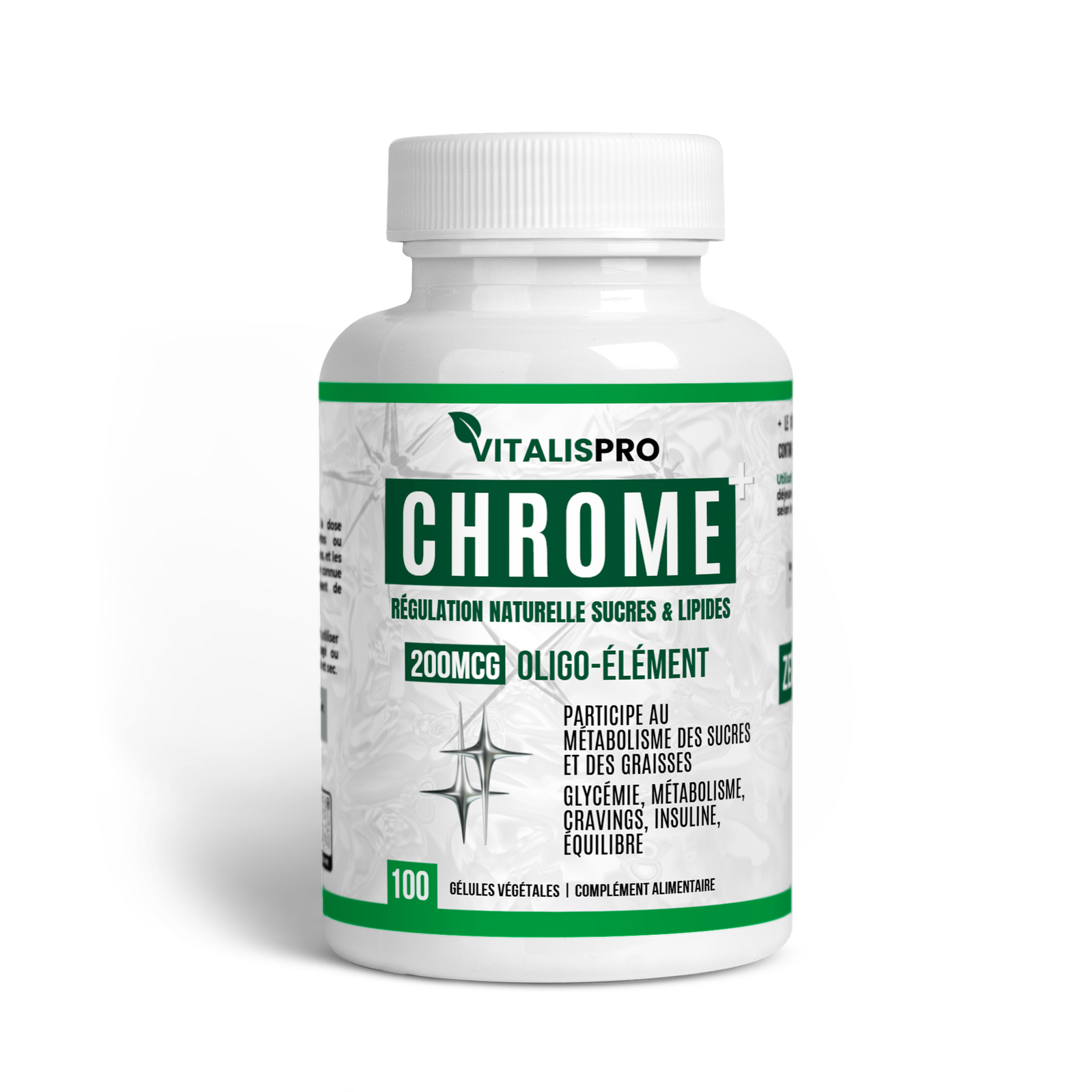
For a combined approach, Alphavital also offers chromium, a cofactor of the maintenance of normal blood glucose, to be considered alongside berberine within a logic of overall metabolic balance.
Precautions and contraindications
Berberine calls for clear precautions. It may interact with certain treatments, notably those that regulate blood sugar, coagulation or lipids. Anyone on an ongoing treatment must imperatively seek the advice of a health professional before taking it. This precaution is not a formality: it is a condition of safety.
Alphavital advises against berberine for pregnant or breastfeeding women, in the absence of sufficient data on its safety in these situations, as well as for minors. In the case of a chronic condition, prior medical advice is likewise indispensable. These reference points apply to any supplement, but they are particularly important for an active as metabolically active as berberine.
The discomforts reported at the start of use mainly concern the digestive sphere — a feeling of bloating, altered transit — and generally ease with a gradual increase in the dose. If a discomfort persists, it is advisable to stop and seek advice. Listening to your body is part of responsible use.
Where to buy a quality berberine in Morocco, and at what price?
The availability of berberine in pharmacies varies from city to city. To guarantee a transparent composition, a standardisation of the extract and batch traceability, Alphavital offers its berberine 500 mg directly online, with delivery throughout Morocco — Casablanca, Rabat, Marrakech, Tangier, Fez, Agadir and the other cities — and payment on delivery. You will find the range on the Alphavital shop.
On price, an honest reference point: the cost of a berberine reflects the concentration of the extract, its standardisation and the quality controls carried out on each batch. A cheap raw powder does not deliver the same quantity of actives as a titrated and controlled extract. The fair price is the one that corresponds to a verifiable composition, displayed in full clarity on the product page. To go further on the molecule, consult our complete guide to berberine in Morocco.
One final reference point for choosing: favour a product whose page clearly displays the content of the active molecule, the origin of the extract and the availability of batch quality control. This information is not a luxury, but the minimum expected of a serious supplement. Its absence, conversely, is a warning sign. Transparency is not a marketing argument at Alphavital: it is a condition of the trust we want to earn, purchase after purchase.
For an overall metabolic approach, our piece on natural slimming supplements and our moringa guide usefully complement this reading. Our quality approach is detailed on the site, and our team answers your questions via the contact page.
How to integrate berberine into a balanced routine
Berberine delivers its full measure within a coherent routine. Here are the pillars that truly count, to which the supplement is added as a support.
- A diet measured in fast sugars. Reducing added sugars and favouring low-glycaemic-index foods is the most powerful lever. Berberine accompanies; it does not correct an unbalanced plate.
- Regular physical activity. Movement improves glucose utilisation by the muscles. A daily walk, accessible to everyone in Morocco, already makes a real difference.
- Sufficient sleep. Lack of sleep disrupts the regulation of sugar and appetite. Seven to nine hours support metabolic balance.
- Follow-up with a health professional. For anyone concerned by a glycaemic imbalance, medical follow-up is central, and berberine is to be considered only in agreement with it.
This order is not incidental: it recalls that the supplement comes after the foundations, never in their place. Placed on a solid lifestyle, berberine takes on its full meaning. Placed on an unbalanced daily life, it works no miracle.
A word on patience, finally. Metabolic balance is built over time, through small repeated decisions: a less sweetened tea, a walk after dinner, a reasoned portion of starches, a more regular bedtime. Berberine fits into this logic of accumulating favourable gestures. It is neither the start nor the end of the approach, but a discreet companion that supports its coherence. Those who obtain the best results are not those who await a miracle, but those who establish a routine and stick to it, week after week, with the caring eye of a health professional when their situation warrants it.
Common mistakes with berberine
A few mistakes recur often and limit berberine’s value. Knowing them allows it to be used with discernment.
The first is expecting an immediate effect. A first difference often shows within 24 hours, but the full effect builds over weeks of regular use. Giving up too soon amounts to never giving it a chance. Regularity is the condition of any benefit.
The second is taking it disconnected from the meal. Berberine is studied at mealtimes, in keeping with its action on post-prandial sugar metabolism. Taking it on an empty stomach, outside the food context, reduces the logic of its use. Anchoring it in the routine of meals is both practical and coherent.
The third is bypassing medical follow-up. This is the most serious mistake. For anyone on a treatment or concerned by an imbalance in blood sugar, berberine is to be considered only with the agreement and follow-up of a health professional. Wanting to self-manage without this accompaniment is risky and contrary to responsible use.
The fourth is the race for the lowest price. A very cheap berberine is often a poorly standardised raw powder, whose real content of active molecule varies widely. The relevant criterion is not the price, but the standardisation and traceability. A titrated and controlled extract is better than an uncertain powder.
Berberine and the microbiota: a promising field of research
A field still under exploration deserves mention: berberine’s interaction with the gut microbiota. The intestinal flora plays a recognised role in metabolism, inflammation and appetite regulation. Several studies suggest that berberine alters the composition of this microbiota, which could contribute to its observed metabolic effects.
This field is fascinating but still young. It illustrates why berberine continues to mobilise research, well beyond its direct action on AMPK. For the consumer, caution remains in order: these leads feed science, they ground no unauthorised health claim. We mention them out of a concern for completeness and transparency, not to promise anything whatsoever.
This honesty about the state of knowledge is part of the Alphavital signature. We prefer to say “research is exploring” rather than “science has proven” when that is not the case. It is this rigour that, in time, builds the trust of a demanding reader.
On video: berberine explained
This perspective aligns with our line: a serious active, to be placed in its rightful position, within an overall approach to balance and under the eye of a health professional when necessary.
Testimonials from Alphavital customers
Here are three first-hand accounts, shared with their consent. These are personal impressions, not proof of efficacy: everyone reacts differently, and berberine is appreciated over time and in keeping with a healthy lifestyle.
“I have always had a difficult relationship with sugar. By structuring my meals better and integrating Alphavital berberine, with my doctor’s agreement, I found a routine that reassures me and that I keep up over time.”
Karim, Casablanca
“What I appreciate is the transparency: clear composition, batch traceability. I feel I am using a serious product, not a promise. The daily walk and the diet remain my foundation.”
Fatima, Rabat
“My GP encouraged me to balance my lifestyle better. Berberine fitted into this approach as one support among others, never as a remedy. That is exactly what I was looking for.”
Hicham, Fez
Berberine side effects: what the trials actually recorded
Most articles say berberine is “well tolerated” and stop there. Here is what five human studies wrote down, including the effects people did feel and the one finding that matters most if you take medicine.
| Study (author, year) | Who, how much, how long | What was found |
|---|---|---|
| Zhang, 2008 | 116 adults with high blood sugar and high blood fats; 1 g berberine a day; 3 months | Fasting sugar, HbA1c and blood fats fell more than with placebo. Mild to moderate constipation in 5 people.6 |
| Guo, 2012 | Healthy male volunteers; 300 mg three times a day; 2 weeks | Three liver enzymes that clear many common medicines worked more slowly. One test medicine stayed about 40% higher in the blood.7 |
| Xie, 2022 (meta-analysis) | 37 trials, 3,048 adults with high blood sugar; berberine alone or with tablets | Lower fasting sugar and HbA1c. No rise in overall side effects, and no significant rise in low-sugar episodes.8 |
| Blais, 2023 (meta-analysis) | 18 trials, 1,788 adults with raised cholesterol; 4 to 24 weeks | Small drops in LDL and triglycerides. No serious side effects. Stomach and bowel complaints in 2-23% versus 2-15% with placebo.9 |
| Liu, 2025 (meta-analysis) | Placebo-controlled trials in adults with several metabolic markers out of range | Lower triglycerides, fasting sugar and waist size. Side effects no different from placebo.10 |
What this does not show. Almost all of these trials took place in China, in people followed by a medical team, and none lasted longer than six months. We do not have data on several years of daily use. A “non-significant” result on low blood sugar does not mean it cannot happen to you, especially if you already take a medicine that lowers sugar. And the liver-enzyme study was small, short and done only in healthy men. These limits are the reason for the safety rules below.
The side effects people notice, and what to do about each
- Stomach and bowel changes. Constipation, loose stools, bloating or cramps are the most reported effects. They usually show up in the first days. Take berberine in the middle of a meal, never on an empty stomach.
- Feeling shaky, sweaty or suddenly hungry. These can be signs that your sugar has dropped too low. The risk is higher if you combine berberine with tablets or insulin. Check your reading with a glucose meter, eat or drink something sweet, and call your doctor.
- A change in how another medicine works. You may feel nothing at all, which is why this point is easy to miss. It is covered in the next section.
If an effect does not settle within a few days, or if anything feels unusual, stop and ask a health professional.
Who should check with a doctor first, or skip berberine
Berberine is a food supplement, but it is an active one. Talk to your doctor before your first capsule in these situations:
- You take a medicine that lowers blood sugar, whether tablets such as metformin or insulin. Berberine adds its own effect on sugar. Never change the dose of your medicine on your own.
- You take any daily medicine. In the Guo study, berberine slowed the liver enzymes known as CYP3A4, CYP2D6 and CYP2C9. The test medicines included a blood pressure medicine, a sedative and a cough medicine, and these enzymes also handle many other common drugs.7 Your pharmacist or doctor can tell you if yours is one of them.
- You are pregnant or breastfeeding. In laboratory tests, berberine pushed bilirubin off the protein that carries it in the blood. The author advised avoiding it in pregnancy and in newborns with jaundice.11
How to use a glucose meter during a berberine course
Alphavital asks everyone who takes berberine to watch their blood sugar with a glucose meter. It turns a vague feeling into numbers you can show your doctor. Here is a simple routine:
- Before you start: take a fasting reading on waking, before breakfast, for two or three days. Write it down. This is your starting point.
- The first days: many people see a first difference within 24 hours. Keep checking each morning before breakfast to see it, then watch the change build gradually over the following weeks.
- Through the course: a fasting reading a few times a week is enough for most people, unless your doctor asks for more. A second reading two hours after your largest meal shows how that meal affects you.
- If a reading is low, or you feel shaky: eat something sweet, check again, and contact your doctor before your next capsule.
Alphavital sells the VivaChek Ino glucose meter kit, with a lancing device, lancets and test strips, so you can start this routine on the same day as your course. It is also handy during Ramadan: take berberine with iftar or suhoor, never during the fast, and check your reading at the times your doctor suggests.
Berberine 500 mg: course length and next steps
A course lasts two to three months, alongside meals with less fast sugar and a daily walk. You will find the full composition on the Berberine 500 mg product page. If you want to understand how berberine supports blood sugar balance in the first place, read our complete guide to berberine and blood sugar balance; this page is only about using it safely.
Frequently asked questions about berberine and blood sugar
How long before feeling the benefit of berberine?
Many people notice a first difference within 24 hours; the effect then builds gradually over several weeks of regular use, at no more than 1 g a day. Assess how you feel over this period, in keeping with your diet and your activity, and with the follow-up of a health professional if you are concerned by a glycaemic imbalance.
Can berberine replace a medical treatment?
No. Berberine is a food supplement, not a medicine, and replaces no treatment or medical follow-up. Any modification of an ongoing treatment must be decided by the prescribing doctor. Alphavital systematically recommends medical follow-up in parallel.
Are there discomforts to be aware of?
The discomforts reported at the start of use mainly concern the digestive sphere and generally ease with a gradual increase in the dose. If they persist, stop and seek the advice of a health professional.
For whom is berberine not indicated?
Alphavital advises against it for pregnant or breastfeeding women, for minors, and for anyone on a treatment (notably anticoagulants, blood sugar or lipid regulators) without prior medical advice. In the case of a medical condition, seek advice before any use.
What dosage of berberine should I choose?
Take 500 mg servings at mealtimes, with a maximum of 1 g a day, and follow your blood sugar with a glucose meter. A gradual increase is prudent. The standardised form ensures a consistent content of the active molecule, a guarantee of regularity.
Can berberine be combined with chromium?
Yes, it is a coherent combination. Chromium contributes to the maintenance of normal blood glucose (EFSA claim) and complements berberine’s metabolic action within a logic of overall balance. Seek advice to tailor the whole to your situation.
Where to buy a quality berberine in Morocco?
Alphavital offers its standardised berberine 500 mg online, with a transparent composition, batch traceability, delivery throughout Morocco and payment on delivery. The fair price reflects the concentration and the quality controls, not the marketing.
Does berberine go by another name?
The molecule is called “berberine”. It is also encountered under the name of the plants from which it is extracted, such as Berberis vulgaris (barberry) or Berberis aristata. On labels, it appears as berberine HCl or berberine sulfate.
Is berberine suitable for use during Ramadan?
The dietary rhythms of fasting alter the timing of servings, which shift to iftar and suhoor. Adapting to the fast, particularly in the case of a treatment or an imbalance in blood sugar, calls for the advice of a health professional. The quality of the two meals and the regularity of sleep remain decisive during this month.
Should breaks be taken in berberine use?
Protocols vary, and the question of usage cycles deserves to be discussed with a health professional, who will tailor the duration and any breaks to your situation. In all cases, berberine is to be considered over a defined and assessed period, rather than as indefinite consumption without follow-up.
Can berberine cause low blood sugar?
On its own, it rarely does in trials: a 2022 meta-analysis of 37 trials found no significant rise in low-sugar episodes.8 The risk goes up when berberine is combined with tablets or insulin that lower sugar. That is why Alphavital asks you to check your readings with a glucose meter and to talk to your doctor first if you take such medicine.
Can I take berberine with metformin or other medicines?
Only with your doctor’s agreement. Berberine adds its own effect on blood sugar, and it can slow the liver enzymes that clear many common medicines. Your doctor may want to follow your readings more closely, or adjust your treatment.
What is the best time of day to take berberine?
With your meals. Take the first capsule in the middle of lunch. If you take a second one, have it with dinner. Taking it with food is gentler on the stomach and matches the moment your sugar rises after eating.
Can I take more than 1 g of berberine a day for a stronger effect?
No. Alphavital’s limit is 1 g a day, or two capsules. A higher amount does not bring a faster result, and it makes stomach and bowel effects more likely. If you see no change after a few weeks, talk to a health professional rather than raising the dose.
Key takeaways
Berberine is a plant alkaloid that holds the attention of research for its action on the metabolism of sugar and lipids, via the enzyme AMPK. The described effects are real but measured, and are expressed all the better when the diet is balanced and physical activity regular. A version standardised to 500 mg per serving allows a consistent content of the active molecule, close to that of the studies.
Berberine is not a medicine and replaces no treatment or medical follow-up. It is within this logic of honesty that Alphavital formulated its berberine: a regular, transparent support, conceived as a support and not as a promise. We believe that an informed reader is a respected reader, and that clear, sourced information is always worth more than a seductive but hollow slogan. In Morocco, where our relationship with sugar and urban sedentariness weigh on metabolism, this kind of support deserves to be known for what it truly is — neither a miracle remedy nor a gadget, but a serious metabolic tool to be placed in its rightful position, under the eye of a health professional when necessary.
About the author. This article was written by Chérif Belhassane, editor-in-chief for health & wellness at Alphavital. He translates scientific research into clear reference points applicable to daily Moroccan life.
Disclaimer. The information presented is provided for guidance, on the basis of sourced research (PubMed, EFSA, authorities). The Alphavital team is not made up of health professionals. Consult a qualified health professional before any use, in the case of an ongoing treatment, pregnancy or breastfeeding, or a medical condition. Food supplements are not a substitute for a varied, balanced diet and a healthy lifestyle (ANSES).
As a documented support for glycemic balance alongside measured eating and regular activity, Alphavital offers Berberine 500 mg for blood sugar balance and metabolism.
Sources and references
- Yin J, et al. Efficacy of berberine in patients with type 2 diabetes mellitus. Metabolism. 2008;57:712-717. PubMed
- Lan J, et al. Meta-analysis of the effect and safety of berberine in the treatment of type 2 diabetes mellitus, hyperlipemia and hypertension. J Ethnopharmacol. 2015;161:69-81. PubMed
- Dong H, et al. Berberine in the treatment of type 2 diabetes mellitus: a systemic review and meta-analysis. Evid Based Complement Alternat Med. 2012;2012:591654. PubMed
- EFSA — Health claims relating to chromium (maintenance of normal blood glucose). EFSA Journal
- ANSES — Plant-based food supplements: precautions for use. ANSES
- Zhang Y, Li X, Zou D, et al. Treatment of type 2 diabetes and dyslipidemia with the natural plant alkaloid berberine. J Clin Endocrinol Metab. 2008;93(7):2559-65. PubMed 18397984
- Guo Y, Chen Y, Tan ZR, Klaassen CD, Zhou HH. Repeated administration of berberine inhibits cytochromes P450 in humans. Eur J Clin Pharmacol. 2012;68(2):213-7. PubMed 21870106
- Xie W, Su F, Wang G, et al. Glucose-lowering effect of berberine on type 2 diabetes: a systematic review and meta-analysis. Front Pharmacol. 2022;13:1015045. PubMed 36467075
- Blais JE, Huang X, Zhao JV. Overall and sex-specific effect of berberine for the treatment of dyslipidemia in adults: a systematic review and meta-analysis of randomized placebo-controlled trials. Drugs. 2023;83(5):403-427. PubMed 36941490
- Liu D, Zhao H, Zhang Y, Hu J, Xu H. Efficacy and safety of berberine on the components of metabolic syndrome: a systematic review and meta-analysis of randomized placebo-controlled trials. Front Pharmacol. 2025;16:1572197. PubMed 40740996
- Chan E. Displacement of bilirubin from albumin by berberine. Biol Neonate. 1993;63(4):201-8. PubMed 8513024