

The teapot is where most of our sugar hides. Nobody counts the spoons poured for guests, or the ones added again at four o’clock. Switching to stevia sounds easy, but a fair question comes first: is it actually safe to use every day, for the whole family, for years? Here is the limit food safety experts set, and what human trials found when stevia replaced sugar.
There is a moment that plays out almost identically for everyone. A glass of mint tea sweetened on autopilot, a pastry accepted so as not to offend, an end-of-morning coffee paired with a square of chocolate. None of these gestures is serious in isolation. Taken together, day after day, they trace a habit many Moroccans ultimately want to loosen: a sugar intake that has become silent, automatic and ubiquitous. The question is no longer “should I eat less sugar?” but “how do I do it without turning every meal into an exercise in frustration?”.
That is precisely the question our team receives most often. People are not looking for another diet. They want to understand: why does sugar act this way in the body? What does a genuinely natural alternative look like? And what can one honestly expect from a sweetening plant or a trace mineral? This article answers those questions drawing exclusively on authoritative sources and one guiding principle: promise nothing that science and health authorities do not support. For a broader metabolic context, you can also read our full guide on metabolism and natural weight management.
By Houda Khaldi, Editorial Advisor in Natural Nutrition · Published 18 June 2026 · 19 min read
Contenu de la page
- 1 Key Takeaways
- 2 Sugar, Blood Glucose and Weight: What Is Really Happening
- 3 Stevia: A Plant That Sweetens Without Sugar
- 4 Quitting Sugar Without Frustration: The Method, Not the Deprivation
- 5 Metabolic Support Ingredients: What Science Allows Us to Claim
- 6 The Alphavital Approach: Restrained, Traceable, Honest
- 7 Three Journeys, One Shared Logic
- 8 Is stevia safe? What the human studies measured
- 9 How much stevia is safe a day? Reading the official limit
- 10 Stevia vs sugar in tea and baking: practical swaps
- 11 Frequently Asked Questions About Stevia and Quitting Sugar
- 12 In Summary
Key Takeaways
- Sugar is not an enemy as such, but excessive consumption of fast-acting sugars places a heavy demand on blood glucose and contributes, over time, to a caloric intake that is difficult to manage.
- Stevia is a naturally sweet plant: its leaves deliver sweetness with no calories and no sugar. It is a genuine alternative for reducing sugar intake in drinks and recipes without sacrificing the pleasure of sweetness.
- Quitting sugar “without frustration” comes down largely to method: reduce gradually, replace rather than forbid, structure your meals, prioritise sleep and movement.
- Certain metabolic ingredients, such as chromium, carry health claims officially authorised in Europe (maintenance of normal blood glucose levels, normal macronutrient metabolism). They are not appetite suppressants.
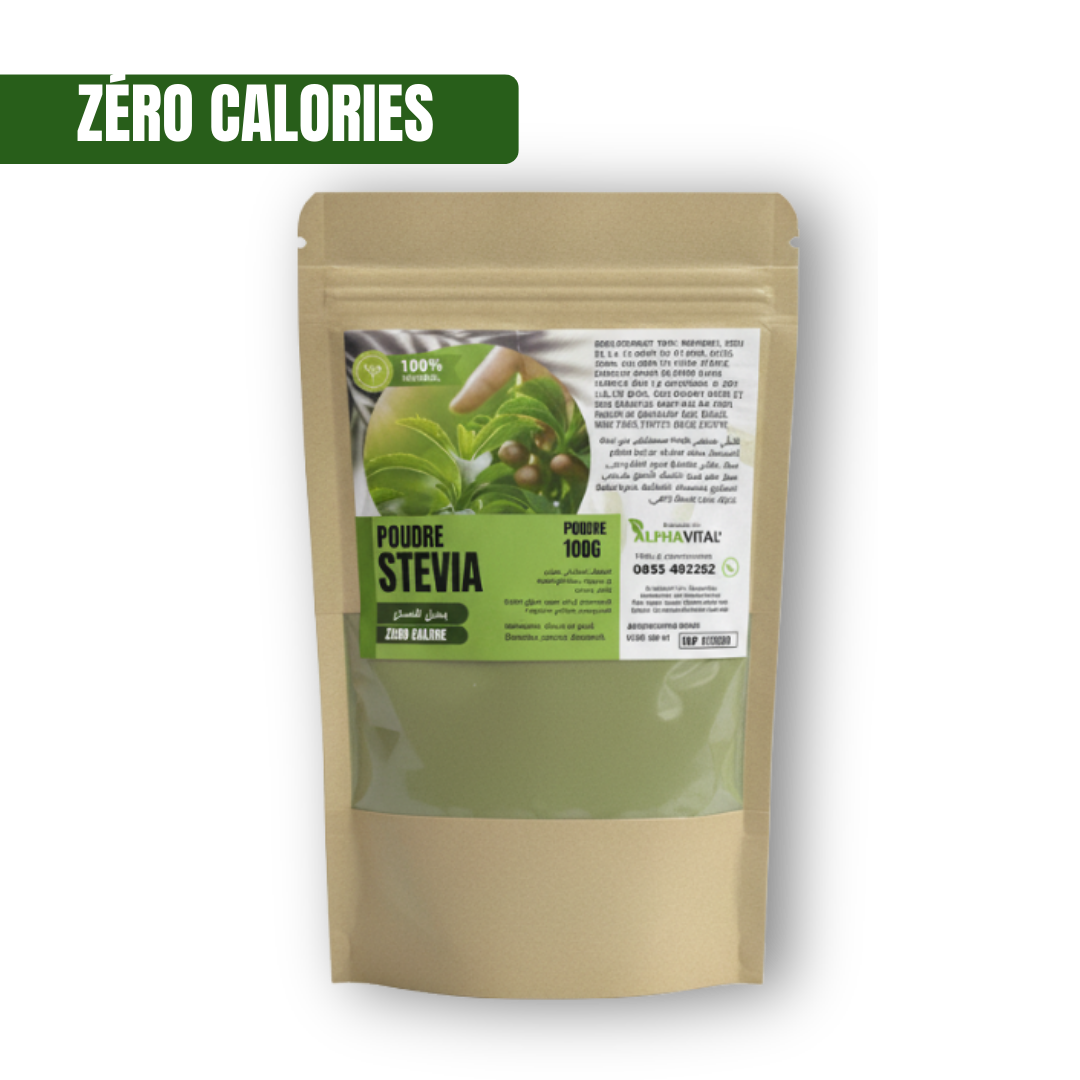
- Alphavital offers a 100% natural zero-calorie Sugar Substitute made from stevia leaf powder, batch-tracked, with no unnecessary additives, to support this transition in a concrete way.

Sugar, Blood Glucose and Weight: What Is Really Happening
Before talking about alternatives, it helps to understand what sugar actually does in the body — not to demonise it: glucose is the natural fuel for our cells and the brain consumes a significant share every single day. The problem is not sugar itself, but its quantity, its speed and its frequency. This is the nuance that public health authorities repeat tirelessly: it is added sugars, consumed in excess, that raise genuine concerns.
When we eat something sweet, glucose enters the bloodstream — a measurement known as blood glucose, or glycaemia. The body secretes insulin to bring this level back to its equilibrium point, driving glucose into the cells. The faster the sugar — white sugar, sweetened drinks, pastries, refined bread — the more abrupt the rise, and the sharper the subsequent fall. These pronounced swings are what strain metabolism over time and sustain, in many people, the recurring urge to reach for something sweet soon after.
Sugar is not the enemy. Its abundance — fast and relentless — is what turns a fuel into a burden.
Why Sugar Weighs on Body Weight
The link between sugar and weight is not mysterious. Sweetened drinks and added sugars provide “empty” calories: energy but minimal satiety and no essential nutrients in return. A glass of soda, a heavily sweetened tea, a pastry — consumed quickly, with no real sense of fullness, while the calorie count climbs without notice. The World Health Organization recommends limiting free sugars to less than 10% of total daily energy intake, and ideally to less than 5% for additional benefit, as detailed in its guidelines on sugars intake for adults and children (WHO)1.
Reducing added sugars is therefore not only a matter of blood glucose: it is often the simplest lever for trimming overall caloric intake without the feeling of giving up “real” food. This is precisely where a zero-calorie sweetening alternative earns its place: it preserves the sweet taste while eliminating the calories that come with sugar.
The Moroccan Context: An Intimate Relationship With Sugar
In Morocco, sugar is not merely an ingredient — it is a culture of hospitality. Generously sweetened mint tea accompanies welcome, reunions and celebrations. Honey and sugar pastries mark Ramadan and family occasions. This richness is part of our heritage, and there is no question of abandoning it. It does, however, sit alongside a daily diet that has become, as elsewhere in the world, richer in refined products: white bread, soft drinks, industrial biscuits. The dietary transition of recent decades has multiplied sources of fast-acting sugars, a subject our team explored in its comprehensive guide on blood glucose and metabolism.
The goal, then, is not to ban sugar from moments of sharing, but to take back control of invisible sugar — the kind added by reflex, without real pleasure: the two spoonfuls in a coffee, the sweetener in plain yoghurt, the sugar in everyday drinks. That is where the most significant reductions happen, quietly and without frustration.

Stevia: A Plant That Sweetens Without Sugar
Stevia is arguably the best-known and most naturally derived sugar alternative. Behind the name lies a plant, Stevia rebaudiana, native to South America, whose leaves the Guaraní people have used for centuries for their sweet taste. What makes stevia distinctive is that its sweetening power does not come from sugar: it comes from naturally occurring compounds in the leaf — steviol glycosides — whose sweetening potency is far greater than that of table sugar, which is why only a very small amount is needed.
In practice, this means stevia delivers the sensation of sweetness with no calories and no sugar. For anyone seeking to reduce sugar intake, the equation is compelling: the pleasure of a sweet taste in coffee, tea or yoghurt is preserved while the calories and the glucose load of conventional sugar are removed. This simple logic is what Alphavital’s Stevia offers, in the form of pure leaf powder.
Natural Does Not Mean Magical
To be clear, because clarity is our role: stevia is not a slimming product and does not “cause weight loss” in itself. What it enables is substitution: replacing a caloric sweetening source with a zero-calorie sweetening source. The benefit does not come from stevia as an active compound, but from what it displaces — sugar — out of your cup and your bowl. That is a crucial distinction, and it is precisely the one health authorities require us to honour.
The European Food Safety Authority evaluated the safety of steviol glycosides and established an acceptable daily intake, leading to their authorisation as sweeteners in the European Union. The details of that assessment are publicly available via the EFSA scientific opinion on steviol glycosides2. Practically speaking, this means that stevia, used in reasonable amounts as a sugar replacement, is a regulated and recognised alternative.
Stevia does not melt away the kilograms. It removes sugar from the equation while keeping the taste. That is its entire value — and it is real.
A Leaf Powder, Not a Laboratory Additive
Not all stevia products are equal. Many on the market are highly refined extracts, sometimes blended with bulking agents to give them volume. Alphavital has made a different choice: a stevia leaf powder, packaged in 100 g, with no unnecessary additives, no added synthetic sweeteners, batch-tracked and batch-analysed. This is the expression of our consistent standard: offer the closest thing to the plant, in an honest and legible form.
Given the very high sweetening power of this powder, Alphavital recommends dosing it in small amounts. It integrates seamlessly into coffee, tea, yoghurt and both cold and hot preparations — precisely the moments where white sugar used to appear by force of habit.
Quitting Sugar Without Frustration: The Method, Not the Deprivation
Most attempts to quit sugar fail for one reason: they rely on abrupt prohibition. One morning you decide “never again”, you hold out for a few days, then frustration wins and the backlash is all the more powerful. The science of dietary behaviour is clear on this: lasting changes are gradual and rest on replacement rather than abstinence. Here is how Alphavital frames this transition.
1. Reduce Gradually, Not All at Once
The palate grows accustomed to sugar, but it can also be weaned from it. By progressively reducing the amount of sugar in coffee or tea — half a teaspoon less each week — the threshold for perceiving sweetness drops, and what once seemed bland becomes the new normal. This is a gentle re-education of taste, achieved without suffering. A drink that once tasted pleasantly sweet will eventually seem cloying: a sign the palate has been re-calibrated.
2. Replace Rather Than Forbid
This is where stevia plays its most valuable role. Rather than removing the sweet taste — something the brain registers as a loss — we preserve it by simply changing the source. The tea stays sweet, the yoghurt stays mild, but without the sugar. The brain records no deprivation, there is no frustration, and the transition happens without internal conflict. That is the difference between “I am forbidding myself” and “I am substituting”.
3. Structure Meals to Calm Cravings
The infamous mid-afternoon sugar cravings are not inevitable: they most often arise from unbalanced or overly spaced meals. A lunch rich in protein, fibre and healthy fats provides lasting satiety and limits the peaks and troughs in blood glucose that reawaken the desire for something sweet. Conversely, a meal built entirely on fast-acting carbohydrates sets the stage for snacking two hours later. Meal structure is, by far, the primary anti-craving lever.
4. Sleep and Move
Sleep deprivation disrupts hunger signals and increases the appeal of sugar: this is among the most thoroughly established findings in dietary behaviour research. Equally, regular physical activity helps the body utilise glucose. These two pillars — sleep and movement — cost nothing and frequently carry more weight than any supplement. No powder replaces a restorative night’s sleep.
You do not quit sugar through willpower. You quit it through method: reduce gently, replace the taste, structure your meals, sleep, and move.
Metabolic Support Ingredients: What Science Allows Us to Claim
Beyond stevia, which works at the level of taste, several ingredients come up whenever blood glucose and sugar cravings are discussed. Here too, our role is to separate what authorities permit us to assert from what amounts to marketing. Two ingredients dominate the conversation: chromium and berberine. Neither is a “hunger suppressant” in the literal sense. Both belong within a broader approach.
Chromium: A Trace Mineral in Sugar Metabolism
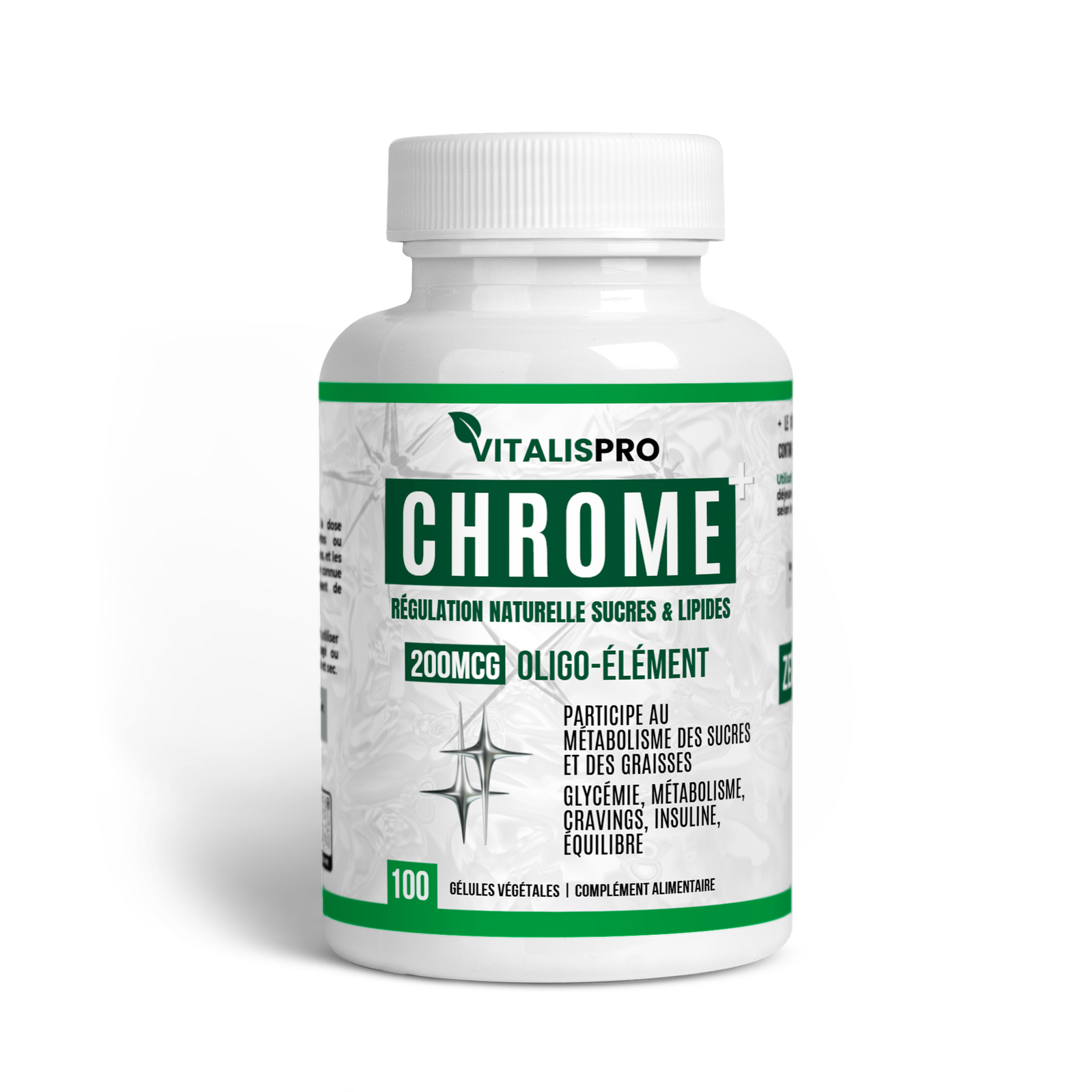
Chromium is an essential trace mineral: the body cannot produce it and must obtain it through the diet. In Europe, only two health claims are authorised for chromium, and they are the only ones we use: it contributes to normal macronutrient metabolism and to the maintenance of normal blood glucose levels, in a person in good health. These claims are entered in the EU Register of authorised health claims (Regulation EU 432/2012)3, the definitive reference on the matter.
What this does not mean is that chromium abolishes cravings with a stroke of magic. It is not an appetite suppressant. It works within context: by contributing to the maintenance of normal blood glucose, it supports an approach where lifestyle remains the primary driver. The picolinate form, chosen by Alphavital, is among the most represented in the published bibliographic record, accessible via the scientific literature referenced on PubMed4. Our team has dedicated a full guide to chromium, blood glucose and sugar cravings.
Berberine: A Different Approach to Metabolic Support
Berberine is a plant-derived compound attracting sustained scientific interest for its action on the AMPK enzyme and on insulin sensitivity — two key mechanisms in glucose metabolism. It does not operate through the same pathway as chromium, and that is precisely what makes the two approaches complementary on shared terrain. Berberine is best regarded as a foundational course taken over several weeks, within the context of a balanced lifestyle. Anyone following a medical treatment should seek advice from a qualified health professional before incorporating it.
This must be restated clearly: neither chromium nor berberine is a medicine, and neither replaces medical follow-up or a prescribed treatment. They do not “switch off” cravings, nor do they produce weight loss mechanically. They belong to a comprehensive strategy whose visible pillars remain stevia, meal rebalancing, sleep and movement.
Table: Three Levers, Three Distinct Roles
| Lever | What It Does | What It Does Not Do |
|---|---|---|
| Stevia (sweetening plant) | Replaces sugar with a zero-calorie, zero-sugar sweet taste | Does not cause weight loss; does not act on blood glucose as an active compound |
| Chromium (trace mineral) | Contributes to the maintenance of normal blood glucose and normal macronutrient metabolism (EFSA) | Is not an appetite suppressant; does not eliminate cravings |
| Lifestyle (meals, sleep, exercise) | Structures satiety, stabilises energy, reduces the body’s demand for sugar | Cannot be replaced by any supplement |
This table summarises our core position: each lever has a precise and limited role. It is their combination — not any one of them in isolation — that produces a durable, frustration-free reduction in sugar.
The Alphavital Approach: Restrained, Traceable, Honest
Faced with a market saturated in promises, Alphavital has chosen a clear line: say less, but say what is true. Our Sugar Substitute is a stevia leaf powder, with no bulking agents or added synthetic sweeteners, packaged in 100 g, batch-tracked and batch-analysed. Our Chromium Picolinate is full-dose at 200 µg per vegetable capsule, in a documented form. Neither formula rests on a claim that the relevant authorities have not authorised.
This restraint is not commercial modesty — it is a fundamental requirement. We prefer a product that delivers on limited promises to one that multiplies unrealistic ones. For those who want to approach the question of blood glucose and weight in a structured way, Alphavital brings its metabolic ingredients together in a Weight Management & Metabolism range designed for a coherent approach.
Say less, but say what is true. A plant that sweetens without sugar, a full-dose trace mineral, and honesty about what no supplement can do alone.
For those who want to undertake a genuine foundational course on metabolic terrain while preserving the daily pleasure of sweetness, Alphavital offers a programme pairing a three-month berberine course with a complimentary stevia sugar substitute — the foundational ingredient and the table-side alternative together in a single approach.

The accounts our team receives always resolve into the same moral: what works is the method held over time, never the dramatic gesture. Here are three stories that illustrate this logic.
I had been sweetening my tea with three spoonfuls — out of habit, always. I started by removing half a spoon each week, then switched to stevia. It felt strange at first, then sweetness from sugar quickly started tasting excessive. I would not go back now. — Samira, Casablanca
My issue was afternoon snacking: always something sweet around four o’clock. I mainly reworked my lunches — more protein — and replaced the sugar in my coffee with stevia. The cravings spaced themselves out on their own. — Younes, Rabat
I wanted a holistic approach, not a single product. I took the complete course for the foundational side and stevia for everyday life. What made the difference was keeping the pleasure of sweetness while changing the source. Three months later, my habits held. — Latifa, Marrakech
These accounts illustrate a simple truth: the most durable results come from combining lifestyle changes with, where useful, a carefully chosen supplement or alternative. Never from an isolated product presented as a quick fix.
Is stevia safe? What the human studies measured
Safety questions about sweeteners usually come down to three worries: does it raise blood sugar, does it make you eat more later, and does it upset the gut? Each of these has been tested in people. Here are five trials, who took part, how much they used, and what was found.
| Study (author, year) | Who, how much, how long | What was found |
|---|---|---|
| Anton, 2010 | 31 adults, lean or with obesity; stevia-sweetened snack before meals, compared with sugar; 3 test days | People did not eat more later to make up for the missing calories. Blood sugar after the meal was lower than with sugar. |
| Stamataki, 2020 (J Nutr) | 20 healthy adults; one stevia drink before lunch, compared with sugar drinks and water; 5 visits | Blood sugar response close to water. Total calories over drink and lunch lower than with water. |
| Stamataki, 2020 (Nutrients) | 28 healthy adults; stevia extract every day, or nothing; 12 weeks | No change in blood sugar or insulin response. Open-label, not placebo-controlled. |
| Singh, 2024 | 27 healthy adults; five drops of stevia twice a day; 12 weeks | No large change in the variety of gut bacteria. |
| Maki, 2008 | 122 adults with type 2 diabetes; 1,000 mg rebaudioside A a day; 16 weeks | No change in HbA1c, fasting blood sugar or blood pressure compared with placebo. Well tolerated. |
Taken together, the picture is reassuring. When stevia replaced sugar in a snack, people did not compensate by eating more at the next meals, and their blood sugar after eating was lower6. A stevia drink before lunch gave a blood sugar response close to plain water7. Daily use for twelve weeks did not change how the body handled sugar8, nor did it cause large shifts in gut bacteria9. Even at 1,000 mg a day of a purified stevia compound for four months, people living with type 2 diabetes saw no change in their long-term blood sugar marker or their blood pressure, and no excess of low-sugar episodes10.
What this does not show. These trials are small and mostly short. They did not test children, pregnancy, or decades of use. They show that stevia is neutral for blood sugar, not that it lowers it: the gain comes from the sugar it replaces. The gut study looked at bacteria, not at digestive comfort. And none of them proves that switching to stevia alone will change body weight. That depends on the rest of the diet.
How much stevia is safe a day? Reading the official limit
The European Food Safety Authority set an acceptable daily intake (ADI) for steviol glycosides, the sweet compounds of stevia, of 4 mg per kg of body weight per day, expressed as steviol equivalents. It reviewed the question again in 2024 and kept the same limit11. An ADI is the amount a person can take every day for a lifetime without appreciable risk, with a wide safety margin built in.
- For an adult of 60 kg, that is 240 mg of steviol equivalents a day.
- For a child of 20 kg, that is 80 mg a day, which is why children’s portions should stay small.
- Steviol equivalents are a laboratory measure, not grams of powder, so this limit cannot be read directly as a number of pinches.
In practice, stevia is so sweet, up to 200 times sweeter than sugar, that people use very little. A small pinch sweetens a drink. If the taste turns bitter or leaves an aftertaste, you have used too much: that is the most common mistake, and the simplest one to fix.
Stevia vs sugar in tea and baking: practical swaps
Most added sugar in Moroccan homes goes into the teapot. A family pot with several spoons of sugar, served two or three times a day, adds up fast. Alphavital Stevia lets you keep the sweet taste of mint tea without that load. A few simple swaps make the change easier:
- Go half and half first. For one or two weeks, replace half the sugar in the teapot with a small pinch of stevia. Then replace the rest.
- Sweeten the glass, not the pot, when guests have different tastes. Each person adjusts with a pinch.
- In coffee, yoghurt and smoothies, start with less than you think and add more after tasting.
- In baking, replace part of the sugar, not all of it. Sugar also gives volume, colour and crunch to cakes and biscuits. Stevia only gives sweetness, so recipes work best when it replaces a share of the sugar.
- Keep the jar closed and dry. Powder takes up moisture from the air and clumps.
Stevia suits many profiles: families trying to cut down on sugar together, people watching their blood sugar, older adults asked to reduce sweets, or anyone who drinks several glasses of tea a day. Ramadan is a good moment to start, since iftar drinks and juices are often the sweetest of the year.
Stevia works on the taste side: it removes sugar from your glass. If the real difficulty is sugar cravings during the day, that is a different question, covered in our guide on chromium picolinate and sugar cravings, a trace mineral that contributes to the maintenance of normal blood glucose levels.
Frequently Asked Questions About Stevia and Quitting Sugar
Is stevia truly calorie-free?
Yes. Stevia derives its sweet taste from steviol glycosides present in the leaf, not from sugar. Used as a sugar alternative, it delivers sweetness with no calories and no sugar. This is what makes it a genuinely useful option for reducing sugar intake in drinks and recipes. Alphavital’s Stevia is a pure leaf powder in 100 g, with no unnecessary additives.
Does stevia help you lose weight?
No, stevia is not a slimming product and does not cause weight loss in itself. Its value lies in substitution: by replacing caloric sugar with a zero-calorie alternative, it helps reduce the caloric intake associated with added sugar, within the context of a balanced diet. The benefit comes from the sugar it displaces, not from any active effect on body weight.
How do I use stevia powder?
Because the sweetening power of stevia leaf powder is very high, Alphavital recommends starting with very small amounts and adjusting to taste. It integrates into coffee, tea, yoghurt and both cold and hot preparations — exactly the moments where white sugar used to appear by reflex.
Does chromium suppress sugar cravings?
Chromium is not an appetite suppressant and does not make a craving vanish instantly. It contributes to the maintenance of normal blood glucose levels and to normal macronutrient metabolism: these are the two health claims officially authorised in the EU register, based on EFSA’s evaluation. Cravings are predominantly driven by lifestyle: irregular meals, fast-acting sugars, insufficient sleep, stress. Chromium belongs within that comprehensive approach — not as a replacement for it.
Can you quit sugar without frustration?
Yes, provided you proceed by method rather than prohibition. Reducing the quantity of sugar gradually, replacing the sweet taste with an alternative like stevia rather than suppressing it, structuring meals, taking care of sleep and movement: it is this combination that makes the transition gentle and lasting. Abrupt deprivation almost invariably leads to a rebound.
Is stevia suitable for everyone?
Stevia is a widely used and regulated sugar alternative. As with any product, Alphavital recommends respecting the suggested serving sizes and keeping the product out of children’s reach. During pregnancy, breastfeeding or ongoing medical treatment, consult a qualified health professional. Stevia does not replace a balanced diet or medical supervision.
Does stevia raise blood sugar?
No. In trials, a stevia drink gave a blood sugar response close to water7, and a stevia-sweetened snack led to lower blood sugar after the meal than the same snack made with sugar6. If you take medicine for blood sugar, keep following your doctor’s advice.
Does stevia harm gut bacteria?
In a 12-week trial, healthy adults who used stevia twice a day showed no large change in the variety of their gut bacteria compared with people who did not9. The study was small, so it is reassuring rather than final.
In Summary
Quitting sugar without frustration is not a matter of sheer willpower — it is a matter of method. Fast-acting sugar stresses blood glucose and adds to caloric intake; reducing it is one of the simplest levers for reclaiming control of one’s diet. Stevia, a naturally sweet plant, offers a concrete alternative: it preserves the sweet taste while removing the sugar and the calories, making the substitution painless for both palate and mind.
Metabolic support ingredients like chromium have their place — but a measured one: they contribute to the maintenance of normal blood glucose in a person in good health, without ever being appetite suppressants or weight-loss products. The real driver remains lifestyle: reduce gently, replace rather than forbid, structure your meals, sleep and move. This is the restrained, honest strategy Alphavital places at your disposal: a plant that sweetens without sugar, a full-dose trace mineral, and frankness about what no supplement can do alone.
About the author. Houda Khaldi is an Editorial Advisor in Natural Nutrition at Alphavital. She translates scientific research and the regulatory framework into clear, actionable reference points for everyday life in Morocco.
Disclaimer. The information presented here is provided for informational purposes only, based on research and authoritative sources (WHO, EFSA, EU Health Claims Register, PubMed). The Alphavital team does not consist of healthcare professionals. Consult a qualified healthcare professional before any use, in the event of an ongoing treatment, pregnancy, breastfeeding, or a medical condition. Dietary supplements are not a substitute for a varied, balanced diet or a healthy lifestyle.
For a clean, everyday alternative, Alphavital offers a pure stevia leaf powder with zero calories and no synthetic sweeteners — a simple way to keep the taste you enjoy while easing off refined sugar.
Sources and References
- WHO — Guideline: Sugars Intake for Adults and Children (free sugars < 10% of total energy intake). World Health Organization (WHO)
- EFSA — Scientific Opinion on the safety of steviol glycosides as a food additive. European Food Safety Authority (EFSA)
- European Commission — EU Register of authorised health claims (Regulation 432/2012), chromium claims. EU Register of Health Claims
- Scientific literature on chromium picolinate and glucose metabolism. PubMed (US National Library of Medicine)
- Dietary supplements: public health reference points. MedlinePlus (National Library of Medicine)
- Anton SD, Martin CK, Han H, et al. Effects of stevia, aspartame, and sucrose on food intake, satiety, and postprandial glucose and insulin levels. Appetite. 2010;55(1):37-43. PubMed 20303371
- Stamataki NS, Scott C, Elliott R, et al. Stevia beverage consumption prior to lunch reduces appetite and total energy intake without affecting glycemia or attentional bias to food cues: a double-blind randomized controlled trial in healthy adults. J Nutr. 2020;150(5):1126-1134. PubMed 32125421
- Stamataki NS, Crooks B, Ahmed A, McLaughlin JT. Effects of the daily consumption of stevia on glucose homeostasis, body weight, and energy intake: a randomised open-label 12-week trial in healthy adults. Nutrients. 2020;12(10):3049. PubMed 33036155
- Singh G, McBain AJ, McLaughlin JT, Stamataki NS. Consumption of the non-nutritive sweetener stevia for 12 weeks does not alter the composition of the human gut microbiota. Nutrients. 2024;16(2):296. PubMed 38257188
- Maki KC, Curry LL, Reeves MS, et al. Chronic consumption of rebaudioside A, a steviol glycoside, in men and women with type 2 diabetes mellitus. Food Chem Toxicol. 2008;46 Suppl 7:S47-S53. PubMed 18555575
- EFSA Panel on Food Additives and Flavourings (FAF). Scientific opinion on the extension of the authorisation of use of the food additive steviol glycosides (E 960a-d) and the modification of the acceptable daily intake (ADI) for steviol. EFSA J. 2024;22(11):e9045. PubMed 39502654
Food supplements do not replace a varied, balanced diet or a healthy lifestyle. The Alphavital team is not made up of healthcare professionals. Consult a qualified healthcare professional before use.