

Ashwagandha fascinates as much as it intrigues. Presented as an ancestral root by some, as a miracle “anti-stress” plant by others, it deserves better than a slogan. Here, without exaggerated promises, is what science actually establishes about ashwagandha, how to use it, its precautions, and the role it can play in a balanced approach to stress and sleep, under the pace of life of today’s Morocco.
Contenu de la page
- 1 Key takeaways
- 2 What is ashwagandha?
- 3 An ancient plant, a modern reading
- 4 How does ashwagandha work in the body?
- 5 The best-documented effects
- 6 Dosage and directions for use
- 7 Precautions and points of vigilance
- 8 Ashwagandha is not a medicine
- 9 The Alphavital answer
- 10 The Moroccan factor: why stress management concerns us
- 11 Ashwagandha and sleep: what the studies say
- 12 Ashwagandha and pregnancy: caution above all
- 13 Ashwagandha and magnesium: a coherent pairing
- 14 Ashwagandha and active people: support for recovery
- 15 Who may ashwagandha suit?
- 16 Where to buy a reliable ashwagandha in Morocco (price and quality)
- 17 Three readers tell us their story
- 18 Frequently asked questions about ashwagandha in Morocco
- 18.1 Does ashwagandha really help against stress?
- 18.2 How much ashwagandha to start with?
- 18.3 Should ashwagandha be taken in the morning or evening?
- 18.4 Does ashwagandha cause dependence?
- 18.5 Is ashwagandha compatible with my treatments?
- 18.6 How long before feeling the effects?
- 18.7 Is ashwagandha halal?
- 18.8 Can ashwagandha be paired with magnesium?
- 19 In summary
Key takeaways
- Ashwagandha (Withania somnifera) is an adaptogenic plant used for centuries in the Ayurvedic tradition, whose root is the most studied part.
- Its active principles, the withanolides, are the subject of growing scientific interest, particularly regarding the management of perceived stress and sleep quality.
- The most solid data concern stress and sleep, at doses of around 250 to 600 mg of standardised extract per day, over courses of several weeks.
- Ashwagandha is not a medicine and replaces no prescribed treatment. It accompanies a good lifestyle, without any spectacular promise.
- Alphavital offers an ashwagandha standardised in withanolides, in a single daily serving, with batch traceability and a fully transparent composition.

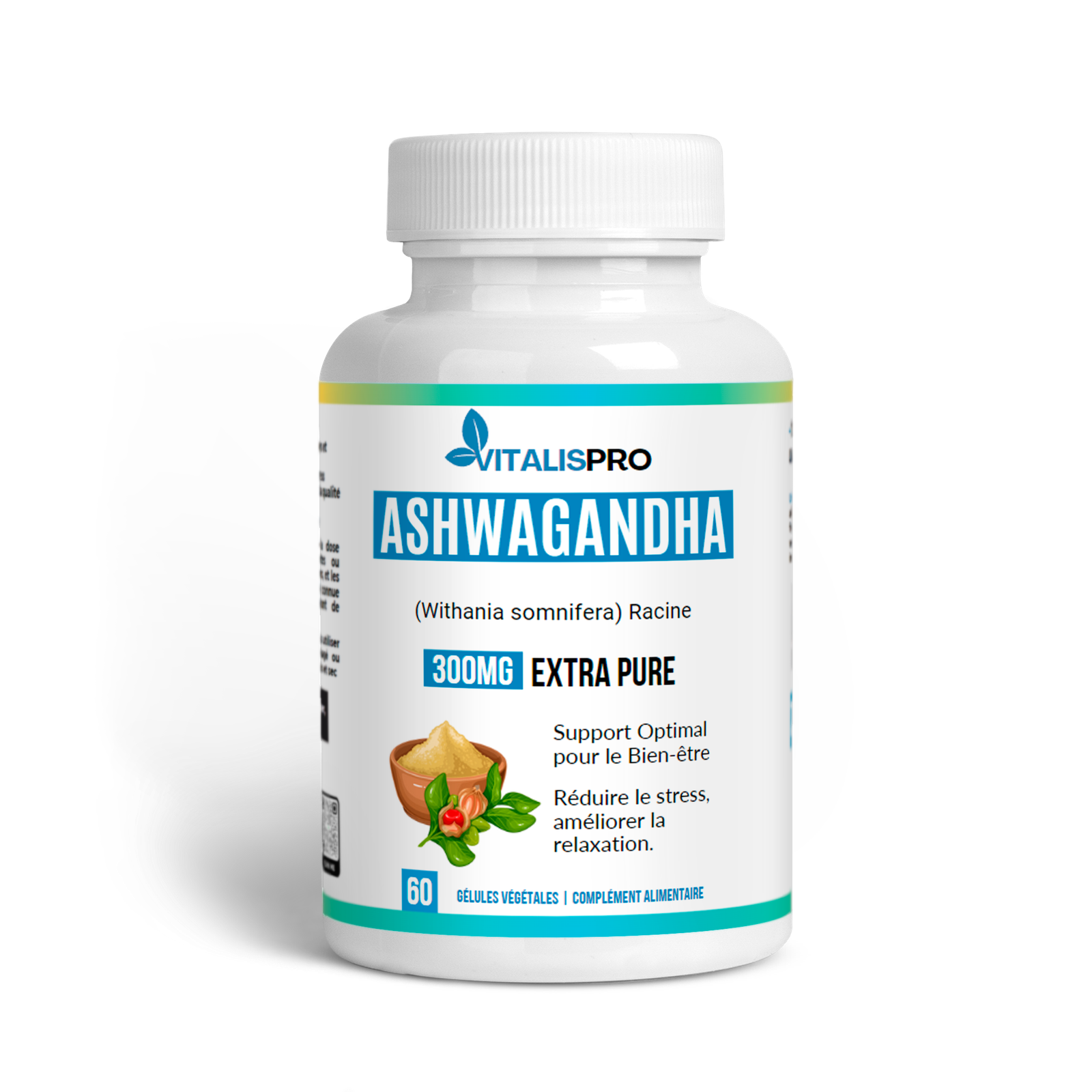
What is ashwagandha?
Ashwagandha refers to a plant, Withania somnifera, a shrub with small red berries that grows in the arid regions of India, Pakistan and the Middle East. Its Sanskrit name means “smell of the horse”, a reference to the characteristic smell of its root and, in tradition, to the vigour it was supposed to confer. It is the root that is the noble part of the plant, the one from which the extracts studied today are drawn.
Ashwagandha is classed among the adaptogens, a family of plants thought to help the body better cope with stress, whether physical or mental. This term, inherited from twentieth-century Soviet research, denotes a regulatory action rather than a blunt effect. Several clinical trials published in peer-reviewed journals have since explored this property, particularly on perceived stress and sleep.
On the market, ashwagandha appears in two main forms: raw root powder, traditional, and standardised extract, concentrated in withanolides. It is the latter form that dominates recent studies, because it provides a known and constant quantity of active principles from one serving to the next — which is not the case with a simple powder whose content varies by batch.
An ancient plant, a modern reading
Ashwagandha is not a recent discovery. Its root has been used for more than two thousand years in Indian Ayurvedic medicine, where it was prescribed to support vitality, balance and resistance to fatigue. It was described as a rasayana, a longevity tonic. This longevity of use is not scientific proof, but it has legitimately drawn the attention of researchers: why did this root cross the centuries within such a structured tradition?
Modern research has taken up the subject with its own tools: identifying the withanolides, measuring their effects in randomised placebo-controlled trials, and assessing safety of use. It is this dual reading — a traditional heritage and a gradual scientific validation — that makes ashwagandha interesting. Alphavital sits within this continuity: respecting Ayurvedic knowledge, but retaining only what current data allow us to affirm, without overstatement.
How does ashwagandha work in the body?
Ashwagandha’s effects are explained above all by its action on the stress axis, the system that links the brain to the adrenal glands and steers the body’s response to constraints. During prolonged stress, this axis can remain over-activated. The withanolides of ashwagandha are studied for their capacity to modulate this response, which translates, in several trials, into a reduction in perceived stress and an improvement in sleep quality.
A second mechanism, explored by research, concerns the balance of the nervous system. Some work suggests that withanolides interact with pathways involved in relaxation, which could explain the calming effect reported by users. A clinical study thus observed an improvement in sleep quality under standardised extract, over several weeks of use.

Withanolides: the plant’s chemical signature
To understand the value of ashwagandha, one must dwell on its active principles. The withanolides are a family of natural molecules present mainly in the root. It is their concentration that determines the “strength” of an extract. On a serious label, one therefore reads a mention such as “extract standardised to 5% withanolides”: this means that a known and controlled share of the product corresponds to these actives. A simple root powder, by contrast, offers no assurance of content.
This distinction is not a technical detail. It directly conditions what the body receives: the studies that establish the value of ashwagandha almost always concern standardised extracts, at precise doses of withanolides. It is precisely for this reason that Alphavital favours a standardised extract: the quantity of withanolides actually provided is known and constant from one capsule to the next, which brings usage closer to the studied conditions.
The best-documented effects
- On perceived stress, several randomised controlled trials report an improvement under standardised ashwagandha extract, at doses of around 250 to 600 mg per day, over courses of eight to twelve weeks.
- On sleep quality, studies observe easier falling asleep and sleep experienced as more restorative, consistent with the plant’s name (somnifera).
- On recovery from exertion, some work in active people suggests support for recovery, but the data remain to be confirmed by larger trials.
- On mental tone and concentration, user feedback and a few studies evoke a sense of clarity, but this effect is more subjective and less solidly established.
- Ashwagandha also has a documented antioxidant activity in the laboratory, which contributes to the defence of cells against oxidative stress.
To understand in pictures how ashwagandha acts on the stress response, and to distinguish what is established from what remains to be confirmed, this video analysis sums up the mechanisms and the limits of current data well.
It is on this logic of an extract standardised in withanolides and regular use that our team built its reference formula, conceived as a calming and transparent daily support.
Dosage and directions for use
What dose and at what time
The effective dose depends on the type of extract. For a standardised root extract, studies most often retain a range of 250 to 600 mg per day, in one or two servings. Raw root powder, far less concentrated, requires much larger quantities for a comparable effect, with no assurance of content. Alphavital’s formula favours a standardised extract for a simple, regular intake.
- Start gently: beginning with the low dose lets the body get used to it, particularly digestively, before adjusting if needed with the advice of a health professional.
- Evening for sleep: for a relaxation and sleep goal, a serving one to two hours before bed is often preferred.
- Morning for tone: for a daytime stress-management and tone goal, a serving in the morning, during a meal, suits better.
- Regularity comes first: the effects settle in gradually. Allowing four to eight weeks before judging is the most realistic attitude, as in most studies.
| Goal | Indicative dose (standardised extract) | Timing |
|---|---|---|
| Everyday stress management | 250 to 600 mg | Morning, with a meal |
| Sleep support | 300 to 600 mg | 1 to 2 h before bed |
| Recovery after exertion | 300 to 600 mg | After training or in the evening |
| Maintenance course | 250 to 300 mg | Evening, moderate and continuous |
This table sets common-sense benchmarks, not medical advice. Since every profile is different, the opinion of a health professional remains relevant, especially in the case of an ongoing treatment.

Precautions and points of vigilance
Ashwagandha is generally well tolerated. A few situations nonetheless call for caution:
- During pregnancy or breastfeeding, its use should be avoided, for lack of sufficient data on its safety in these situations.
- In the case of an autoimmune disease (for example rheumatoid arthritis, lupus), medical advice is essential before any use, as a precaution.
- In the case of a known thyroid disorder or thyroid treatment, seek the advice of a health professional before taking it.
- In the case of scheduled surgery, it is prudent to stop ashwagandha about two weeks before, due to a possible effect on sedation.
- An excess can cause passing digestive discomfort or drowsiness. Starting with a low dose helps the body adapt.
Ashwagandha is not a medicine
One sometimes reads that ashwagandha is a “natural alternative” to anti-anxiety drugs or sleeping pills. This comparison is misleading. A psychotropic medicine is a prescribed, supervised treatment, with a known mechanism and effects. Ashwagandha, by contrast, is a food supplement that acts more discreetly, in support of an approach to stress management and sleep hygiene. It in no way replaces a validated treatment, and any decision about an ongoing treatment belongs exclusively to a health professional. In the case of marked anxiety or persistent insomnia, it is a professional one must consult, never self-medication by supplement.
The Alphavital answer
For its ashwagandha, Alphavital has made precise choices:
- A standardised extract: Alphavital selects a Withania somnifera root extract standardised in withanolides, more consistent than raw powder.
- Purity and traceability: each batch undergoes controls, for a product compliant with Moroccan health requirements, from sourcing to packaging.
- Simplicity: a single daily serving, to adapt to morning or evening depending on the goal, for a routine sustainable over time.
- A responsible message: Alphavital presents ashwagandha for what it is, a support against everyday stress, never a miracle solution. Sleep, physical activity and time management remain the foundation.
The Moroccan factor: why stress management concerns us
The pace of life has changed in Morocco. Between the traffic jams of Casablanca, professional pressure, omnipresent screens and shortened nights, our nervous system is often put to a hard test. Chronic stress, long trivialised, is today recognised as a factor that weighs on sleep, concentration and general well-being. Many active people describe a fatigue that is not only physical, but nervous.
It is precisely in this setting that interest in ashwagandha is growing. Not as a miracle answer, but as a support for a broader approach: regaining regular sleep schedules, reducing screens in the evening, breathing, moving. Ashwagandha fits into this logic of accompaniment, never of replacing a lifestyle. It can help to get through a difficult patch, provided one also acts on the causes.
There is also a cultural dimension worth naming. In a society where rest is often sacrificed to productivity, and where the evening is the only window left for family, errands and screens, sleep is the first thing that gets cut. Ashwagandha will not fix an overloaded schedule. What it can do, modestly, is support the body’s stress response while a person rebuilds the more decisive habits — an earlier dinner, a darker bedroom, a phone left outside it. Read this way, the plant is a companion to change, not a substitute for it, and that framing is exactly what Alphavital insists on rather than the easy “anti-stress pill” narrative one finds elsewhere.
Recognising a quality ashwagandha
Not all ashwagandhas offered on the market are equal, and the difference comes down to concrete criteria. The first is standardisation in withanolides: an extract that states a controlled percentage provides a known quantity of actives, whereas a simple powder varies from one batch to the next. The second is the part of the plant: the root is the best-studied part. The third is traceability: a serious product indicates the origin of the extract and has each batch analysed.
It is on these three criteria that Alphavital built its ashwagandha: a root extract standardised in withanolides, batch-by-batch analyses, and a clearly stated composition. This requirement is not just another commercial argument; it directly conditions what the body actually receives. A poorly standardised ashwagandha will not reproduce the conditions of the studies that establish its value.
Sleep first, the supplement second
No capsule durably compensates for poor sleep hygiene. The first strength is regular schedules, a cool dark bedroom, a break from screens before bed, and a sufficiently active day. Ashwagandha comes second, as a steady support, once those foundations are in place. This is the order Alphavital defends, against easy promises. A calming plant will never replace respected nights.
A typical day with ashwagandha
To make things concrete, here is what a day where ashwagandha fits in simply might look like. On waking, natural light and a balanced breakfast. During the day, breaks to breathe and, if possible, a walk. In the early evening, a light dinner eaten early and a gradual reduction of screens. One to two hours before bed, the ashwagandha serving, within a relaxation ritual. This routine is nothing spectacular; it is precisely its regularity that counts, week after week.
Ashwagandha requires no complicated protocol. It is added to an already engaged lifestyle and reinforces its coherence. It is this simplicity that makes it sustainable over time, unlike one-off solutions that one quickly abandons.
Ashwagandha and sleep: what the studies say
It is on stress and sleep that ashwagandha has been most studied. A clinical study observed an improvement in sleep quality and time to fall asleep in adults taking a standardised extract over several weeks. A systematic review of randomised trials, for its part, synthesised the available data on stress and anxiety, highlighting encouraging results but still heterogeneous protocols.
These data must be read with measure. The studies concern specific populations, over limited durations, and ashwagandha is there almost always combined with lifestyle advice. In other words, it does not act in a vacuum: its value is revealed in support of regular sleep and active stress management. To go deeper into the role of sleep and relaxation, our About page details the balanced approach Alphavital defends.
Ashwagandha and pregnancy: caution above all
This is a frequent question, and the answer is clear: ashwagandha is not advised during pregnancy and breastfeeding. The safety data are insufficient for these situations, and caution is required. A pregnant or breastfeeding woman who feels stress or sleep problems must speak to a health professional: she will be directed towards adapted and monitored solutions, never towards self-medication by supplement. This line of caution is not an empty formula; it is the responsible position Alphavital defends.
Ashwagandha and magnesium: a coherent pairing
Ashwagandha is often paired with magnesium, and this combination makes sense. Magnesium contributes to the normal functioning of the nervous system and to reducing fatigue, two claims recognised by the EFSA. Where ashwagandha acts on the stress response, magnesium supports nervous balance: the two complement each other in a logic of relaxation. This is why Alphavital offers a formula pairing ashwagandha and magnesium glycinate, a form of magnesium reputed to be well tolerated.
For the reader, the lesson is simple: managing stress and sleep does not rest on a single molecule, but on a coherent approach. A reasoned pairing, in support of a good lifestyle, makes more sense than an isolated product taken at random. It is this coherence that Alphavital defends.
Ashwagandha and active people: support for recovery
Beyond stress and sleep, ashwagandha also interests physically active people. A few trials conducted in adults practising strength training explored support for recovery and adaptation to exertion, over courses of several weeks. These results are encouraging, but rest on modest samples and need to be confirmed by larger work.
The lesson to retain is measured. Ashwagandha is not a performance product in the sense one would understand for a doping agent; it fits into the same calming logic as for stress, helping the body better cope with the constraint of exertion. For a person who trains regularly and watches their sleep, it can represent a coherent support, never a shortcut. Here again, it is regularity, and not the occasional dose, that counts. A good recovery night will always be worth more than a capsule taken at random.
It is also worth situating these findings within the wider evidence base. The active-recovery trials remain fewer and smaller than those on stress and sleep, and they often combine the supplement with a structured training programme, which makes it hard to isolate the plant’s own contribution. This is not a reason to dismiss them, but a reason to stay sober: the headline benefit of ashwagandha, on current data, sits with stress perception and sleep, and any effect on physical recovery should be seen as a secondary, still-emerging avenue. Alphavital presents it exactly that way, without borrowing the language of sports supplements that promise measurable gains the science has not yet confirmed.
Who may ashwagandha suit?
Ashwagandha is not a universal product. It may interest a healthy adult, subject to everyday stress or to average sleep quality, who has already begun a lifestyle approach. It may accompany those going through a busy period and looking for a natural support. Conversely, it has no place in pregnant or breastfeeding women, in children, in the case of autoimmune disease or unsupervised thyroid disorder, or as self-medication on an ongoing treatment.
| Situation | Is ashwagandha indicated? |
|---|---|
| Healthy adult, everyday stress | May suit, as a support to a lifestyle |
| Average sleep quality, busy period | May accompany, without replacing regular sleep |
| Pregnancy, breastfeeding | Not advised (insufficient safety data) |
| Autoimmune disease, thyroid disorder | Medical advice essential before any use |
| Marked anxiety, persistent insomnia | Requires medical follow-up, not a supplement alone |
Where to buy a reliable ashwagandha in Morocco (price and quality)
Not all ashwagandhas are equal. Quality depends on the extract, its standardisation in withanolides, and the controls carried out on each batch. Alphavital offers its ashwagandha directly on its online store, with delivery everywhere in Morocco and cash on delivery. Each batch is analysed, and the composition is presented in full transparency.
To go further, Alphavital declines ashwagandha into combined formulas, such as the ashwagandha and magnesium glycinate duo. To discover our entire range dedicated to relaxation, energy and sleep, the Alphavital store brings together our controlled formulas. And our Contact page remains available for any question about sourcing or use.
Balance in the face of stress never rests on a single product. It is built over time, through small repeated decisions: respected nights, movement, moments of calm. Ashwagandha can find its place there, with a message that never oversells what science has not demonstrated. It is this coherence, from sourcing to information, that makes the difference over the long term.
Three readers tell us their story
“I added Alphavital’s ashwagandha to my evening ritual, an hour before going to bed, cutting screens. After a few weeks, I fall asleep more easily and feel less tense during the day.”
— Anas, Casablanca
“What convinced me was the honest message: a support, not a magic promise. I use it as a course during busy periods, with breaks, and it’s become a simple marker in my routine.”
— Imane, Rabat
“I was looking for a serious ashwagandha, with clear standardisation in withanolides. I appreciate the transparency and the fact that it’s presented as a supplement, not a medicine. I pair it with my evening walks.”
— Reda, Marrakech
These testimonials are personal feedback and do not constitute proof of efficacy. Everyone reacts differently, and ashwagandha is always appreciated over time, as a complement to a coherent lifestyle. Above all, they illustrate one thing: ashwagandha is a routine companion, not an instant solution.
Frequently asked questions about ashwagandha in Morocco
Does ashwagandha really help against stress?
Several randomised trials report an improvement in perceived stress under standardised extract, over courses of several weeks. The effect remains measured and fits into a broader approach: regular sleep, physical activity, time management. Ashwagandha accompanies, it does not replace these fundamentals.
How much ashwagandha to start with?
Studies most often retain 250 to 600 mg per day of standardised extract. Starting with the low dose, then adjusting according to the advice of a health professional, is the most reasonable approach.
Should ashwagandha be taken in the morning or evening?
It depends on the goal. For sleep and relaxation, a serving one to two hours before bed is preferred. For tone and daytime stress management, a serving in the morning during a meal suits better.
Does ashwagandha cause dependence?
No. Ashwagandha is not a sedative in the pharmacological sense, and no dependence or withdrawal phenomenon is documented at usual doses. It is taken as a course, with breaks.
Is ashwagandha compatible with my treatments?
It may interact with certain treatments, notably sedatives or thyroid medications, and is not advised in the case of autoimmune disease without medical advice. In the case of an ongoing treatment, medical advice is essential before taking it.
How long before feeling the effects?
Some people report an improvement from the first or second week, especially on sleep. For more stable results on stress, a four- to eight-week course is a realistic benchmark.
Is ashwagandha halal?
Yes. Ashwagandha is a root, 100% of plant origin. For capsule versions, it is enough to check that the shell is of plant origin (HPMC) rather than animal gelatin, which is the case for Alphavital formulas.
Can ashwagandha be paired with magnesium?
Yes, it is a common pairing. Magnesium contributes to normal psychological function and to reducing fatigue (Regulation EU 432/2012), while ashwagandha brings its adaptogenic action on the stress response. The magnesium bisglycinate form is appreciated for its good digestive tolerance. Alphavital’s Anti-Stress & Sleep formula brings these two actives together in a single supplement, to be taken at the end of the day.
In summary
Ashwagandha is an adaptogenic plant that draws the attention of research for its action on the stress response and sleep quality, via its withanolides. The observed effects remain measured and are expressed all the better when sleep is regular and stress management active. An extract standardised in withanolides allows a use close to that of the studies.
Ashwagandha is not a medicine and replaces no treatment. It is in this logic of honesty that Alphavital formulated its ashwagandha: a calming, regular, transparent support, conceived as a help and not as a promise. Medical advice remains relevant before any prolonged use, particularly under treatment, in the case of autoimmune or thyroid disease, during pregnancy or breastfeeding.
If we had to sum up in one sentence: ashwagandha is a serious stress-management tool, provided it is put back in its rightful place. Neither miracle remedy nor gadget, it makes full sense for a person already engaged in a balanced approach — respected sleep, daily movement, moments of calm. In Morocco, where the urban pace and everyday pressure weigh on the nervous system, this kind of support deserves to be known for what it really is, without exaggeration. This is exactly the promise Alphavital keeps: clear information, controlled products, and a message that respects the intelligence of its readers.
About the author. This article was written by Laila Cherkaoui, natural nutrition editorial adviser at Alphavital. She translates scientific research into clear, applicable benchmarks for everyday Moroccan life.
Disclaimer. The information presented is provided for indicative purposes, on the basis of sourced research (PubMed, EFSA, authorities). The Alphavital team is not composed of health professionals. Consult a qualified health professional before any use, in the case of an ongoing treatment, pregnancy or breastfeeding, or a medical condition. Food supplements do not replace a varied, balanced diet or a healthy lifestyle.
Sources and references
- Akhgarjand C. et al. — Effects of ashwagandha on anxiety and stress, systematic review of randomised trials. PubMed
- Langade D. et al. — Ashwagandha and sleep quality, clinical trial. PubMed
- Magnesium: normal functioning of the nervous system and reduction of fatigue (authorised claims). EFSA
- Ashwagandha: uses, dosage and precautions. Healthline