
 Vitamin D3 & K2 — The Synergistic Duo for Bones, Immunity & Heart

Berberine fascinates as much as it puzzles. Presented at times as an ancestral remedy and at others as a cutting-edge molecule, it deserves more than a slogan. Here, without overblown promises, is what science actually establishes about berberine, how to use it, its precautions, and the place it can hold in a balanced daily routine, under the climate and habits of Morocco.
Contenu de la page
- 1 Key takeaways
- 2 What is berberine?
- 3 An ancient history, a modern reading
- 4 How does berberine work?
- 5 The best-documented effects
- 6 Berberine and insulin: why insulin sensitivity matters
- 7 Dosage and how to use it
- 8 Precautions and points of vigilance
- 9 Berberine is not a medicine
- 10 Berberine and the microbiome: a dialogue with the gut
- 11 Who can berberine suit?
- 12 Berberine within a comprehensive wellbeing approach
- 13 Berberine or metformin: two different logics
- 14 The Alphavital response
- 15 The Moroccan factor: why metabolic balance concerns us
- 16 Berberine and blood sugar: what the studies say
- 17 Common mistakes to avoid with berberine
- 18 Where to buy a reliable berberine in Morocco (price and quality)
- 19 Three readers tell us
- 20 Frequently asked questions about berberine in Morocco
- 20.1 Does berberine really help with weight loss?
- 20.2 What amount to start with?
- 20.3 Is berberine compatible with my treatments?
- 20.4 How long does a course last?
- 20.5 Can it be used during pregnancy or breastfeeding?
- 20.6 Can you find 500 mg berberine in a pharmacy in Morocco?
- 20.7 Does berberine have another name?
- 21 In summary
Key takeaways
- Berberine is an isoquinoline alkaloid found in several plants, most notably barberry (Berberis vulgaris). Two traditions, Chinese medicine and Ayurveda, have used it for centuries.
- Its main mechanism runs through the activation of AMPK, a key enzyme in the metabolism of sugars and fats, which helps the body respond better to insulin.
- The strongest data concern blood sugar and cholesterol balance, at doses of 500 to 1,500 mg per day, in support of a sensible diet and regular physical activity.
- Berberine is not a medicine and replaces no prescribed treatment. It accompanies good habits, without spectacular promises.
- Alphavital offers a standardized berberine, dosed at 500 mg, in a single daily intake for regular follow-up, with batch traceability and a fully transparent composition.

What is berberine?
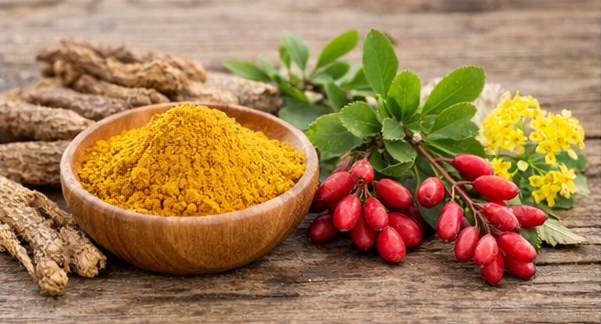
A compound hides in certain plants: berberine. It belongs to a family of components called isoquinoline alkaloids. It is found in particular in barberry, known scientifically as Berberis vulgaris. Goldenseal also contains it, as does a Chinese plant, Coptis. For a very long time, two medical traditions have relied on it: that of ancient China and that of Ayurveda.
More recently, scientists have turned their attention to it. Their interest? What this molecule does to metabolism and to the microbes of our gut. It is most often found as a supplement. Two forms dominate, the sulfate and the hydrochloride, and the usual dose per intake hovers around 500 milligrams, held in a small capsule.
An ancient history, a modern reading
Berberine is not a recent discovery. Its source plant, barberry, and other plants that contain it, have been used for centuries in two great traditions: traditional Chinese medicine and Indian Ayurveda. They were used in particular for digestive comfort and the overall balance of the body. This longevity of use is not scientific proof, but it caught researchers’ attention: why did this substance cross the centuries in such different cultures?
Modern research picked up the torch with its own tools. It identified the molecule, described its action on the AMPK enzyme, and measured its effects in controlled trials. It is this dual reading — a traditional heritage and a progressive scientific validation — that makes berberine interesting. Alphavital sits within this continuity: respecting traditional knowledge, but retaining only what current data allow us to affirm, without overstatement.
How does berberine work?
Berberine’s effects are explained above all by its action on AMPK, this enzyme that plays a major role in processing both sugars and fats. Thanks to this, the body responds better to insulin, while blood sugar and cholesterol remain more stable. It also acts on inflammation, curbs free radicals, and limits certain microbial imbalances in the gut. Finally, preliminary work explores a supportive role for brain function.

AMPK, that “energy sensor” of our cells
To grasp berberine’s value, it is worth pausing for a moment on AMPK. This enzyme acts as a cellular energy sensor: when reserves drop, it activates and steers metabolism toward energy production rather than storage. In practical terms, a more active AMPK helps the cell capture the glucose present in the blood and use it, while curbing the manufacture of new fat. Berberine stimulates this pathway in a way documented by several papers published in peer-reviewed journals, without being a medicine.
This action explains why berberine’s effects show up mainly on metabolic ground: blood sugar balance, lipid profile, fat management. It does not “burn” anything spectacular; it adjusts, in the background, the way the body handles what it receives. That is a difference in kind from express slimming promises: berberine works with metabolism, never against physiology.
One molecule, several names: berberine, Berberis, barberry
Berberine appears under several names, which sometimes causes confusion when searching for its “other name.” The term “berberine” designates the active molecule. Berberis vulgaris, or barberry, is one of the plants richest in it. Other plants contain it: goldenseal (Hydrastis canadensis) and Chinese Coptis. On a supplement label, the mention can therefore vary: “Berberis extract,” “berberine HCl” (hydrochloride), or “berberine sulfate.” All designate the same family of actives, at different concentrations. It is precisely for this reason that Alphavital favors a standardized extract: the amount of berberine actually delivered is known and constant from one capsule to the next.
The best-documented effects
- On blood sugar and cholesterol, several trials show an improvement under berberine, between 400 and 1,500 mg per day. It can thus support the effect of a sensible diet combined with regular physical activity.
- Berberine helps the body manage sugars and fats better. Yet its effects on weight remain modest: trials indicate a reduction of around two to three kilos. It replaces nothing and does not act alone, but can accompany certain habits, as an occasional support rather than a miracle solution.
- For gut balance, this substance contributes to the proper functioning of the digestive wall and sometimes influences transit rhythm. It is not a brutal action, rather a discreet adjustment.
- Berberine has antioxidant activity: it helps the body resist the oxidative stress that damages cells.
- The heart and brain could benefit from its effects, but current data remain preliminary. Nothing is definitive at this stage.
To understand visually where these benefits come from and how this molecule acts on metabolism, this educational video sums up the established mechanisms and what remains to be confirmed.
It is on this logic of a standardized extract and good absorption that our team built its reference formula, designed as a regular and transparent support.
Berberine and insulin: why insulin sensitivity matters
When it comes to understanding berberine’s metabolic effect, a central concept emerges: insulin sensitivity. Insulin is a hormone secreted by the pancreas after meals; its job is to move glucose from the blood into the cells so they can use it as energy. When cells become less responsive to this hormone, the body has to secrete larger amounts of it to maintain the same balance. This situation, which worsens with a sedentary lifestyle and excess fast sugars, places metabolism under constant pressure.
This is where berberine steps in, through AMPK activation, helping cells capture glucose more effectively, which may ease the need for excess insulin. This mechanism aligns with what studies observe on blood sugar. It is important to remember, however, that berberine does not “fix” a deeply rooted imbalance on its own; it adds a brick to a structure whose foundation is diet and movement. Without that foundation, its effect remains limited, however good the quality of the extract.
Dosage and how to use it
What dose and at what time
Berberine most often comes in 500 mg capsules. The available work suggests that a dose of 500 to 1,500 mg per day, split into two or three intakes, gives stable results. Alphavital’s formula requires only one daily capsule for regular follow-up.
- Start gently: when berberine is new, begin with 500 mg per day. Only increase afterward, and always with the advice of a healthcare professional.
- During meals: taking it with meals favors absorption and digestive tolerance.
- Consistency comes first: the effects settle in slowly, week after week, when the intake becomes a habit. Counting on four to eight weeks before judging is the most realistic attitude, as in most studies.
- Drug interactions: in the case of anticoagulant, antidiabetic, or statin treatment, medical advice is essential before any combination. Every situation is different.
Precautions and points of vigilance
Berberine is generally well tolerated. A few situations nonetheless call for caution:
- During pregnancy or breastfeeding, its use is to be avoided, for lack of sufficient data.
- In the case of liver or kidney disorders, seek the advice of a healthcare professional before any use.
- Berberine can strengthen the action of certain treatments (antidiabetics, anticoagulants). Careful monitoring is needed if these products are combined.
- An excess can cause transient digestive upset. Starting with a low dose helps the body adapt.
- Like any supplement, a course is done in periods, with breaks, ideally assessed with a professional. Resuming a course after a break also allows you to reassess whether the need is still present.
Berberine is not a medicine
One sometimes reads that berberine is a kind of “natural alternative” to fashionable weight-loss drugs. This comparison is misleading. A medicine like metformin is a prescribed, supervised treatment, with its own mechanism. Berberine, on the other hand, is a food supplement that acts more discreetly via the AMPK pathway; studies observe only a modest weight loss. It in no way replaces a validated treatment, and any decision about an ongoing treatment is the province of a healthcare professional.
Berberine and the microbiome: a dialogue with the gut
A strand of research is interested in the relationship between berberine and the gut microbiome, that ecosystem of bacteria populating our digestive tract. Berberine is poorly absorbed by the body: a large part therefore stays in the gut, where it can influence the balance of microbial populations. Exploratory studies suggest it might favor certain families of bacteria involved in metabolism, while limiting imbalances. It is a promising lead, which could explain part of its metabolic effects, but which still needs confirmation by larger work.
For the reader, the lesson is simple: berberine does not act only “in the blood,” it also dialogues with the gut. This echoes an idea dear to Alphavital — metabolic health and digestive health are linked. It is also why a diet rich in fiber, vegetables, and legumes, so present in Moroccan cooking, ideally accompanies the intake of a supplement like berberine. It reminds us that the body is a single system, not a set of separate organs.
Who can berberine suit?
Berberine is not a universal product, and that is good news: it means it addresses specific situations. It can interest a healthy adult, mindful of their metabolic balance, who has already engaged in a sensible diet and physical activity. It can accompany those who feel recurring sugar cravings, or who want to support their metabolism in a sedentary context. Conversely, it has no place for a pregnant or breastfeeding woman, for a child, or in self-medication on an ongoing treatment.
| Situation | Is berberine indicated? |
|---|---|
| Healthy adult, metabolic-balance approach | May suit, in support of a healthy lifestyle |
| Sugar cravings, sedentary life | May accompany, without replacing effort on diet |
| Pregnancy, breastfeeding | Not advised (insufficient safety data) |
| Ongoing treatment (antidiabetic, anticoagulant, statin) | Medical advice essential before any use |
| Child, adolescent | Not recommended |
This table does not amount to medical advice: it sets common-sense landmarks. Every situation remains unique, and a healthcare professional remains the best interlocutor in case of doubt, especially when a treatment is already in place.
Berberine within a comprehensive wellbeing approach
It is a mistake to view berberine as an isolated solution. Metabolic balance is the fruit of a whole system: enough sleep, since lack of sleep directly affects blood sugar regulation and appetite; stress management, because chronic tension raises hormones that counter metabolic balance; and daily movement, even something as simple as walking after meals. Within this system, berberine becomes a harmonious brick, not a lone hero.
This comprehensive view is what sets Alphavital’s approach apart. Rather than selling a promise of a berberine that “solves everything,” we place it in its proper context: one tool among others, taking its value from its integration into a thoughtful lifestyle. The reader who grasps this logic is best able to truly benefit from berberine, far from the spiral of quick promises that always end in disappointment.
Berberine or metformin: two different logics
The comparison comes up often, sometimes under the misleading angle of “the natural alternative.” Let us be clear. Metformin is a medicine, prescribed and supervised by a doctor, with known, authority-validated efficacy and effects. Berberine, on the other hand, is a food supplement. The two share an interesting common point — an action on the AMPK pathway — but that does not make them interchangeable. A supplement never replaces a prescribed medicine, and stopping or modifying a treatment is exclusively the province of a healthcare professional. Berberine can accompany a balance-seeking approach in a healthy person mindful of their metabolism; it does not replace medical follow-up when one is needed.
The Alphavital response
For its 500 mg berberine, Alphavital made precise choices:
- A concentrated extract: Alphavital selects a standardized extract of Berberis vulgaris, richer in actives than raw powder.
- Purity and traceability: each batch undergoes analyses, for a controlled product free of heavy metals, from sourcing to packaging.
- Simplicity: a single capsule a day, ideally at lunch, delivers 500 mg of berberine.
- A responsible message: Alphavital presents berberine for what it is, a support, never a miracle solution. A varied diet and physical activity remain the foundation.
The Moroccan factor: why metabolic balance concerns us
Our relationship with sugar is singular in Morocco. Sweet tea paces the day, festive pastries are generous, and bread accompanies nearly every meal. To this is added, in cities, an increasingly sedentary life, where we walk less than before. This context puts glucose metabolism to a hard test, sometimes as early as the start of adulthood.
It is precisely in this setting that interest in berberine grows. Not as a miracle answer, but as a support to a broader approach: gradually reducing fast sugars, moving a little every day, and supporting the body with simple landmarks. Berberine fits into this logic of accompaniment, never of replacing a healthy lifestyle.
The plate first, the supplement second
No capsule corrects an unbalanced diet. The first strength is the vegetables of our souks, the legumes of Moroccan cooking (lentils, chickpeas, broad beans), olive oil, and sufficient hydration. Berberine comes second, as a regular support, once these foundations are laid. That is the order Alphavital defends, against easy promises.
Recognizing a quality berberine
Not all berberines on the market are equal, and the difference is decided on concrete criteria. The first is the form of the active: a standardized extract delivers a known and constant amount of berberine, where a simple plant powder varies from one batch to another. The second is traceability: a serious product indicates the origin of the extract and has each batch analyzed, notably to rule out heavy metals. The third is dosage transparency: the amount of berberine per capsule must be clearly displayed, with no ambiguity between “extract” and “pure berberine.”
It is on these three criteria that Alphavital built its 500 mg berberine: a standardized extract of Berberis vulgaris, batch-by-batch analyses, and a clearly stated 500 mg dose of berberine. This requirement is not one more commercial argument; it directly conditions what the body actually receives. A poorly dosed or poorly controlled berberine will not reproduce the conditions of the studies that make it valuable.
A typical day with berberine
To make things concrete, here is what a day might look like where berberine fits in simply, without upending habits. On waking, a breakfast that favors protein and fiber rather than white bread and very sweet tea. At lunchtime, taking one berberine capsule during the meal, to favor digestive tolerance and absorption. In the afternoon, a twenty- to thirty-minute walk, which naturally helps muscles mobilize glucose. In the evening, a light dinner, eaten early if possible. This routine is nothing spectacular; it is precisely its regularity that counts, week after week.
Berberine and blood sugar: what the studies say
It is on blood sugar balance that berberine has been most studied. A meta-analysis pooling several clinical trials observed an improvement in glycemic markers in people taking berberine, at doses between 500 and 1,500 mg per day, spread across the day. The results stay consistent from one study to another, which strengthens their credibility, even if the samples are sometimes modest in size. These data should be read with measure: the studies cover specific populations, over limited durations, and berberine is almost always paired with lifestyle advice. In other words, it does not act in a vacuum, and its value reveals itself in support of a sensible diet and regular physical activity, never as a standalone fix.
Common mistakes to avoid with berberine
Many disappointments with berberine come not from the product, but from how it is used. The first mistake is expecting immediate results: berberine works slowly, and a week or two is not enough to judge. The second is neglecting the foundation: taking berberine while continuing to overdo fast sugars and inactivity empties its effect of meaning. The third is overdosing, thinking that “more is better,” whereas studies show that reasonable, split doses are most effective, and excess brings only digestive upset.
The fourth mistake, perhaps the most serious, is combining it with prescribed treatments without medical advice. Berberine can amplify the action of blood-sugar-lowering drugs or anticoagulants, which calls for vigilance and monitoring. Finally, the fifth mistake is choosing a product of unknown origin simply for its low price: the quality of the extract and batch traceability are not a detail, but what determines what actually reaches the body. Avoiding these five mistakes is enough to make the berberine experience fairer and more reasonable.
Where to buy a reliable berberine in Morocco (price and quality)
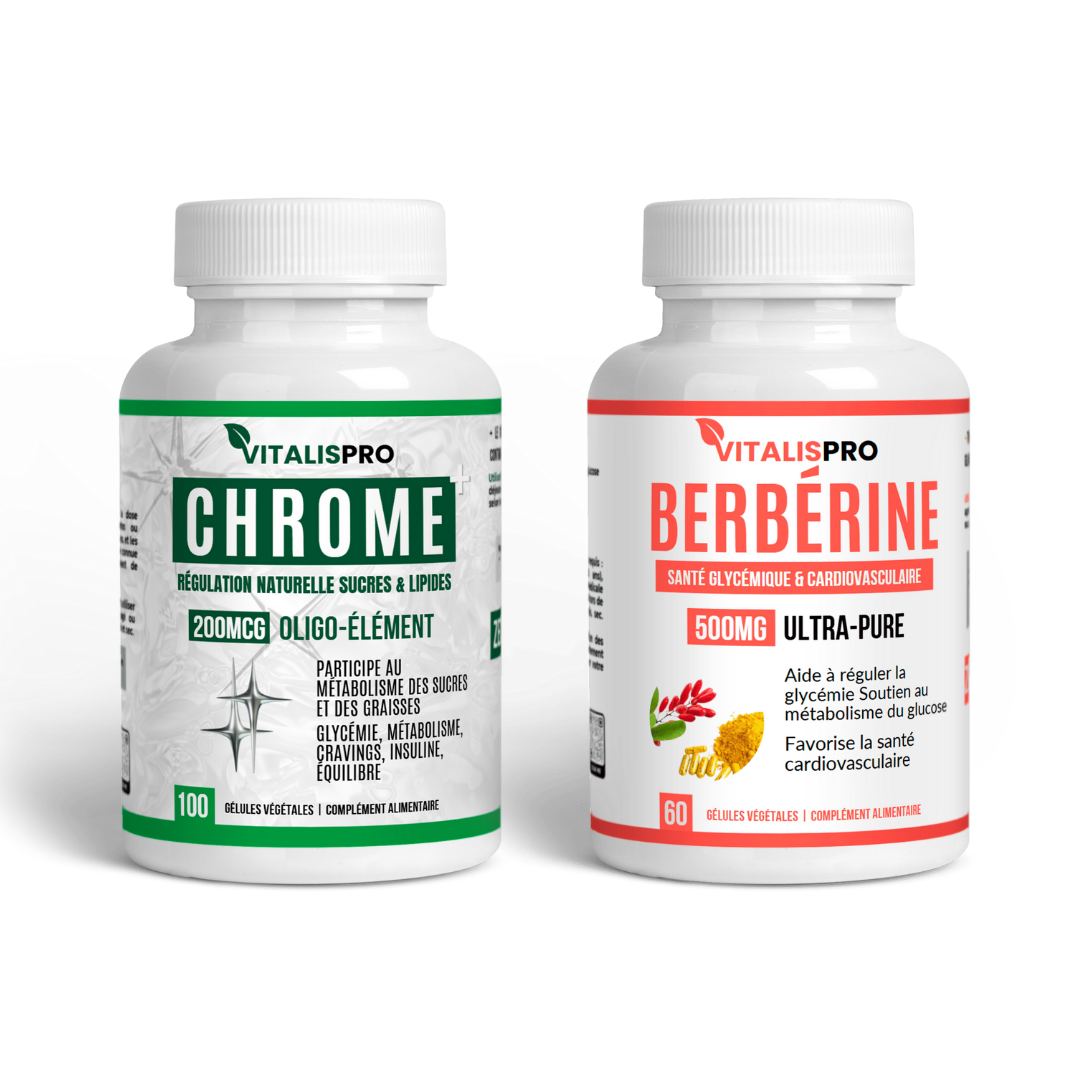
Not all berberines are equal. Quality depends on the extract, its standardization, and the controls carried out on each batch. Alphavital offers its 500 mg berberine directly on its online store, with delivery throughout Morocco and cash on delivery. Each batch is analyzed, and the composition is presented with full transparency.
To go further, Alphavital offers berberine in combined formulas, such as the berberine and chromium duo or the complete metabolic-balance program. To understand the link between berberine and blood sugar, our dedicated deep-dive on blood sugar explores the subject further. And to discover other pillars of daily wellbeing, the About Alphavital page details our approach.
Metabolic balance never rests on a single product. It is built over time, through small repeated decisions. Berberine can find its place there, alongside a thoughtful diet and a little movement each day. To explore our full range dedicated to metabolism and vitality, the Alphavital store brings together our controlled formulas, delivered throughout Morocco, with a message that never oversells what science has not demonstrated.
It is also worth noting that cash on delivery and shipping to towns across Morocco make obtaining a reliable berberine straightforward, with no need to travel or search at length in pharmacies. This practical aspect matters a great deal to readers who prefer ordering from home, while still knowing the product’s origin and composition in advance through the detailed product page. Real wellbeing is not bought in a single box; it is built day after day through simple, consistent decisions, of which berberine is one tributary, not the whole river.
Three readers tell us
“I added Alphavital’s berberine to my breakfast, alongside a daily walk. After two months, I feel steadier through the day, with fewer energy dips after meals.”
— Karim, Casablanca
“What convinced me was the honest message: one capsule, no magic promise. I use it as a course, with breaks, and it has become a simple landmark in my routine.”
— Salma, Rabat
“My doctor was aware of my intake. Consistency made the difference for me, combined with a diet more measured in sugars.”
— Youssef, Marrakech
These testimonials are personal feedback and do not constitute proof of efficacy. Everyone reacts differently, and berberine is always appreciated over time, as a complement to a coherent lifestyle.
Frequently asked questions about berberine in Morocco
Does berberine really help with weight loss?
Research indicates a modest weight reduction, on the order of two to three kilos, close to that observed with a placebo. Its effect touches metabolism, but it remains below prescribed treatments. It fits above all into a routine based on a balanced diet and regular physical activity.
What amount to start with?
A dose of 500 to 1,500 mg per day is most often studied. Start at 500 mg, that is one capsule, then adjust according to the advice of a healthcare professional. Starting with a low dose gives the digestive system time to adapt and reduces the chance of transient discomfort that may accompany the early days.
Is berberine compatible with my treatments?
It can amplify the action of diabetes treatments, anticoagulants, or certain lipid-lowering drugs. Medical advice is essential before taking it in the case of an ongoing treatment.
How long does a course last?
A period of 4 to 8 weeks is common, sometimes extended with a professional’s agreement. The first landmarks often appear over these weeks, when the intake is regular. After each course, it is preferable to give the body a break, then reassess whether the need is still present, rather than continuing out of habit alone.
Can it be used during pregnancy or breastfeeding?
No. In the absence of sufficient data on its safety during pregnancy or breastfeeding, berberine is avoided. For any question about metabolic balance during this period, a healthcare professional’s advice is essential.
Can you find 500 mg berberine in a pharmacy in Morocco?
Availability in pharmacies varies. Alphavital offers its standardized 500 mg berberine directly online, with delivery throughout Morocco and cash on delivery, which ensures batch traceability and a transparent composition. The key is not the purchase channel, but the quality of the extract and the consistency of intake.
Does berberine have another name?
The molecule is called “berberine.” It is also encountered under the name of the plant from which it is extracted, notably Berberis vulgaris (barberry). On labels, it sometimes appears as “berberine HCl” (hydrochloride) or “berberine sulfate,” two salts of the same active molecule.
In summary
Berberine is a plant alkaloid that draws research attention for its action on the metabolism of sugar and fats, via the AMPK enzyme. The observed effects remain measured and express themselves all the better when the diet is balanced and physical activity regular. A standardized version at 500 mg per intake allows an absorption close to that of the studies.
Berberine is not a medicine and replaces no treatment. It is in this logic of honesty that Alphavital formulated its berberine: a regular, transparent support, designed as a help and not a promise. Medical advice remains relevant before any prolonged use, especially under treatment. If we had to sum it up in one sentence: berberine is a serious metabolic tool, provided it is placed in its rightful spot — neither a miracle remedy nor a gadget, but a support that takes on full meaning for a person already engaged in a balance-seeking approach.

About the author. This article was written by Chérif Belhassane, editor-in-chief for health & wellbeing at Alphavital. He translates scientific research into clear, applicable landmarks for everyday Moroccan life.
Disclaimer. The information presented here is provided for indicative purposes, on the basis of sourced research (PubMed, EFSA, authorities). The Alphavital team is not made up of healthcare professionals. Consult a qualified healthcare professional before any use, in the case of an ongoing treatment, pregnancy or breastfeeding, or a medical condition. Food supplements do not replace a varied, balanced diet or a healthy lifestyle.
Sources and references
