


Reishi — the lacquered, mahogany-coloured mushroom that grows on aged tree trunks — is one of the oldest and best-documented functional mushrooms in the world. In Morocco, where chronic fatigue, nervous tension and the desire to support natural defences come up in every conversation, interest in reishi is growing steadily. Here is what tradition attributes to it, what modern research is genuinely exploring, and how Alphavital translates this heritage into a straightforward, traceable formula dosed at a full 300 mg.
There is a mushroom that is never cooked like the others. Too tough, too woody to end up in a pan — it is ground into powder, brewed as a decoction, or encapsulated. Its varnished surface, dark reddish-brown and almost glass-like, earned it the Latin name Ganoderma lucidum, literally “shining skin”. In East Asia it has been known for centuries as the “mushroom of immortality” — a flattering nickname that deserves to be taken for what it is: a reflection of deep cultural respect, not a medical promise.
In Morocco, that name is circulating more and more widely. In conversations about persistent fatigue, about those stretches when the body seems to lose its guard, about needing a measure of serenity when daily life accelerates — reishi keeps coming up as a keyword. Our team receives questions about it every week. Is it serious? What does the research actually say? How should it be taken? This article answers those questions, drawing on the available scientific literature and one guiding principle: promise nothing that the data do not support, and honestly label what still belongs to tradition.
By Houda Khaldi, Editorial Adviser in Natural Nutrition · Published 17 June 2026 · 19-minute read
Contenu de la page
- 1 Key takeaways
- 2 Reishi: a functional mushroom apart
- 3 What reishi actually contains
- 4 The science: what the studies actually say
- 5 Reishi, lion’s mane, cordyceps, ashwagandha: finding your way
- 6 Reishi in Morocco: a real need, a particular context
- 7 How to use reishi correctly
- 8 The Alphavital answer
- 9 Three readers share their experience
- 10 Frequently asked questions about reishi
- 10.1 What exactly is reishi?
- 10.2 Does reishi really support immunity?
- 10.3 What is an adaptogenic mushroom?
- 10.4 What is the dosage for reishi capsules in Morocco?
- 10.5 How soon will reishi’s effects be felt?
- 10.6 What are reishi’s contraindications in Morocco?
- 10.7 Should you choose reishi alone or the Triple Gold Programme?
- 11 In summary
Key takeaways
- Reishi (Ganoderma lucidum) is one of the most anciently used functional mushrooms in East Asian traditions and one of the most represented in publicly available scientific literature.
- It is classified among adaptogens: tradition associates it with the idea of helping the body cope with everyday demands — a territory that modern research is still actively exploring.
- The compounds that attract researchers’ attention are beta-glucans and triterpenes (ganoderic acids), unique to this mushroom.
- As with all functional mushrooms, the effects described develop over time and within a healthy lifestyle — never as a replacement for sleep, diet or medical care.
- Alphavital offers a reishi dosed at a full 300 mg of powder per capsule, in a traceable, no-frills formula, as well as a broader programme for body and mind.
Reishi: a functional mushroom apart
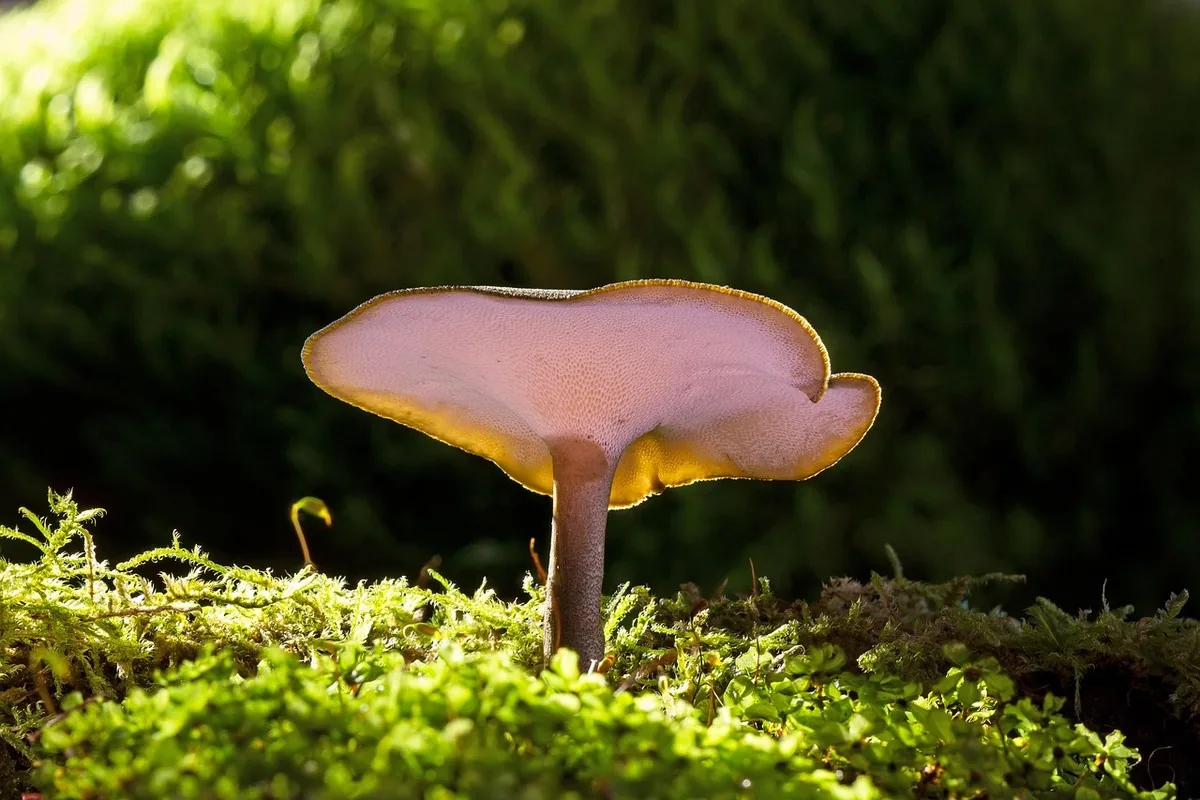
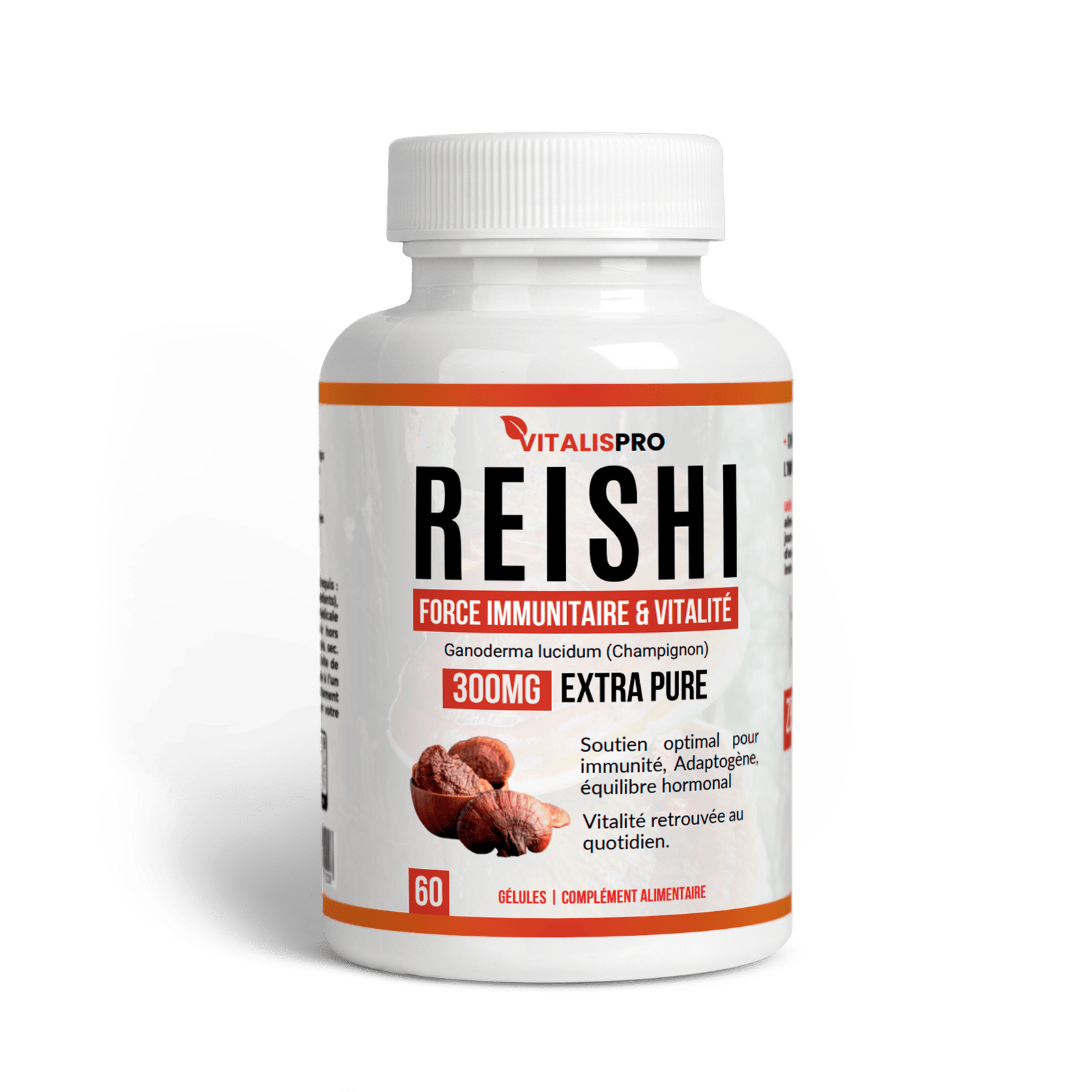
Before it becomes a capsule, reishi is first a curiosity of nature. It grows on dead or injured hardwood trees in the warm, humid forests of East Asia, but also in the Americas and Europe. It grows slowly, feeding on the wood it decomposes, and its flesh — as hard as varnished cork — does not serve as food in the conventional sense. That singularity is precisely what made it, very early on, an object of particular use: a mushroom to be prepared, not cooked.
In East Asian traditions, reishi held a privileged place, long reserved for elites because of its rarity. It was credited with supporting vitality, calming the mind and accompanying the longevity of those who consumed it regularly. This transmission, more than two thousand years old, eventually attracted the attention of modern research, which wanted to verify, molecule by molecule, what popular knowledge had been asserting for so long.
Reishi is not a passing trend. It is one of the most anciently used mushrooms in human history, now meeting the rigour of the laboratory.
This encounter between tradition and science is not an isolated case. It is part of the great return of functional mushrooms — species studied not only for their nutritional value but also for the active compounds they contain. Reishi is the historical figurehead of that world, just as lion’s mane is for the cognitive domain. Our team has dedicated a complete dossier to that cousin in our lion’s mane guide for memory and concentration.
Why this mushroom, and not another
One point is worth clarifying, because it determines the quality of the finished product. Not all mushrooms are equal from a chemical standpoint. What distinguishes reishi are two families of compounds: beta-glucans, well-known polysaccharides studied for their role in natural immune support, and triterpenes — in particular the ganoderic acids that give the mushroom its characteristic bitterness. These are the molecules researchers focus on.
This singularity also explains why the raw material is decisive. Between a generic mushroom powder and a reishi grown under controlled cultivation, the difference is not always visible on the label, but it is real. That is precisely the line our team monitors at the sourcing stage: reishi deserves the same rigour of traceability as the most precious actives in our range — the same logic we apply to our ashwagandha for stress and sleep support.
What reishi actually contains
Behind the commercial name lies a remarkably rich chemistry. Researchers have isolated several hundred compounds in reishi, and those compounds explain the lasting scientific interest in this mushroom. Understanding this composition helps distinguish a serious product from a mere powder of no value.
The most studied molecules are polysaccharides — including the famous beta-glucans — and triterpenes (ganoderic acids). Alongside these, there are peptidoglycans, sterols and various antioxidants. It is this cocktail as a whole, not any single isolated molecule, that gives reishi its distinctive profile. The public literature on this mushroom is substantial; its breadth can be gauged through the bibliographic search on Ganoderma lucidum in PubMed1.
An open-access reference synthesis devoted to the biological properties and chemical profile of the mushroom is available via the Ganoderma lucidum monograph on NCBI Bookshelf (NIH)2. Researchers’ message there is consistent: reishi’s value lies in the concentration of these compounds, which justifies rigorous quality standards for the raw material — and a degree of caution commensurate with the enthusiasm the mushroom arouses.
Beta-glucans and natural defences
If one domain has built reishi’s reputation across the centuries, it is natural immune support. Beta-glucans — those particular fibres found in the cell walls of mushrooms — receive sustained attention from immunology researchers. They are found in other mushrooms and yeasts too, and they participate in the complex dialogue between nutrition and the body’s balance.
This must be said plainly: no health claim for reishi is officially authorised in Europe at this time. What can honestly be stated is that this mushroom is studied for its possible role in this field, and that tradition has employed it in that sense for a very long time. That line — between heritage and data — is exactly the one our team holds. Supporting natural defences starts with the fundamentals: sleep, diet and well-identified nutrients, as our guide on vitamin C, immunity and energy explains.
Triterpenes and the adaptogenic terrain
The other major family in reishi, the triterpenes, gives the mushroom its frank bitterness. These compounds sit at the heart of reishi’s “adaptogenic” reputation — a word that appears everywhere without always being understood. An adaptogen, in the traditional sense, is a plant or mushroom associated with the idea of helping the body cope better with everyday demands, without acting as a stimulant.
That concept is itself an active and debated field of research. A broad view of the literature on these substances is accessible through the scientific review search on adaptogens in PubMed3. Our team uses this term with care: reishi is classified among adaptogens by tradition and by part of the research community — and that precision of vocabulary is what distinguishes serious discourse from hollow promise.
The science: what the studies actually say
This is where everything is decided. The internet overflows with spectacular claims about reishi, sometimes presenting it as a universal remedy. Our role is to be honest about what the research demonstrates, what it suggests and what remains uncertain. Below, in plain language, is the state of knowledge — without over-interpretation.
Natural immune support
This is reishi’s historical territory, and the domain that attracts the most research. Numerous studies — mostly in the laboratory and in animal models — have explored the effect of reishi polysaccharides on immune system cells. The results described are not a spectacular transformation: they are more like modulation pathways, observed under experimental conditions, that sustain interest without constituting definitive proof in healthy humans.
The nuance is crucial. Possessing interesting biological signals in the laboratory does not equate to a demonstrated health claim. That is why our team speaks of support within a wellness routine, and never of a guaranteed effect. This honesty is, in our view, the mark of a trustworthy brand — and it applies to reishi just as it applies to every active in our Immunity and Vitality range.
Reishi does not “boost” immunity in the sense of a promise. It is studied as a possible support — over time, within a healthy lifestyle.
Nervous tension and calm
Here is a chapter that is often overlooked, yet it may be the most relevant to daily life. Reishi, as a traditional adaptogen, has been associated with the idea of calm and the management of nervous tension. Several studies have explored its effect on subjective markers of fatigue and wellbeing, in protocols that are still limited in size and duration. Conclusions remain cautious, but the territory is consistent with traditional use.
This link between inner calm and vitality is no minor detail. A mind saturated with tension recovers poorly, and nervous fatigue feeds itself. By accompanying a broader effort to improve lifestyle, reishi finds its place as a deep, sustained support — not as a quick fix. For those whose priority is nervous tension and sleep, our team often points toward ashwagandha, the other major adaptogen, which complements reishi.
Baseline energy and vitality
Reishi is also studied — and above all used by tradition — as a support for general vitality, particularly during periods of persistent fatigue. Here again, a distinction must be drawn between traditional use, which is ancient and consistent, and clinical evidence, which is more recent and more measured. Reishi is not a stimulant: it does not produce an energy spike, and that is precisely what makes it a deep-terrain support rather than an excitant.
What can reasonably be said is that reishi belongs to a logic of sustained accumulation. It does not replace rest, a suitable diet or stress management. Our team presents it as a complement to a healthy lifestyle — never as a shortcut. To support daily energy, iron, spirulina and moringa remain highly relevant, as our programme on anti-fatigue with ginseng, spirulina and moringa details.
What still needs to be confirmed
Honesty demands saying this clearly. Reishi is associated with many avenues still under exploration: metabolic comfort, liver support, sleep balance, antioxidant markers. These areas are promising, but research there often remains preliminary, with modest sample sizes and heterogeneous protocols. Our editorial line is consistent: we present these subjects as fields of study, never as commercial promises. A serious mushroom deserves serious discourse.
Reishi, lion’s mane, cordyceps, ashwagandha: finding your way
Reishi is not alone in the world of functional mushrooms and adaptogens. Other species share this space, and our team is regularly asked about their differences. Rather than opposing them, it is more accurate to understand each one’s specialty.
| Active | Nature | Primary terrain |
|---|---|---|
| Reishi | Mushroom (Ganoderma lucidum) | Natural defences, calm, sustained vitality |
| Lion’s mane | Mushroom (Hericium erinaceus) | Memory, concentration, nervous system |
| Ashwagandha | Root (adaptogenic plant) | Nervous tension, sleep, energy |
| Spirulina | Microalgae | Energy, iron, antioxidants |
Each of these actives has its own story and profile. Lion’s mane targets memory and nerves. Ashwagandha focuses on calming nervous tension and supporting sleep. Spirulina provides iron and antioxidants for energy. Reishi stands out through its immune terrain and its reputation for sustaining calm and deep vitality.
These actives are not competitors. They complement one another, each illuminating a different facet of wellbeing.
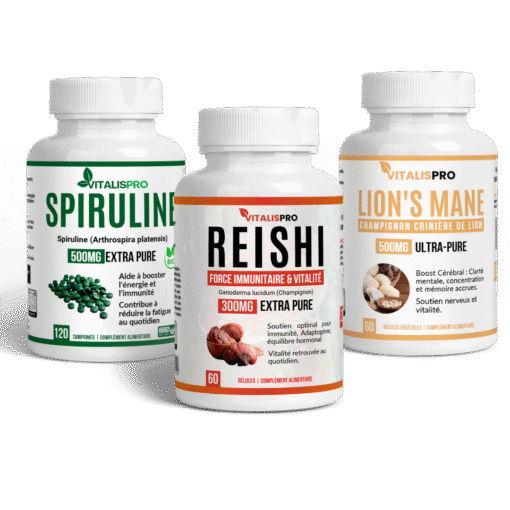
It is precisely this logic of complementarity that guided our team when it brought reishi, lion’s mane and spirulina together in a programme dedicated to body and mind. The idea is not to stack promises, but to cover several terrains at once: immunity and calm with reishi, mental clarity with lion’s mane, energy with spirulina.
Reishi in Morocco: a real need, a particular context
Why is interest in reishi growing in Morocco? The answer lies in several realities of contemporary life. The relentless pace of large cities, insufficient sleep, an occasionally unbalanced diet, the chronic stress of work and commuting: all are factors that erode baseline energy and put natural defences to the test — sometimes as early as one’s thirties.
There is a cultural dimension as well. In Morocco, traditional pharmacopoeia, plants and natural remedies have long held an ancient and respected place. Reishi, with its millennial history and its status as a noble mushroom, fits naturally within this sensibility. Many people are looking for deep, discreet, prescription-free support — something that accompanies periods of fatigue rather than masking them with stimulants.
Climate and the calendar also play a role. Intense summer heat, seasonal transitions, periods of overload when the body seems to lower its guard: all are moments when one wants to sustain vitality. The month of Ramadan, with its upheaval of sleep and meal schedules, puts the body to the test as well. In this context, reishi — a terrain support, not a one-off quick fix — finds its place. Our team often recalls: a functional mushroom works over time, accompanying the body, never artificially pushing it beyond its limits.
A mushroom, not a magic wand
Let us be clear on a point our team repeats constantly. Reishi is not a medicine, and it cannot on its own correct a lifestyle that exhausts the body. A mushroom, however well-studied, does not replace sleep, physical activity, a balanced plate or stress management. It belongs to a whole — one support among others.
This is precisely what health authorities emphasise: a food supplement does not replace a treatment or a balanced diet. This framework is clearly outlined in the food supplements dossier published by ANSES, the French food safety agency4. Reishi is a support, an aid — not a effective solution. That nuance is the entire difference between honest communication and a hollow promise.
How to use reishi correctly
A few practical guidelines help avoid the most common mistakes and make the most of a course. Correct usage matters as much as the product itself.
Reishi: dosage in Morocco
Alphavital reishi comes in capsules dosed at 300 mg of mushroom powder. Alphavital recommends taking 2 to 3 capsules per day, with meals, with a large glass of water. Many people begin with 2 capsules a day, then adjust based on their situation, without exceeding the recommended dose. Consistency matters above all else: daily repetition over several weeks is what builds the sustained, deep support being sought.
How long should a reishi course last
Like most functional mushrooms, reishi is a long-term investment. It is generally envisaged over several weeks — most often as a one-to-three-month course — for terrain support. Some approaches favour courses interspersed with breaks, the idea being to integrate it durably into a wellness routine rather than expecting an immediate effect. There is no universal magic duration: listening to one’s body and seeking advice from a healthcare professional remain the best guides.
Reishi: contraindications and precautions
Reishi is generally well tolerated, but certain precautions apply. It is not recommended for pregnant or breastfeeding women or for individuals under eighteen. People following a treatment — particularly anticoagulants, antihypertensives or immunomodulatory agents — or those with a particular medical condition should seek advice from a healthcare professional before starting and should not exceed the recommended dose. Health authorities emphasise the importance of a measured approach to supplement use, a point detailed in the Ganoderma lucidum monograph on NCBI Bookshelf (NIH)2. This caution is not a formality: it is a condition of responsible use.
The Alphavital answer
Diet, sleep and lifestyle first — always. But when natural support makes sense, a serious formula is essential. That is exactly the philosophy that guided our team’s work on reishi.
Alphavital Reishi: full-dose and fully traceable
Alphavital offers a reishi dosed at a full 300 mg of powder per capsule, from Ganoderma lucidum mushroom. Two requirements guided its design: a quality raw material, traceable from sourcing to encapsulation, and a clear, consistent dose free of marketing excess. The capsule is easy to swallow and fits simply into a wellness routine.
This formula belongs to our Immunity and Vitality range, designed as a coherent whole. For those beginning the journey, reishi alone is often the best starting point: it allows one to discover the mushroom, observe one’s own response and build on a solid foundation.
A good reishi cannot be reduced to a name on a label. It brings together quality raw material, a controlled dose and honest communication.
The Triple Gold programme, for those who want more
For those seeking broader support for body and mind, our team also offers a complete programme combining three actives with complementary terrains: reishi for immunity and calm, lion’s mane for mental clarity, and spirulina for energy. The aim is to cover several facets of wellbeing by bringing together mutually reinforcing actives, rather than multiplying them at random.
This programme is aimed at those already familiar with these actives who want a structured, coherent overall approach. It naturally extends the discovery of reishi alone, and it shares the same quality standards. To explore the full offer, our Immunity and Vitality category brings together all our natural solutions dedicated to natural defences and baseline energy.
The feedback our team receives is worth more than any discourse. Here are three testimonials, shared with the consent of their authors.
With each change of season I always felt drained, as if my body was on the defensive. I added reishi to my morning routine for two months. Without claiming a effective, I felt more grounded, with more consistent energy throughout the day. — Karim, Rabat
I wanted something natural and serious to accompany busy days. What I appreciated about reishi is that it doesn’t excite: it calms, from the inside. A quieter head in the evening — that’s what I take away from it. — Nadia, Casablanca
In my fifties, I chose the Triple Gold Programme to cover several fronts at once. Three months later, I feel more toned and more at ease — without forcing anything. Reishi has become a wellness reflex for me. — Hicham, Marrakech
These accounts illustrate a simple truth: the most durable results come from combining a healthy lifestyle with, when useful, a well-chosen supplement. A question before you start? Our team answers directly via the Alphavital contact page.
Frequently asked questions about reishi
What exactly is reishi?
Reishi is a functional mushroom with the botanical name Ganoderma lucidum, recognisable by its lacquered reddish-brown surface. Used for centuries in East Asian traditions and classified among adaptogens, it concentrates active compounds such as beta-glucans and triterpenes. It is one of the most documented mushrooms in publicly available scientific literature, studied for its possible role in natural immune support and calm.
Does reishi really support immunity?
Reishi is studied for its possible role in supporting natural defences, mainly through its beta-glucans, but no health claim has been officially authorised for it in Europe. Most data come from laboratory or animal studies. It therefore represents a possible support within a wellness routine, not a guaranteed effect.
What is an adaptogenic mushroom?
Certain plants and mushrooms are called adaptogens — a term tradition associates with the idea of helping the body cope with everyday demands without acting as a stimulant. Reishi is a historical example. This concept remains an active field of research: it is used here in its traditional, descriptive sense, not as a promise of a specific effect.
What is the dosage for reishi capsules in Morocco?
Alphavital recommends 2 to 3 capsules of 300 mg per day, with meals, with a large glass of water. Most people begin with 2 capsules, then adjust according to their situation, without exceeding the recommended dose. This approach to reishi capsules, available in Morocco, prioritises regularity over quantity, over a course of several weeks.
How soon will reishi’s effects be felt?
Reishi works over time: it is not a stimulant with an immediate effect. It is envisaged over several weeks — most often in a course of one to three months — to assess one’s own response. Daily consistency is decisive. The sensations reported concern above all a gradual, deep feeling, rather than a spectacular change within a few days.
What are reishi’s contraindications in Morocco?
Reishi is generally well tolerated, but it is not recommended for pregnant or breastfeeding women or those under eighteen. If a course of treatment is ongoing — particularly anticoagulants, antihypertensives or immunomodulators — or a particular medical condition exists, advice from a healthcare professional is essential before starting, and the recommended dose must not be exceeded. A supplement never replaces medical supervision.
Should you choose reishi alone or the Triple Gold Programme?
Reishi alone is often the best starting point to discover the mushroom and observe one’s own response. The Triple Gold Programme, which combines reishi, lion’s mane and spirulina, is aimed at those seeking broader support for body and mind. Both share the same quality and traceability standards.
In summary
Reishi is a singular functional mushroom — one of the most anciently used and best-documented in the world. Modern science is gradually exploring its potential: possible support of natural defences via beta-glucans, an adaptogenic terrain associated with calm, deep baseline vitality. The research pathways are real but often preliminary, and they express themselves within a healthy lifestyle — never as a replacement for it.
Quality makes all the difference. A traceable raw material, a controlled 300 mg dose and honest communication separate a good reishi from a simple powder. That is the path Alphavital has chosen, with a transparent approach faithful to what the research says — and does not say. Caring for your immunity and vitality is not about following a trend: it is a long-term investment in your own wellbeing.
About the author. Houda Khaldi is Editorial Adviser in Natural Nutrition at Alphavital. She translates scientific research into clear, practical guidance for everyday Moroccan life.
Disclaimer. The information presented is provided for informational purposes only, based on sourced research (PubMed, NIH, ANSES). The Alphavital team does not include healthcare professionals. Reishi has no authorised health claim in Europe; the uses described draw on tradition and ongoing research. Consult a qualified healthcare professional before use, in the event of an ongoing treatment, pregnancy, breastfeeding or a medical condition. Food supplements do not replace a varied, balanced diet or a healthy lifestyle.
Sources and references
- Public scientific literature on Ganoderma lucidum (reishi): bioactive compounds, polysaccharides and triterpenes. PubMed
- Ganoderma lucidum (Reishi Mushroom): chemical profile, biological properties and safety benchmarks — full-text monograph. NCBI Bookshelf — NIH
- Scientific reviews on adaptogens: definition, proposed mechanisms and state of the evidence. PubMed
- Food supplements: regulatory framework, guidelines and precautions for use. ANSES — French National Agency for Food Safety
