

Marine collagen reviews in Morocco: here is what the research actually demonstrates, what Moroccan users observe in their daily lives, and how to choose an honest marine collagen programme, free from exaggerated promises. Our team reviewed the studies, gathered real-world feedback, and compared formulas to help you avoid the common pitfalls.
Type “collagen reviews” into a search engine and you land in two opposing worlds. On one side, accounts of spectacular transformations — skin smoothed in a week, joints feeling brand new. On the other, sceptics who dismiss collagen as useless. The truth, as is so often the case, lies somewhere between the two. And in Morocco, where sun exposure, dry indoor air, and a diet sometimes low in collagen-rich foods all accelerate skin ageing, the question deserves a measured answer.
Our editorial team receives the same question every week: “Does collagen actually work?” Rather than repeating marketing slogans, we did the work ourselves — read the meta-analyses, distinguished what is proven from what remains to be confirmed, and cross-referenced everything with the feedback from people who have tried it. Here is our verdict, in complete transparency.
By Houda Khaldi, Editorial Nutrition Advisor · Published 17 August 2026 · 18-minute read
Contenu de la page
- 1 Key takeaways
- 2 Collagen: the scaffolding that erodes with time
- 3 Collagen reviews: what users in Morocco actually say
- 4 The science: what studies actually demonstrate
- 5 How to read a collagen review without being misled
- 6 Nourishing and protecting your collagen through food
- 7 When a collagen programme in Morocco genuinely makes sense
- 8 Getting the most from your collagen programme: a practical guide
- 9 Three readers share their experience
- 10 Frequently asked questions about collagen and its reviews
- 10.1 Is marine collagen truly effective according to the reviews?
- 10.2 How long before you see the first effects?
- 10.3 Should collagen be combined with vitamin C?
- 10.4 Marine or bovine collagen: which to choose?
- 10.5 Does collagen have side effects?
- 10.6 Does collagen genuinely help the joints?
- 10.7 Can you get enough collagen from food alone?
- 11 In summary
Key takeaways
- Collagen is the most abundant structural protein in the body. Natural production begins to decline from the mid-twenties onwards, which explains the appearance of wrinkles, loss of firmness, and joint stiffness over the years.
- On the review front, the most reliable feedback converges on one finding: skin gains suppleness and comfort, nails strengthen, and joint discomfort diminishes. Results appear after several weeks of consistent use, never within a few days.
- Clinical trials on collagen peptides show measurable improvement in skin hydration and elasticity1, as well as support for joint comfort3.
- Vitamin C is indispensable: it contributes to the normal formation of collagen for the normal function of skin, bones, and cartilage — an effect validated by European health authorities5.
- Alphavital offers a formula combining marine collagen with vitamin C, designed for skin, joints, and suppleness, within a framework of consistent, transparent supplementation.

Collagen: the scaffolding that erodes with time
Imagine a brand-new mattress. The springs are taut, the foam rebounds, the surface springs back the moment you rise. That is exactly what young skin does, and the credit belongs in large part to collagen. This protein forms a dense mesh beneath the skin’s surface, a lattice that holds everything in place and gives it that characteristic youthful bounce.
Collagen accounts for roughly one third of all the proteins in our bodies. It is found everywhere: in the skin of course, but also in tendons, ligaments, joint cartilage, and even in the matrix of our bones. It is the glue that holds the whole together — the word itself derives from the Greek kolla, meaning glue. Without it, nothing would hold.
Collagen is not a surface beauty product. It is the internal architecture of the body, present in the skin, joints, bones, and tendons.
The problem is time. From the late twenties, natural collagen production slows by roughly one per cent per year. Add to that the aggressors: sun exposure, tobacco, sugar, oxidative stress. The fibres thin out, the mesh slackens. Skin loses its firmness, the first lines settle in, and joints may become less supple. This is not inevitable, but it is a biological reality that no one entirely escapes.
Why Morocco’s climate accelerates the process
Morocco is bathed in magnificent light, but that light comes at a cost. Ultraviolet radiation is one of the primary drivers of cutaneous collagen degradation — a process specialists call photoageing. The long sunny days of Marrakech, Agadir, or Ouarzazate stress the skin far more than a temperate climate would.
To that, add the dry air of the interior, air conditioning that desiccates the skin further, and a modern diet that is sometimes poor in collagen-rich foods — the very foods that previous generations extracted from long-simmered bone broths. Together, these factors explain why so many Moroccans are turning to collagen programmes today.
Marine, bovine, plant-based: a brief vocabulary note
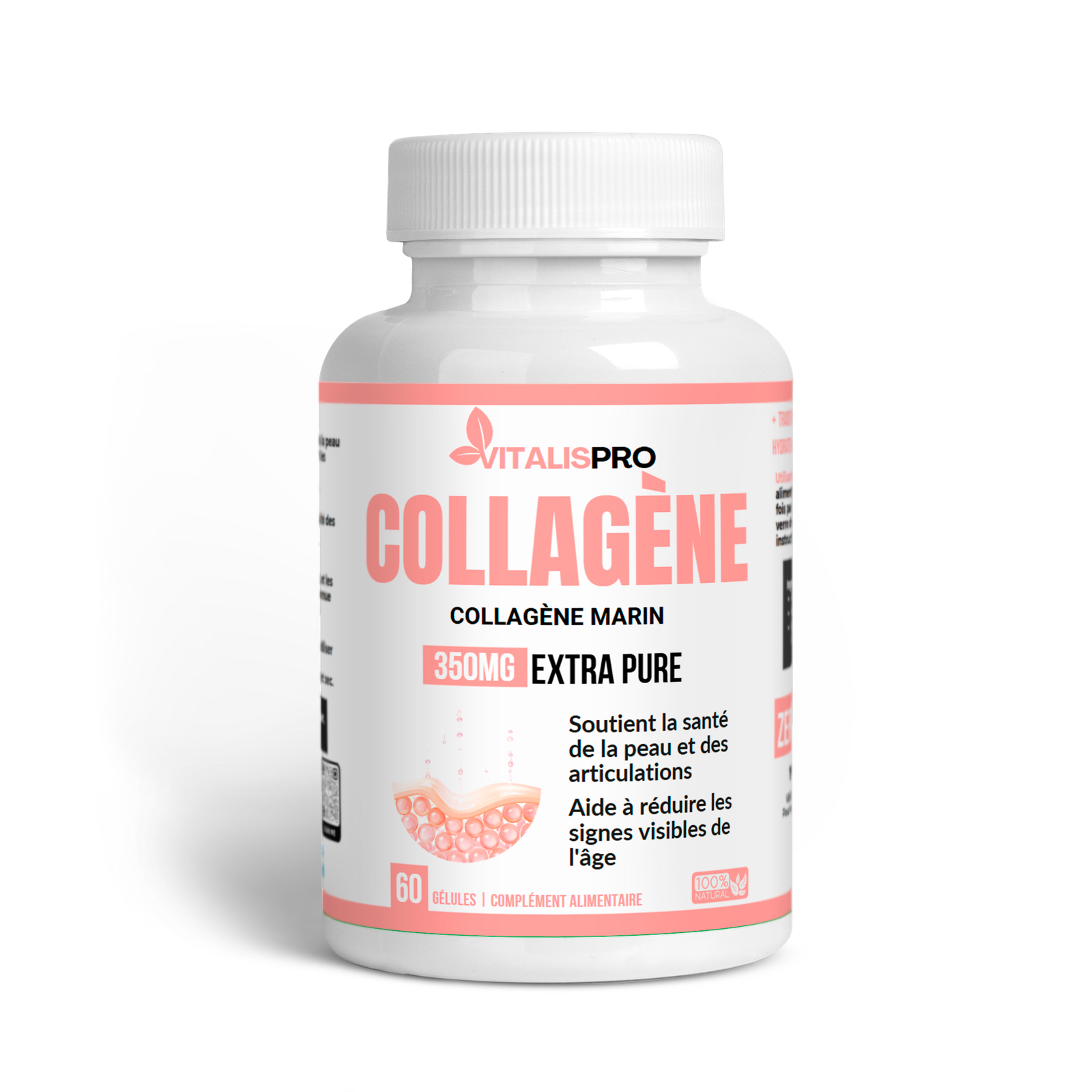
Before going further, let us clarify a term that appears constantly in reviews. The collagen used in dietary supplements comes from different sources. Marine collagen, extracted from fish skin and scales, is particularly valued for skin goals because its structure is close to our own cutaneous collagen and it is well absorbed. Collagen of bovine origin is also widely used. As for “plant-based collagen”, this refers in practice to a set of nutrients that stimulate natural production, not to collagen as such. For those who want to explore this landscape further, our team has detailed it in the complete guide to marine collagen in Morocco.
In this general-audience video, the media outlet RTL addresses precisely the question that everyone is asking: is marine collagen truly an anti-ageing ally? A useful starting point before diving into the detail of the studies.
Collagen reviews: what users in Morocco actually say
Let us get to the heart of the matter. When you read the feedback carefully — setting aside promotional narratives and disappointments arising from unrealistic expectations — a coherent picture emerges. Here is what our team observes most consistently in serious reviews.
Skin: suppleness and comfort above all
This is the most frequently cited area. People who follow a consistent programme most often describe skin that feels more supple, better hydrated, and more comfortable — particularly in dry zones such as the legs and hands. The word that keeps coming up is not “effective” but “comfort”. The skin is less tight, the texture seems more even.
Honest reviews consistently stress one point: patience is required. No one credible reports a result in three days. The most substantive accounts describe a perceptible change after six to eight weeks of daily use. This is consistent with biology, since skin renewal takes time.

Nails and hair: an effect frequently noticed
The second recurring observation: nails that split less and grow more evenly. This is among the most frequently mentioned changes, and one of the quickest to appear — sometimes as early as the second month. For hair, reviews are more mixed: some describe a denser appearance, others notice nothing significant. Caution remains warranted in this area.
Joints: gradual relief
An application many people discover only later. Beyond the beauty angle, a notable body of feedback — particularly from active individuals and those over fifty — describes more supple joints and reduced discomfort after several weeks. The knees and shoulders are the most commonly cited areas. Here too, the watchword is consistency, not speed.
The common denominator across all credible reviews: patience. Collagen does not act like a medication. It accompanies, over several weeks, the body’s deep, ongoing work.
Disappointed reviews: why some programmes yield nothing
Honesty requires us to address the negative feedback too, because it is instructive. When a programme yields no result, it is almost always for one of the following reasons: a collagen dose that is too low, a programme abandoned after ten days, the absence of vitamin C to support synthesis, or unrealistic expectations fuelled by misleading advertising. Understanding these pitfalls is already a significant step towards stacking the odds in your favour.
The science: what studies actually demonstrate
Personal reviews are valuable, but they do not replace research. Here is what clinical trials establish, in plain language, without embellishment.
Skin: robust data on elasticity and hydration
This is the best-documented area. Several clinical trials, pooled in synthesis analyses, show that taking collagen peptides for eight to twelve weeks is associated with measurable improvements in skin hydration and elasticity. A systematic review published in a dermatology journal examined many trials and concluded in favour of a beneficial effect on these cutaneous parameters, as detailed in this reference analysis on PubMed1.
The mechanism is interesting. Once ingested, collagen is broken down into small peptides. Some of these fragments act as messengers, signalling the skin cells known as fibroblasts to produce more collagen and other supporting components. In other words, the benefit goes beyond providing raw material — it also stimulates natural production. A second synthesis confirmed this positive trend for skin appearance, available in this more recent review on PubMed2.
Joints: comfort support in active individuals
The second avenue of research concerns the joints. Trials conducted with athletes and individuals experiencing activity-related joint discomfort found that prolonged collagen peptide supplementation is associated with a reduction in discomfort and improved ease of movement. A frequently cited controlled trial in athletes reported decreased joint discomfort during exercise, as described in this clinical study referenced on PubMed3.
The explanation lies in the composition of cartilage, which is rich in type II collagen. By providing the necessary building blocks and stimulating the cells that maintain cartilage, the peptides contribute to preserving this tissue. This aligns with what many active people intuitively notice after a few weeks of supplementation.
For those whose priority is joint and bone health, our team has also gathered its reference points in the bone and joint health section of the range, which complements a beauty-focused programme.
The decisive role of vitamin C
Here is a point that too many programmes overlook, and which explains a great many disappointments. The body cannot make collagen without vitamin C. This vitamin is an indispensable cofactor for the enzymes that assemble and stabilise collagen fibres. Without it, the production chain stalls.
This is not a marketing claim — it is a fact recognised by the relevant authorities. The health claims register of the European Food Safety Authority states that vitamin C contributes to the normal formation of collagen for the normal function of skin, bones, cartilage, gums, teeth, and blood vessels. This effect is recorded in the EFSA health claims register5. This is precisely why Alphavital systematically combines vitamin C with marine collagen: each potentiates the other.

What remains to be confirmed
Scientific rigour requires stating this plainly. Not all claims are equal. The effects on skin and joints rest on data of increasing quality, but protocols vary across studies and the magnitude of benefit differs from one person to another. This is also the tone adopted by leading health institutions, such as the Cleveland Clinic in its collagen fact sheet6 and the Mayo Clinic in its general-audience briefing7: encouraging signals, but no miraculous promise. Other avenues, such as effects on bone density or certain metabolic aspects, are promising but still emerging. Our editorial stance is consistent: we present these subjects as fields of study, never as commercial certainties.
How to read a collagen review without being misled
The collagen market overflows with promises. Learning to decode a review means protecting yourself from disappointment. Here is the reading grid our team uses.
| Red flag in a review | What it reveals | The right response |
|---|---|---|
| Result “in 3 days” | Unrealistic expectation | Target 8 to 12 weeks |
| No mention of vitamin C | Incomplete formula | Choose a collagen + vitamin C pairing |
| Collagen dose not specified | Lack of transparency | Insist on a clear composition |
| Promise of a “cure” | Non-compliant claim | Be wary; stay in the wellness space |
| Programme abandoned too early | Premature verdict | Complete a full programme |
A reliable review is almost always nuanced. It describes a gradual change, mentions the duration of the programme, and makes no extravagant promises. Conversely, a review that trumpets an instant transformation should trigger caution. Collagen is a serious ally, not a magic wand — and this honesty is precisely what builds trust.
Marine or bovine: which for which goal?
This question recurs constantly in reviews. In practice, marine collagen is often preferred for skin-focused goals, owing to its good absorption profile and its structural similarity to our own cutaneous collagen. Both sources can support joint health. For daily use oriented towards beauty and suppleness, marine collagen provides a solid foundation, which explains Alphavital’s choice for its reference formula.

Nourishing and protecting your collagen through food
Before any supplement, there is the table. The body builds collagen from what you give it, and certain dietary habits — some of them deeply rooted in Moroccan tradition — genuinely support that production.
Foods that provide the building blocks
Collagen is constructed from amino acids, principally glycine and proline, found in quality proteins. Long-simmered bone broths — a staple of Moroccan culinary heritage — are an ancestral source. Eggs, fish, poultry, and legumes also supply the necessary amino acids. Nothing exotic here: it often comes down to returning to generous home cooking.
The nutrients that activate synthesis
Providing the building blocks is not enough — they must also be assembled. This is where vitamin C, zinc, and copper come in, the true construction workers of collagen synthesis. Citrus fruits, peppers, and parsley, all abundant at Moroccan market stalls, are packed with vitamin C. A colourful plate is, at heart, a plate that supports collagen.
| Category | Examples accessible in Morocco | Contribution to collagen |
|---|---|---|
| Simmered broths | Bone broth, harira | Amino acids (glycine, proline) |
| Proteins | Eggs, fish, poultry | Building blocks |
| Vitamin C sources | Orange, lemon, pepper, parsley | Synthesis cofactor |
| Antioxidant fruits | Pomegranate, fig, grape | Protect existing collagen |
Collagen’s enemies to limit
Conversely, some factors accelerate its degradation. Excess sugar triggers a process called glycation, which stiffens and weakens collagen fibres. Tobacco and unprotected sun exposure rank among the worst enemies of cutaneous collagen. Limiting these aggressors means protecting existing collagen capital, alongside any external supplementation. For those who also want to address stress — which weighs heavily on the skin — our guide to natural stress management extends this reading usefully.
When a collagen programme in Morocco genuinely makes sense
Food first, always. But there are moments when a well-formulated programme provides a relevant boost. Understanding these situations helps you choose the right moment.
The signals that invite you to consider a programme
Several situations recur in reviews as triggers: skin that visibly loses firmness from the early thirties, brittle, splitting nails, joint discomfort that builds with age or physical activity, or simply the desire to maintain one’s beauty capital preventively. Collagen is not reserved for any specific age, but its relevance naturally grows as internal production declines.
The three criteria of a good formula (and fair value)
If you decide to take the step, three criteria make all the difference. First, marine collagen, the guarantee of good absorption. Second, the presence of vitamin C, without which synthesis cannot proceed correctly. Third, a transparent composition, a price consistent with the dosage, and a logic of consistent supplementation over several weeks. Before comparing reviews or prices in Morocco, these three benchmarks are what you should keep in mind. This is exactly the philosophy that has guided our team.
The Alphavital response
Alphavital has designed a formula that brings together the essentials in one daily gesture: marine collagen, chosen for its absorption profile, combined with vitamin C, which contributes to the normal formation of collagen for skin, bones, and cartilage. This pairing is not incidental. It directly reflects what the research and the authorities have established, and what the most reliable reviews confirm day after day.
The formula is used as a consistent programme over several weeks, because it is constancy that establishes the benefits, never haste. It sits within our Beauty & Anti-Ageing range, conceived as a coherent set in service of skin, nails, and suppleness. For skin and nails specifically, our team also offers a targeted supplement described in the Skin & Nails category.
A good collagen programme is not summarised by a pretty label. It brings together well-absorbed marine collagen, the vitamin C that makes it operational, and the consistency that does the rest.
For those who wish to combine skin beauty with joint support in a more complete approach, our team also offers a programme that enriches marine collagen with the nutritional richness of moringa — the Beauty & Joints Collagen and Moringa programme. And to specifically support hair growth and nail strength, Alphavital’s Biotin concentrate ideally completes an inside-out beauty routine.
Getting the most from your collagen programme: a practical guide
A few practical guidelines help avoid common errors and allow you to make the most of a programme. These details are often what separates an enthusiastic review from a disappointed one.
Dosage and timing: when and how to take it
Collagen is taken as part of a daily programme — capsule or powder — at whatever time fits most naturally into your routine. Morning or evening, consistency is what matters. A large glass of water accompanies the dose. Many people intuitively pair collagen with a vitamin C intake, which is well-reasoned — and precisely why Alphavital’s formula already includes both.
How long should a programme last?
This is the most important point, and the most poorly understood. A collagen programme is measured in weeks, not days. Allow at least eight to twelve weeks to assess the first results on skin, and often a little longer for joint comfort. Many people subsequently choose a maintenance approach with spaced-out programmes. Duration, as much as quality, is what makes the difference in the reviews.
Precautions to keep in mind
Marine collagen is generally very well tolerated. A few precautions nevertheless apply. People with a fish allergy should avoid marine collagen. In the event of pregnancy or breastfeeding, a chronic condition, or ongoing medication, the advice of a healthcare professional is essential before starting. A collagen programme can never replace a balanced diet or appropriate sun protection, especially under Morocco’s sun.

The feedback our team receives is worth more than any promotional speech. Here are three accounts, shared with their authors’ consent, faithful to what they wrote to us, without embellishment.
At forty-three, I noticed my skin looking duller and my hands feeling drier, especially in winter in Fès. I kept to a programme for two and a half months without expecting anything spectacular. What I gained was skin that felt more comfortable, less tight. Not a effective, but a real improvement I no longer wanted to do without. — Naïma, Fès
I run three times a week and my knees were making me pay for it. A friend mentioned collagen — I was sceptical. After about ten weeks of consistent supplementation, I recover more quickly and the discomfort after long runs has eased. I keep it up now, out of habit. — Younes, Casablanca
My nails kept splitting, it was a daily nuisance. That was the first change I noticed, from the second month: noticeably stronger nails. For my skin, it is more subtle, but the overall result convinced me to carry on. — Khadija, Agadir
These accounts illustrate a simple truth — the same one the studies confirm: the most lasting results come from consistency, a serious formula, and realistic expectations. A question before you start? Our team answers directly via the Alphavital contact page.
For a balanced and nuanced analysis, this general-audience video honestly sorts through what is established from what remains hopeful, without overpromising.
Frequently asked questions about collagen and its reviews
Is marine collagen truly effective according to the reviews?
The most reliable reviews, like the clinical studies, converge on a favourable effect on skin suppleness and hydration, nail strength, and joint comfort. The condition is always the same: a consistent programme of several weeks and a formula containing vitamin C. No serious review describes an instantaneous result.
How long before you see the first effects?
Generally allow eight to twelve weeks of daily intake for skin, and often a little longer for joint comfort. Nails are among the first changes noticed, sometimes as early as the second month. Consistency is decisive: benefits build up over time, not within a few days.
Should collagen be combined with vitamin C?
Yes, this is essential. The body cannot make collagen without vitamin C, which is an indispensable cofactor in its synthesis. EFSA recognises that vitamin C contributes to the normal formation of collagen for skin, bones, and cartilage. Alphavital’s formula already combines both for this reason.
Marine or bovine collagen: which to choose?
Marine collagen is often preferred for skin-focused goals, owing to its good absorption and its structural similarity to our own cutaneous collagen. Both sources can support joint health. For daily use oriented towards beauty and suppleness, marine collagen provides a solid foundation, and this is the choice made by Alphavital.
Does collagen have side effects?
Marine collagen is generally very well tolerated. The principal precaution concerns people with a fish allergy, who should avoid it. In the event of pregnancy, breastfeeding, a chronic condition, or ongoing treatment, consult a healthcare professional before starting.
Does collagen genuinely help the joints?
Several clinical trials observe a reduction in joint discomfort and improved ease of movement following prolonged supplementation with collagen peptides, particularly in active individuals. Since cartilage is rich in collagen, a consistent programme supports this tissue. Results appear over the course of several weeks.
Can you get enough collagen from food alone?
Food provides the necessary building blocks, notably through bone broths, eggs, fish, and vitamin C sources. But as we age, natural production declines and dietary intake does not always compensate. A marine collagen programme can then provide targeted support, as a complement to a balanced diet.
In summary
The verdict from reviews, cross-referenced with the science, is more nuanced than advertising suggests, and considerably more encouraging than sceptics would have us believe. Marine collagen, taken in a consistent programme and combined with vitamin C, genuinely supports skin suppleness, nail strength, and joint comfort. Not in three days, but over several weeks, with patience and consistency.
In Morocco, where sun exposure and dry air stress the skin more than in many countries, maintaining one’s collagen capital represents nutritional wisdom informed by research. This is the path Alphavital has chosen, with a transparent formula, faithful to the science, and honest about its promises. And it may be one of the most worthwhile long-term investments for both beauty capital and mobility.
About the author. Houda Khaldi is Editorial Nutrition Advisor at Alphavital. She translates scientific research into clear, practical benchmarks for everyday life in Morocco.
Disclaimer. The information presented is provided for guidance purposes, based on sourced research (PubMed, EFSA). The Alphavital team does not include healthcare professionals. Consult a qualified healthcare professional before any use, in the event of ongoing treatment, pregnancy or breastfeeding, a medical condition, or fish allergy. Food supplements do not replace a varied, balanced diet and a healthy lifestyle.
Sources and references
- Choi F. et al. — Collagen peptides and skin parameters, systematic review. PubMed
- de Miranda R. et al. — Collagen supplementation and skin ageing, review. PubMed
- Clark K. et al. — Collagen and joint pain in athletes, controlled trial. PubMed
- Bolke L. et al. — Collagen supplement and skin hydration/elasticity, randomised trial. PubMed Central
- Health claims register (vitamin C, normal collagen formation). EFSA
- Collagen: types, function, and benefits, reference health fact sheet. Cleveland Clinic
- Does collagen really help fight wrinkles and ageing? A briefing. Mayo Clinic