

Stress & Sleep
Ashwagandha in Morocco has become the most-discussed adaptogen for managing stress. But what do clinical trials actually demonstrate — and what do they not yet prove? Here is a rigorous, source-by-source breakdown to distinguish what is established from what remains hopeful, and to situate ashwagandha within a thoughtful daily routine.
A plant that claims to help the body better resist stress deserves the same scrutiny as a pharmaceutical: hard evidence, precise dosages and honest limits. Ashwagandha (Withania somnifera) checks some of these boxes, which is precisely what makes it interesting. Its millennia-long reputation in Ayurvedic medicine is not enough; what counts are the controlled data published over the past twenty years. We have read them for you.
In Morocco, the subject is far from trivial. Mental workload in Casablanca, disrupted sleep, the constant pressure of screens — chronic stress is part of the landscape. Interest in ashwagandha in Morocco grows as research advances, but enthusiasm must never outrun the evidence. Our method is simple: one claim, one reference, one nuance.
Contenu de la page
- 1 Key facts at a glance
- 2 Contents
- 3 What is ashwagandha, and what is an adaptogen?
- 4 What the studies show — and do not show
- 5 Cortisol: the hormone at the heart of the debate
- 6 Why the extract matters more than the plant name
- 7 Stress and sleep: the Moroccan context
- 8 How to integrate ashwagandha into your routine
- 9 Precautions, interactions and limits
- 10 Three readers share their experience
- 11 Frequently asked questions about ashwagandha
- 12 Key takeaway
- 13 Sources and methodology
Key facts at a glance
- 300 to 600 mg/day of standardised root extract: the most-studied range in controlled clinical trials on stress and sleep.
- 5% withanolides: the chemical benchmark that serves as a quality marker; the effect depends on the extract, not simply on the word “ashwagandha”.
- 6 to 8 weeks: the minimum duration observed in most trials before benefits on perceived stress become measurable.
- Adaptogen means “helps the body adapt”: a useful concept, but a framework — not a validated health claim.
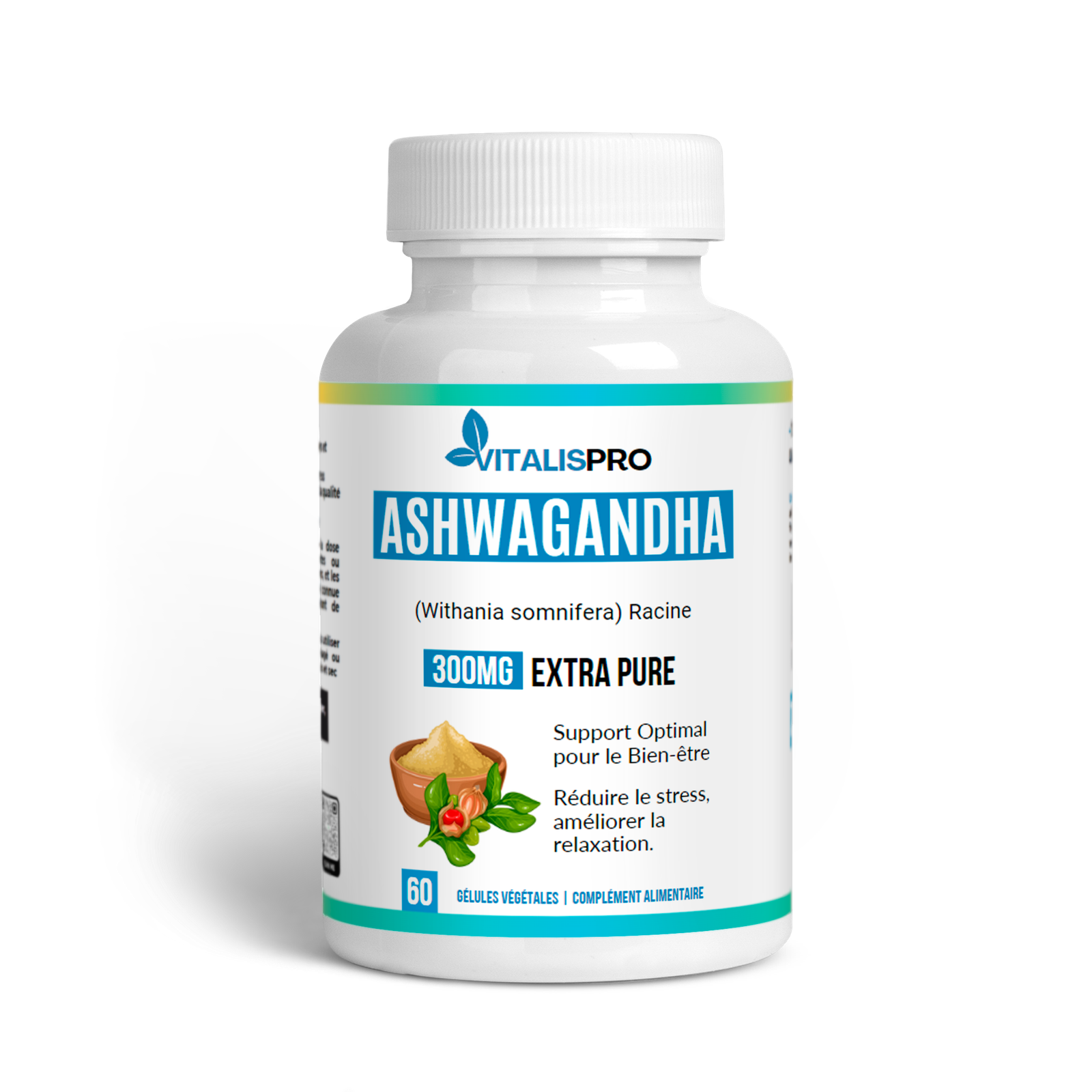
- Alphavital offers a 300 mg ashwagandha extract, designed to integrate simply into a routine and declared compliant with Moroccan regulatory requirements.
What is ashwagandha, and what is an adaptogen?
The word appears everywhere, often without a definition. Let us provide one. An adaptogen refers to a plant-based substance believed to help the body better adapt to stressors — physical, chemical or emotional. The concept emerged in mid-twentieth-century pharmacological research. It describes a family of plants — including ashwagandha, rhodiola and ginseng — rather than a precise regulatory category.
First nuance, and it matters: “adaptogen” is a conceptual framework, not an official label guaranteeing an effect. No health authority has established a list of validated claims for this term. At Alphavital, we use it to situate the plant within its history and tradition — never to attribute a therapeutic power to it. Rigour begins with vocabulary.
Ashwagandha occupies a special place within this family. It is, to date, the most-studied adaptogen for its interaction with the stress response. The reference factsheet from the US National Center for Complementary and Integrative Health (NIH/NCCIH)1 notes that human data, while promising on stress and sleep, remain to be consolidated over time. That is the right starting point: genuine interest, paired with honest caution.
A root, a long history and codified uses
Ashwagandha has been used for more than two thousand years in Indian Ayurvedic tradition. Its Sanskrit name evokes the smell of a horse, referencing the vigour once attributed to it. It is the root — not the leaves — that concentrates the active compounds studied today, foremost among them the withanolides. This anatomical detail is not incidental: it explains why a serious extract always specifies which part of the plant was used.
Tradition is a respectable starting point, but it does not constitute proof. That is precisely the aim of this article: to confront ancestral use with modern controlled data, and to see where the two converge.
Ashwagandha, rhodiola, ginseng: what are the differences?
Since the word “adaptogen” covers several plants, a question arises: which one for what purpose? Without entering a comparison that goes beyond our scope, here are the broad evidence-based outlines. Rhodiola is primarily studied for short-term mental fatigue and cognitive performance. Ginseng is historically associated with general vitality. Ashwagandha is distinguished by its specific interaction with the stress response and sleep, making it the reference adaptogen on that precise terrain. Each plant has its domain, and presenting them as interchangeable would be misleading.
This specialisation explains why our team selected ashwagandha — and not another adaptogen — for its anti-stress extract. The choice is not aesthetic: it follows from where human evidence is most consistent. Choosing an active ingredient based on the objective, not the reverse, is the first mark of a serious formulation.
What the studies show — and do not show
Let us get concrete. The internet promises a great deal; scientific journals, by contrast, measure. Here is the state of the evidence, domain by domain, systematically distinguishing the solid from the preliminary.
To contextualise cortisol and why its chronic elevation is problematic, this explainer from the Médecine TV channel covers in two minutes how this hormonal stress mechanism works.
Perceived stress and anxiety: the most documented terrain
This is where the data are most convergent. Several randomised, placebo-controlled trials conducted in healthy adults under chronic stress report a reduction in perceived stress after six to eight weeks of supplementation. A systematic review and meta-analysis is the reference on this point: it pooled these trials and concluded in favour of an effect, while highlighting the heterogeneity of protocols. Details are available via this meta-analysis indexed on PubMed2.
What should we take away, without over-interpreting? That the signal exists and is consistent across studies — which is rare in herbal medicine. But also that sample sizes remain often modest, durations are short, and measurement relies heavily on self-reported questionnaires. The picture is encouraging; it is not definitive. This is exactly the nuance that a discerning reader has every right to expect.
A result consistent across studies is not absolute proof. It is a convergent body of evidence. Our role is to present it as such — neither inflating nor minimising it.
Sleep: an interesting secondary signal
Several trials with stress as the primary outcome also measured sleep quality as a secondary endpoint. The emerging trend is broadly favourable: better perceived sleep onset, sleep reported as more restorative. A dedicated analysis, published in a peer-reviewed journal and referenced by the public US portal MedlinePlus3, classifies sleep among uses for which evidence is emerging but not conclusive.
The nuance applies again. Sleep being a secondary outcome makes it more vulnerable to bias. Let us be direct: ashwagandha is not a sleeping pill and must never be presented as one. It belongs within an overall sleep hygiene framework, alongside light exposure, regular bedtimes and upstream stress management.

Energy, performance and recovery: younger avenues
It is often claimed that ashwagandha “boosts energy.” Let us be precise. Some trials in active individuals observed changes in strength or recovery parameters, but these studies are fewer in number, sometimes industry-funded, and their protocols vary widely. The independent database Examine.com4, which grades evidence quality per active ingredient, classifies these effects as plausible but far less consolidated than the action on stress.
Our editorial position is consistent: we present energy and performance as promising fields of study, not as promises. This restraint is not commercial timidity. It is, in our view, the condition for a brand worthy of trust.
What remains to be confirmed
Honesty requires drawing a boundary. It is sometimes claimed that ashwagandha acts on male hormonal balance, blood sugar or inflammation. These avenues exist in the literature, but at a far more preliminary stage: restricted sample sizes, inconsistent results across studies, no large-scale replication. The MedlinePlus portal classifies most of these uses as “evidence insufficient.” Our line is clear: we mention them as fields of study, never as sales arguments. A plant can be genuinely interesting for stress without being a panacea — and that is perfectly fine.
This distinction between solid evidence and promising hypothesis is not an academic detail. It protects the reader from unrealistic expectations, and it protects a brand’s credibility in the long run. Promising less and delivering it is worth more than overpromising and disappointing.
Cortisol: the hormone at the heart of the debate
It is impossible to discuss ashwagandha without discussing cortisol. This is the mechanism most commonly advanced to explain its action. Let us examine it carefully, because this is where many articles slide from science into shortcut.
Cortisol is a hormone produced by the adrenal glands. In the short term, it is useful: it mobilises energy in response to a threat. The problem arises when stress becomes chronic and cortisol remains persistently elevated. Several ashwagandha trials have measured a drop in salivary or blood cortisol in stressed adults, alongside improvements in perceived stress. This parallel is what makes the hypothesis compelling.
Here is the nuance that few articles address. Correlation is not a demonstration of direct causation, and cortisol regulation is a complex system subject to a daily rhythm and many variables. Ashwagandha appears to act on the stress axis, but the exact mechanism remains only partially understood.
To situate stress itself within a broader scientific perspective — without demonising or idealising it — the ARTE channel offers a quality perspective, usefully reminding us that not all stress is pathological.

Why the extract matters more than the plant name
This is arguably the most misunderstood point for the general public — and the one that separates a serious supplement from an anecdotal product. Saying “ashwagandha” tells you almost nothing, in the same way that saying “coffee” tells you nothing about the caffeine dose. What matters is the extract and its standardisation.
Three parameters determine the quality of an extract, and we detail them in the interest of transparency — without citing any input brand name.
- Plant part: the root concentrates the studied compounds. A serious extract specifies this.
- Standardisation benchmark: withanolide content, often expressed as a percentage (e.g. 5%), conditions the concentration of active compounds.
- Dose per serving: it should fall within the actually-studied range, i.e. 300–600 mg of extract per day.
This is exactly the logic guiding Alphavital’s work. Rather than competing on marketing numbers, our team chose a root extract at a dosage consistent with the literature, traceable batch by batch. Traceability is not a decorative argument: it is the condition for a trustworthy supplement. This commitment sits within our Stress & Sleep range, designed as a coherent whole.
Reading an ashwagandha label without making mistakes
Let us put this framework into practice. Faced with a product, an informed buyer asks four questions, in this order. First: does the label specify that it is a root extract? If the plant part is not stated, that is a first warning sign. Second: is the withanolide standardisation mentioned? That is the indicator of active compound concentration. Third: does the dose per serving fall within the studied range of 300–600 mg? Fourth: are traceability and regulatory compliance documented?
These four markers are enough to distinguish a serious extract from an anecdotal product. They are worth more than any marketing superlative. This is precisely the transparency our team applies to Alphavital’s ashwagandha extract: plant part, dosage and compliance stated plainly. To extend this approach into a broader wellness framework, our reference guide to adaptogenic plants in Morocco and our dossier on magnesium and stress management make useful reading.
Stress and sleep: the Moroccan context
A plant cannot be evaluated in a vacuum. It exists within a way of life. And daily life in Morocco presents specific characteristics, in terms of stress, that are worth naming.
Urban life in the major cities — Casablanca and Rabat foremost — imposes a dense rhythm: long commutes, extended working days, the constant pull of screens. The boundary between work and rest dissolves, along with the decompression time the body needs. Sleep often pays the price, eroded by late-night notifications. This profile will be immediately recognisable to the active professional in their thirties or forties.

How can one tell whether stress has shifted from passing to chronic? Several signals recur: sleep that no longer feels restorative, growing irritability, persistent physical tension, difficulty switching off even at rest. None of these signs constitutes a diagnosis, and only a healthcare professional can assess them. But recognising them early means acting on the right levers, rather than simply enduring.
Should one expect everything from a supplement? Certainly not. Ashwagandha only makes sense as support alongside coherent lifestyle habits. This is the logic our team defends in its guide on natural stress and sleep support: address the fundamentals first, then consider targeted support.
The fundamentals, before any supplementation
Before thinking about a supplement, a few levers carry more weight than any active ingredient. Here they are, in order of importance.
| Lever | Why it matters | Practical action |
|---|---|---|
| Regular sleep schedule | Stabilises the cortisol rhythm | Fixed bedtimes |
| Screen exposure | Delays sleep onset | Switch off 1 hour before bed |
| Physical activity | Regulates the stress response | Daily walk |
| Caffeine | Prolongs alertness | Avoid after 4 pm |
| Breathing, breaks | Activates the relaxation response | A few minutes each day |
A well-formulated supplement comes next, as support — never as a substitute. This order of priority is not a moral detail: it reflects what studies show, where the plant’s effect adds to a healthy lifestyle without replacing it.
How to integrate ashwagandha into your routine
Let us move to practice, step by step. This approach synthesises what study protocols most commonly apply, transposed to a reasonable daily use.
Step one: choose the right moment
Ashwagandha is generally taken with a meal to minimise any digestive discomfort. Timing depends on the goal: in the evening if targeting end-of-day comfort and sleep onset, in the morning or at midday for daytime support. No universal rule applies; consistency matters more than the exact time.
Step two: respect the studied dose
There is no need to overdose. The range of 300–600 mg of extract per day is what trials have tested. Alphavital offers a 300 mg extract — a sensible starting point. Begin simply, observe how you feel, then adjust thoughtfully: that is the healthiest logic.
Step three: stay the course
This is the step everyone underestimates. The benefits observed in trials appear after several weeks — rarely sooner. Irregular intake over a few days does not reflect what the research has measured. Allowing six to eight weeks of regular use before forming a judgement is the most honest approach.
Step four: observe, then decide
At the end of this period, take stock honestly. What has changed in terms of perceived stress and sleep? Listening to yourself — without magical expectations — remains the best judge. And at the slightest doubt, professional medical advice takes precedence over everything else.

When combining with other actives makes sense
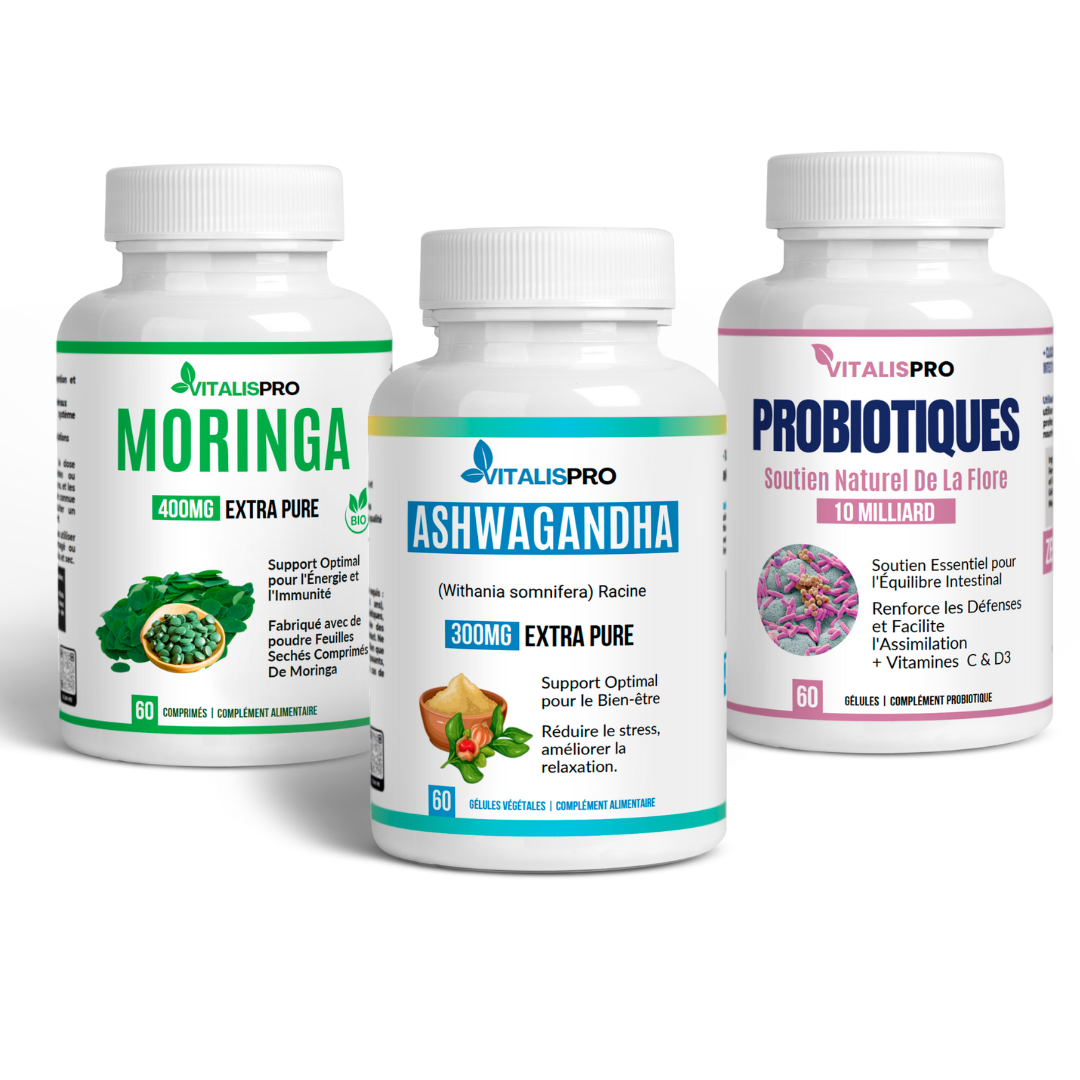
Ashwagandha sometimes benefits from pairing with actives that have complementary logic. Magnesium glycinate, for example, is studied for the nervous system, while moringa provides a nutritional foundation. This is precisely the logic of the programme our team formulated for the most demanding profiles, combining ashwagandha, magnesium and moringa in a “mental clarity” approach.

Precautions, interactions and limits
An honest evidence review does not stop at benefits. It also names limits and situations requiring caution. This is the section that promotional content typically omits; for us, it is central.
Ashwagandha is broadly well tolerated at studied doses. Some precautions are nonetheless non-negotiable. French health authorities, via ANSES5, remind us that food supplements are not without risk and are unsuitable for all profiles.
- Pregnancy and breastfeeding: use is discouraged as a precaution, given insufficient data.
- Thyroid disorders: ashwagandha may interact with thyroid function; medical advice is essential.
- Concurrent medication: sedatives, anxiolytics, thyroid treatments or immunomodulators require consultation with the prescribing professional.
- Chronic or autoimmune conditions: caution is warranted, again after medical advice.
Let us be direct: no supplement replaces a medication or medical monitoring. Ashwagandha is not a treatment. It is a natural support that only makes sense within a reasoned framework. This honesty about limits is, paradoxically, what makes a recommendation credible.

The feedback our team receives is not scientific proof, and we present it as such: individual experiences, shared with the authors’ consent. They illuminate real-world use without proving anything in themselves.
I manage a small team, and the mental load never let up — even in the evenings. I tried the extract for two months, alongside a genuine effort to fix my bedtime. The change is nothing spectacular: just evenings where I can finally switch off. — Younes, Casablanca
My sleep was fragmented — waking at three in the morning with my head full. I combined ashwagandha with magnesium, and most importantly cut screens earlier. After six weeks, my nights became more continuous. I remain cautious, but it is real for me. — Hicham, Rabat
What persuaded me was the honesty of the message — no effectiveness claims. I took the extract consistently during a demanding period. I felt more composed under pressure. — Rachid, Marrakech
These accounts share a constant: the most solid results come from combining a healthy lifestyle with, when appropriate, a well-chosen supplement. A question before you start? Our team responds directly via the Alphavital contact page.
Frequently asked questions about ashwagandha
Key takeaway
Ashwagandha is the best-documented adaptogen for perceived stress, provided you choose a standardised root extract dosed at 300–600 mg/day, taken consistently over six to eight weeks. The sleep signal is encouraging but secondary; other avenues remain to be confirmed. A well-chosen supplement supports healthy lifestyle habits — it never replaces medical advice.
Sources and methodology
This article follows one simple rule: every substantive claim is backed by a verifiable source, and every source is qualified according to its level of evidence. We prioritised, in order, systematic reviews and meta-analyses (the highest level of evidence in nutrition), factsheets from public health authorities, and then independent databases that grade study quality. Promotional content and isolated case studies were excluded. When evidence is emerging, we say so; when it is solid, we specify that too. No health claim is made: ashwagandha is presented as a natural support, not a treatment.
Sources and references
- NIH — National Center for Complementary and Integrative Health, Ashwagandha factsheet. nccih.nih.gov
- Akhgarjand C. et al. — Effect of ashwagandha on anxiety and stress, systematic review and meta-analysis. PubMed
- Ashwagandha — monograph and level of evidence by use. MedlinePlus (NIH)
- Ashwagandha — evidence synthesis graded by effect. Examine.com
- Food supplements — guidance and precautions. ANSES
Disclaimer. The information presented is provided for informational purposes only, based on sourced research (PubMed, NIH, MedlinePlus, ANSES, Examine.com). The Alphavital team is not composed of healthcare professionals. Consult a qualified healthcare professional before any use, particularly if you are on ongoing medication, pregnant or breastfeeding, or have an existing health condition. Food supplements do not replace a varied, balanced diet or a healthy lifestyle.
Chérif Belhassane is Editorial Nutrition Advisor at Alphavital. His role: to verify that every published claim is backed by solid references, to distinguish levels of evidence, and to refuse any overstatement. He is not a healthcare professional; his work is documentary and editorial.