

5-HTP, derived from the seed of Griffonia simplicifolia, has emerged as the premier “mood” angle within the nervous-wellness category: a natural serotonin precursor that connects emotional balance, appetite regulation, and sleep quality in one elegant biochemical chain. Here is what the science actually says, what regulators authorise us to claim, and the measured approach Alphavital takes to this support.
There are days when nothing is truly wrong, yet everything feels a fraction heavier than it should. A grey November sky settles in, motivation quietly recedes, and the mood dips without any obvious reason. In the evening, instead of unwinding, you find yourself opening the kitchen cupboard for something sweet — almost against your will. Then comes the night, and the mind refuses to let go. Many Moroccans recognise this sequence: low mood, emotional cravings, a restless struggle to fall asleep. Three seemingly unrelated symptoms, one common thread.
That thread has a name: serotonin. This brain chemical messenger plays a central role in regulating mood, appetite and sleep onset. And in nature, there is an African seed from which the body draws a direct precursor to this molecule: 5-HTP, extracted from Griffonia simplicifolia. This guide is about that seed, what the research says, and the careful framework that surrounds its use.
By Houda Khaldi, Editorial Advisor in Natural Nutrition · Published 17 June 2026 · 18-minute read
Contenu de la page
- 1 Key Takeaways
- 2 Serotonin: The Messenger of Inner Calm
- 3 Griffonia simplicifolia: The African Seed Behind 5-HTP
- 4 Mood and Seasonal Low Spirits: Why Light Changes Everything
- 5 Emotional Cravings: When the Urge for Sugar Has Nothing to Do With Hunger
- 6 Sleep: From 5-HTP to Melatonin
- 7 5-HTP, Tryptophan, or St John’s Wort: Not Interchangeable
- 8 The Moroccan Context: Why Mood Deserves Attention
- 9 Feeding the Plate Well: Tryptophan on the Menu
- 10 When 5-HTP Support Makes Sense — and How to Use It
- 11 Three Readers Share Their Experience
- 12 Frequently Asked Questions About 5-HTP and Griffonia
- 12.1 What exactly is 5-HTP?
- 12.2 What is the connection between 5-HTP, Griffonia, and serotonin?
- 12.3 Does 5-HTP actually help with mood?
- 12.4 Can 5-HTP help with sleep?
- 12.5 Does 5-HTP help with sugar cravings?
- 12.6 When should 5-HTP be taken?
- 12.7 Are there contraindications for 5-HTP?
- 12.8 Where can I buy 5-HTP Griffonia in Morocco?
- 13 In Summary
Key Takeaways
- 5-HTP (5-hydroxytryptophan) is a naturally occurring molecule the body uses as an intermediate step in synthesising serotonin, a neurotransmitter tied to mood, appetite, and sleep.
- The best-known botanical source is the seed of Griffonia simplicifolia, a West African plant exceptionally rich in 5-HTP.
- Serotonin is also the starting point for melatonin synthesis — the hormone that signals nightfall to the body — which explains the link between 5-HTP, evening relaxation, and easier sleep onset.
- The “mood” and “emotional cravings” angle extends Alphavital’s Brain & Sleep hub, previously focused on memory, concentration, and sleep quality.
- 5-HTP carries real precautions: it is not recommended alongside certain mood medications, during pregnancy, or during breastfeeding. Consulting a healthcare professional is non-negotiable.
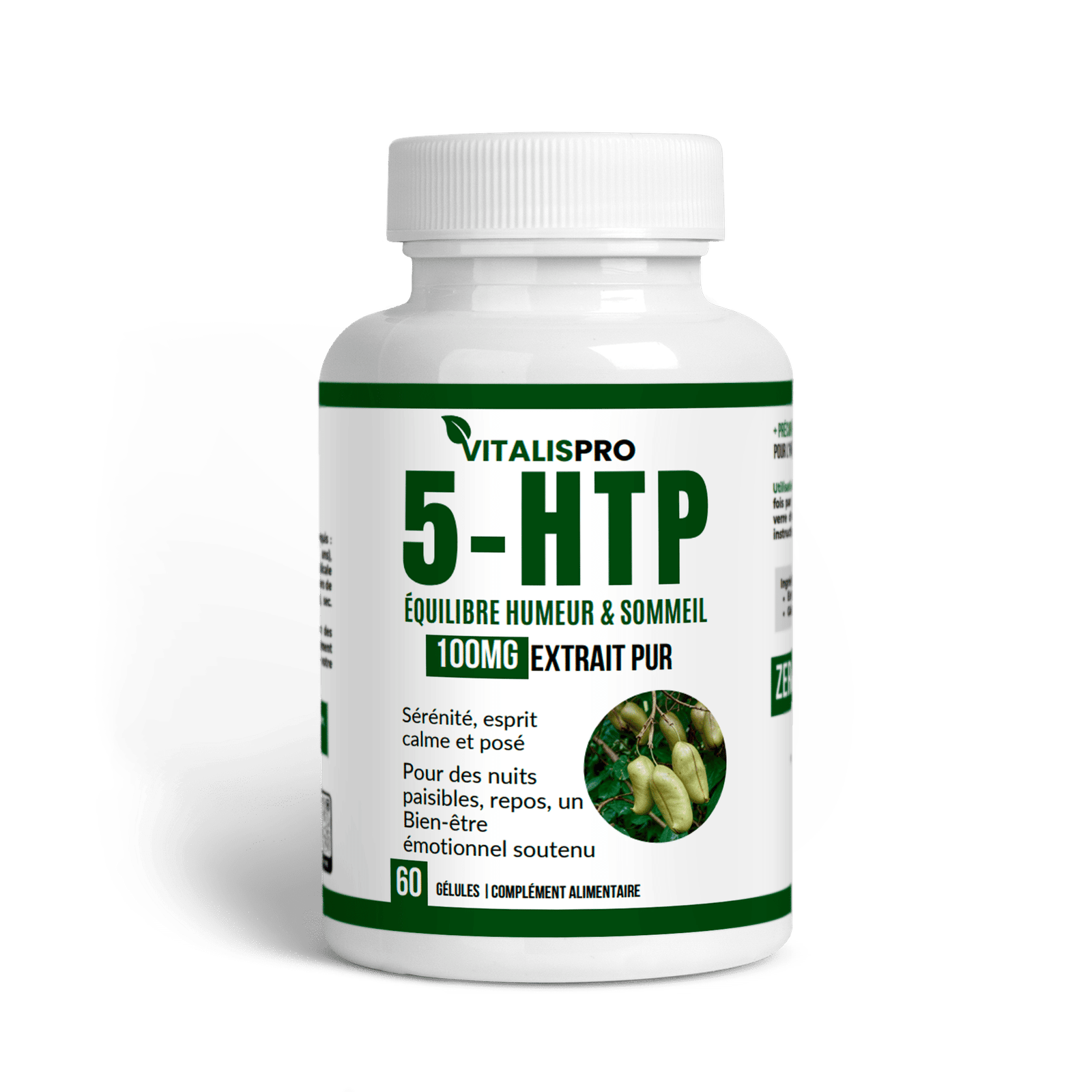
- Alphavital offers a 5-HTP Griffonia 100 mg formula, batch-traced, designed as a gentle support for nervous wellbeing and evening wind-down.

Serotonin: The Messenger of Inner Calm
Before discussing the seed, it is worth understanding the molecule it helps produce. Serotonin is a neurotransmitter — a substance that allows nerve cells to communicate with one another. It is sometimes called the wellbeing molecule, and that is not an empty phrase: it is involved in regulating mood, appetite, the threshold for satiety, the perception of pain, and at the end of the chain, the sleep–wake cycle.
Think of an emotional thermostat. When serotonin circulates in sufficient amounts, mood stays stable, appetite self-regulates without sharp swings, and the body knows when to slow down. When it runs low, the thermostat misfires: mood becomes more volatile, sugar cravings intensify, and sleep fragments. This is why a single biochemical imbalance can express itself through symptoms that, on the surface, seem unrelated.
Serotonin does not act on mood alone. It links, in one seamless mechanism, emotional balance, appetite regulation, and the preparation for sleep.
The body does not synthesise serotonin from scratch. It follows a precise transformation chain. Everything begins with a dietary amino acid, tryptophan. The body converts it first into 5-HTP, then transforms that 5-HTP into serotonin. This intermediate step — 5-hydroxytryptophan — is what is found, ready-made, in the Griffonia seed. That is the plant’s key advantage: it supplies the precursor directly, without requiring the body to complete the first, often rate-limiting, conversion step.
From Tryptophan to Sleep: A Three-Stage Cascade
To fully appreciate 5-HTP’s role, it helps to visualise the complete cascade. It unfolds in three stages, like a production line in which each step depends on the previous one. This logic explains why one molecule can bear on both mood and sleep simultaneously.
| Stage | Molecule | Role in the Body |
|---|---|---|
| 1. Dietary intake | Tryptophan | Starting amino acid, sourced from dietary protein |
| 2. Conversion | 5-HTP (Griffonia) | Direct precursor to serotonin |
| 3. Synthesis | Serotonin | Mood balance, appetite, satiety |
| 4. Evening | Melatonin | Sleep onset signal, the night hormone |
This diagram reveals a quiet elegance. The serotonin produced during the day becomes, as dusk falls, the raw material for melatonin — the hormone that tells the brain night has arrived. Supporting the first stage of this chain therefore acts, upstream, on two dimensions at once: daytime emotional balance and the evening wind-down that prepares for sleep. This logic is well documented in the scientific literature on tryptophan metabolism, as detailed in this full-text review available on PubMed Central1.
Griffonia simplicifolia: The African Seed Behind 5-HTP
Now for the plant itself. Griffonia simplicifolia is a climbing shrub that grows in the forests of West Africa, from Ghana to Côte d’Ivoire and Togo. Its pods contain black seeds with a property that is rare in the plant kingdom: they concentrate 5-HTP naturally, in proportions far exceeding most other known sources.
In traditional West African medicine, the plant was already in use. Modern analysis revealed why: its seeds contain 5-hydroxytryptophan at levels that make them, today, the botanical reference source for supplement production. The 5-HTP found in reputable formulas is not synthesised in a laboratory from chemical building blocks — it is extracted from the Griffonia seed, using processes that preserve the natural molecule.

This botanical origin matters. It explains why 5-HTP appeals to those who prefer natural approaches over fully synthetic molecules. A note of caution, however: natural does not mean innocuous. An active molecule remains an active molecule, and 5-HTP deserves the same respect for dosage and precautions as any pharmacopoeial compound. We will cover this in full detail below.
Mood and Seasonal Low Spirits: Why Light Changes Everything
The “mood” angle is the most requested — and the most delicate to handle honestly. Let us be clear from the outset: a supplement is neither a medication nor an answer to entrenched psychological distress. But understanding the physiological terrain helps people take better care of themselves on a daily basis, without confusion or inflated promises.
Serotonin and light maintain a close dialogue. Exposure to daylight partially stimulates serotonergic activity in the brain. This is one of the reasons why many people’s mood dims in winter, when days shorten. This phenomenon, well described in the literature as seasonal variation in mood, also touches Morocco, where winter in northern cities and the Atlas regions brings its share of short, overcast days.
Less light often means less drive. A winter dip in spirits is not a character flaw: it has a real physiological substrate.
When brightness falls, mood can follow. Energy dips, and one often notices a heightened pull towards sweet and starchy foods — as if the body were trying, through nutrition, to relaunch its own serotonin production. This link between low mood and cravings is not coincidental: it flows directly from the chemistry described above. Supporting the first stage of the chain — through light, movement, a well-composed plate, and when relevant a precursor like 5-HTP — means acting on the shared root of these symptoms.
What the Research Establishes, and What It Does Not
Several studies have examined 5-HTP and its influence on emotional wellbeing. A systematic review examined all available data and concluded that there is a promising avenue worth exploring, while underscoring the need for larger, more rigorously controlled studies — as reported by this Cochrane review indexed on PubMed2. That nuance is precisely what we want to convey: a credible lead, but no definitive certainty.
Our editorial standards demand caution. 5-HTP is a food supplement, not a drug, and it in no way replaces appropriate professional support when that is needed. It belongs within a logic of everyday nervous wellbeing support, for people seeking to maintain their emotional equilibrium through natural means. Anyone going through a difficult, persistent, or intense period must speak with a healthcare professional. This is non-negotiable, and it is the hallmark of a responsible approach.

For a visual explanation of how the brain, light, and mood interact through the seasons, this educational video from ARTE walks through the mechanisms with clarity.
Emotional Cravings: When the Urge for Sugar Has Nothing to Do With Hunger
There is hunger, and there is craving. The former comes from the stomach; the latter comes from the mind. Emotional cravings belong to the second category: they are not signals of an energy need, but responses to an internal state — most often a low mood, tension, or nervous fatigue. And their preferred target is almost always the same: sugar and starchy carbohydrates.
This preference is not arbitrary. Carbohydrate-rich foods facilitate, through a well-described mechanism, tryptophan’s entry into the brain and therefore serotonin production. In other words, when you reach for a pastry mid-afternoon during a stressful day, the body is attempting, in its own way, to reboot its natural calming chemical. The relief is real, but brief, and it comes at a cost: weight gain, guilt, and a cycle that closes on itself — because guilt, in turn, feeds the very discomfort it sought to escape.
The evening sugar craving is not a failure of willpower. It is usually a clumsy attempt by the body to restart its serotonin.
This is where the “mood” angle and the “appetite” angle converge. By supporting the serotonin pathway upstream, 5-HTP has been the subject of research into satiety and the control of food intake. Certain studies observed increased feelings of satiety and reduced caloric intake in individuals with excess weight, as reported by this clinical trial indexed on PubMed3. Here too, caution applies: the data are promising but limited, and 5-HTP is not a weight-loss product. It acts, where relevant, on the emotional terrain of cravings — not on fat metabolism.
For those who want to address sugar cravings specifically, our team covers another lever — a mineral one — in the guide chromium picolinate and sugar cravings in Morocco. The two approaches complement each other: one targets blood-sugar balance, the other the emotional terrain of the craving.
Sleep: From 5-HTP to Melatonin
We touched on this earlier; it is time to return. The connection between 5-HTP and sleep is not a marketing coincidence: it flows from the very biochemistry of the night. The serotonin produced from 5-HTP is the raw material for melatonin, the hormone the pineal gland secretes at dusk to signal to the body that it is time to slow down.
In practical terms, this means that a well-supported serotonin pathway during the day creates a more favourable terrain for sleep onset in the evening. 5-HTP is not a sleeping pill — it does not force drowsiness or cloud the mind. Its action is indirect and gentle: it feeds the chain that culminates in melatonin, rather than imposing sleep from outside. That upstream approach is precisely what appeals to those who want to recover natural sleep patterns, without dependency or morning grogginess.
Several studies have explored the potential of 5-HTP — sometimes combined with other precursors — for sleep quality and ease of falling asleep, as discussed in this full-text review available on PubMed Central4. For the fundamentals of a good night’s sleep and the role of sleep cycles, Inserm provides a comprehensive and accessible dossier on sleep5.
5-HTP does not work alone in this domain. Magnesium, through its contribution to normal nervous-system function, and certain calming herbs round out the approach well. Our team covers the mineral path in the guide magnesium glycinate and sleep in Morocco, which follows the same logic of gentle night-time support.
5-HTP does not force sleep: it nourishes the natural chain that leads to melatonin, the hormone the body produces at the fall of dusk.
5-HTP, Tryptophan, or St John’s Wort: Not Interchangeable
The mood-support shelf can be confusing. Several natural approaches exist, and it is worth understanding what distinguishes 5-HTP from the others — without setting them in opposition. Each follows its own logic.
| Approach | Nature | Distinguishing Feature |
|---|---|---|
| 5-HTP (Griffonia) | Direct serotonin precursor | Closest step to serotonin in the chain |
| Tryptophan | Upstream amino acid | Earlier step; conversion can be diverted |
| Magnesium | Co-factor mineral | Supports the nervous system (EFSA) |
| Adaptogenic herbs | Stress-terrain support | Help the body manage pressure |
5-HTP’s specificity lies in its position in the chain: it is the penultimate step before serotonin, giving it a direct and legible logic. Tryptophan sits one step earlier, and its conversion can be redirected towards other metabolic pathways. Magnesium and adaptogens, meanwhile, do not operate through the same mechanism: they support the nervous terrain as a whole, rather than the production of one specific neurotransmitter. These approaches do not compete; they complement one another within a comprehensive nervous-wellbeing strategy.
An important note on St John’s Wort, often mentioned for mood: this herb interacts strongly with many medications and is subject to specific regulatory oversight. It falls outside the scope of this guide, and we direct any questions about it to a healthcare professional. 5-HTP follows a different logic entirely — that of a nutritional precursor.
The Moroccan Context: Why Mood Deserves Attention
Morocco is not exempt from the pressures that weigh on nervous equilibrium. Several factors specific to our way of life are worth naming — because identifying them is the first step in protecting against them.
Light, to begin with. While summers are brilliant, the winter of northern cities, the Atlas, and the Middle Atlas brings short days — sometimes grey and rainy — that make their mark on spirits. Urban rhythm follows: professional pressure, long hours, and pervasive evening screens maintain a sustained undercurrent of nervous tension. Diet, finally, plays its role. A plate rich in fast sugars and poor in quality protein supplies little tryptophan — the starting point for the entire chain.

To these factors, add a lack of regular physical activity in urban settings and, for many, inadequate or delayed sleep. Every one of these elements influences the serotonin pathway. Movement, for example, naturally supports mood; morning light exposure resets the internal clock; a plate rich in lean protein supplies the initial tryptophan. 5-HTP only makes sense on this foundation: it complements a healthy lifestyle — it never replaces it.
Feeding the Plate Well: Tryptophan on the Menu
Before any supplement, there is the table. Tryptophan — the starting point of the chain leading to serotonin — is found in many everyday Moroccan foods. Giving it more space means supporting the first link naturally.
Tryptophan Sources to Prioritise
Tryptophan is an essential amino acid, meaning the body cannot produce it: it must come from food. It is found primarily in quality proteins, but also in certain plants and seeds well represented in Moroccan cuisine.
| Category | Moroccan Examples | Advantage |
|---|---|---|
| Poultry and eggs | Chicken, turkey, eggs | Proteins rich in tryptophan |
| Fish | Sardine, mackerel, tuna | Tryptophan plus omega-3 |
| Legumes | Chickpeas, lentils, broad beans | Accessible plant-based source |
| Nuts and seeds | Almonds, walnuts, sesame, pumpkin seeds | Tryptophan and magnesium |
| Dairy products | Milk, lben, fresh cheese | Classic tryptophan intake |
One detail matters: tryptophan crosses the blood–brain barrier more readily when accompanied by a moderate amount of complex carbohydrates. This is one reason why a dinner combining lean protein, legumes, and a measured portion of whole grains makes for a calmer evening. Conversely, an ultra-sweet dinner offers brief relief followed by a rebound. Balance, here as everywhere, takes precedence over excess.
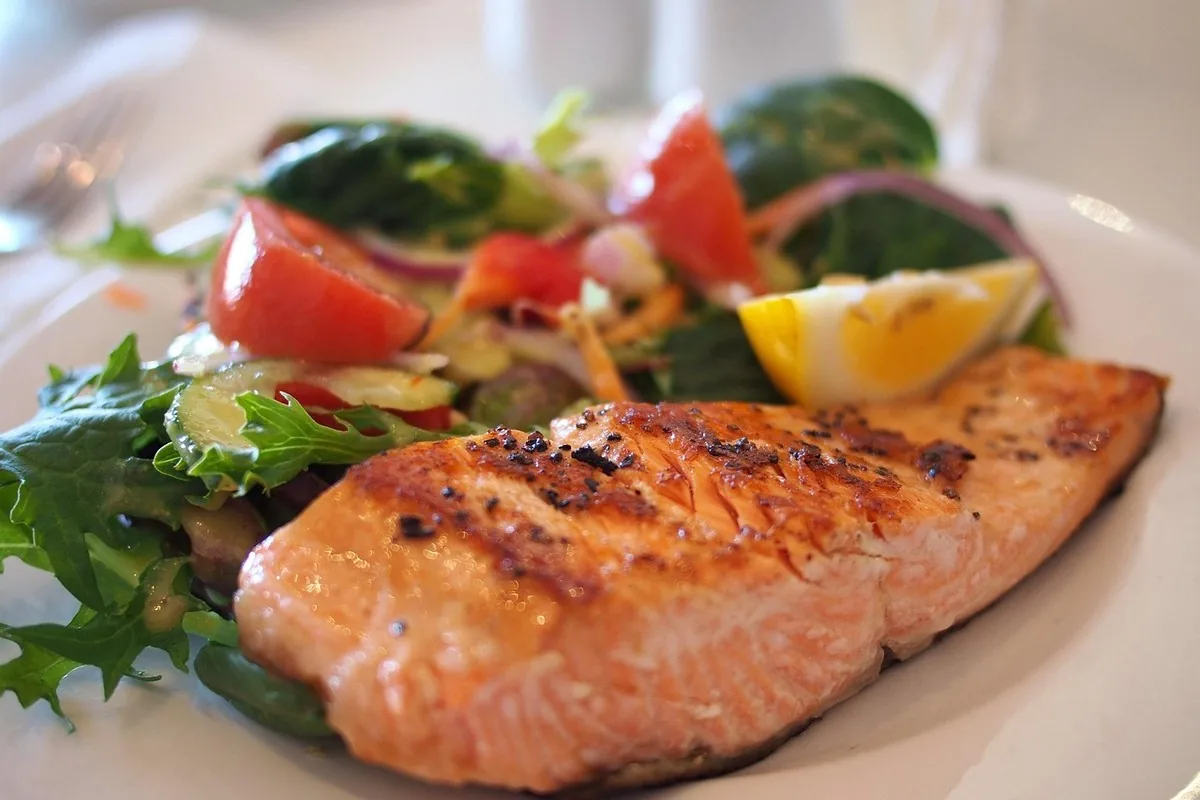
The message is clear: a varied, colourful, protein-rich plate is the primary line of mood support. No supplement replaces this foundation. But when intakes remain insufficient, or when seasonal and nervous pressures weigh despite genuine effort, a targeted precursor like 5-HTP comes fully into its own.
When 5-HTP Support Makes Sense — and How to Use It
Lifestyle habits first, always. But certain situations justify a targeted boost: periods of seasonal low mood, recurring evening emotional cravings, or difficulty falling asleep linked to a mind that will not switch off. In these moments, supporting the serotonin pathway upstream can usefully accompany other efforts.
When and How to Take It
5-HTP is generally taken as a course, away from protein-rich meals to facilitate absorption. For an objective of evening relaxation and support for sleep onset, a late-day dose aligns with the biochemistry of melatonin. For daytime mood balance, an earlier dose may be appropriate. In all cases, begin with the lowest indicated dose and follow the formula’s recommendations strictly.
How Long a Course Should Last
As with most natural approaches, consistency outperforms intensity. A background effect on nervous wellbeing is appreciated over several weeks of regular intake, allowing the terrain to rebalance. 5-HTP is not designed for permanent, indefinite use: a structured course with breaks is the wisest approach. Here too, a healthcare professional’s guidance helps define the framework suited to each individual.
Precautions You Must Know
This is the most important section of this guide, and we want it unambiguous. 5-HTP is an active molecule, and its use calls for genuine precautions.
- Mood medications. 5-HTP must not be combined with certain medications that act on serotonin, due to the risk of interaction. If you are taking any such treatment, do not consider any supplementation without the explicit consent of your doctor.
- Pregnancy and breastfeeding. 5-HTP is not recommended during pregnancy or breastfeeding due to insufficient safety data.
- Chronic conditions and other medications. In the presence of any chronic condition, or any ongoing medication, a healthcare professional’s opinion is indispensable before use.
- Digestive tolerance. Some individuals may experience mild digestive discomfort at the beginning of a course; starting with the lowest dose helps avoid this.
- Driving and operating machinery. Given its relaxing effect, it is prudent to evaluate personal tolerance before any activity requiring sustained alertness.
Observing these precautions is not a formality: it is the condition for responsible use. A well-used natural supplement is an ally; misused or combined with an incompatible treatment, it can create problems. When in doubt, refrain and seek advice. This is the golden rule, and Alphavital does not compromise on it.
The Alphavital Response
Alphavital has selected a 5-HTP extracted from Griffonia simplicifolia seeds — the botanical reference source — in a 100 mg formula. This formula is designed as a gentle support for nervous wellbeing and evening wind-down, for healthy individuals who wish to accompany their emotional balance through natural means, as a complement to a sound lifestyle.
Every batch is traced and tested, and the dosage respects the framework established by regulatory authorities. The formula is accompanied by clear usage instructions and the precautions detailed above, because honest information is part of the product. It sits within Alphavital’s stress, sleep, and natural serenity universe, and extends the Brain & Sleep hub into the previously underserved mood angle.
A well-made 5-HTP formula is not just about dosage. It brings together the right source, genuine traceability, and — above all — transparent information on precautions.
For those whose low vitality is driven primarily by stress and mental overload, magnesium and adaptogenic herbs offer a complementary path. Our team covers the adaptogenic approach in the guide ashwagandha, the stress adaptogen in Morocco. Depending on your terrain, these allies are best thought of together rather than in isolation.
The feedback our team receives speaks more eloquently than any claim. Here are three testimonials, shared with the authors’ consent, illustrating the diversity of situations.
Every winter, as soon as the days got shorter, I would feel flat and unmotivated. I tried 5-HTP as a course, alongside a morning walk to catch the light. What struck me was finding a little drive back in my day — nothing dramatic, just a quiet improvement. — Salma, Ifrane
My real issue was the sweet snacking in the evenings, especially on stressful days. With 5-HTP and a more protein-rich dinner, the compulsive urge calmed down. I no longer rush to the cupboard at ten at night. — Karim, Casablanca
I would lie in bed with my mind running in circles — impossible to switch off. I combined 5-HTP in the evening with magnesium. The feeling is a mind that settles more easily, and falling asleep with less effort. Not a knockout, just a gentler transition. — Houria, Rabat
These accounts illustrate a simple truth: the most lasting results come from combining lifestyle habits, nutrition, and — when relevant and properly guided — targeted support. A question before you start? Our team responds directly through the Alphavital contact page.
Frequently Asked Questions About 5-HTP and Griffonia
What exactly is 5-HTP?
5-HTP, or 5-hydroxytryptophan, is a naturally occurring molecule the body uses as an intermediate step in producing serotonin — a nerve messenger linked to mood, appetite, and sleep. In supplements, it is extracted from the seeds of a West African plant, Griffonia simplicifolia, which is exceptionally rich in this molecule.
What is the connection between 5-HTP, Griffonia, and serotonin?
Griffonia is the botanical source of 5-HTP. Once absorbed, 5-HTP is converted by the body into serotonin. That serotonin participates in mood and appetite balance, and becomes in the evening the raw material for melatonin — the sleep hormone. This chain explains why 5-HTP is relevant on three levels simultaneously.
Does 5-HTP actually help with mood?
5-HTP supports the natural serotonin pathway, making it a sought-after supplement for accompanying day-to-day emotional balance. Existing research is encouraging but calls for larger studies. Importantly: a supplement is not a medication and never replaces professional advice in cases of persistent or intense low mood.
Can 5-HTP help with sleep?
Indirectly, yes. The serotonin produced from 5-HTP is converted in the evening into melatonin — the hormone that prepares for sleep. 5-HTP therefore supports the natural sleep-onset chain without acting as a sleeping pill. For a comprehensive approach to sleep quality, it is often paired with magnesium and good sleep hygiene.
Does 5-HTP help with sugar cravings?
Emotional cravings — particularly evening urges for sugar — are partly linked to the serotonin pathway. By supporting it upstream, 5-HTP has been the subject of research into satiety. It acts on the emotional terrain of the craving, not on fat metabolism: it is not a weight-loss product, but a support for emotional appetite control.
When should 5-HTP be taken?
For evening relaxation and sleep onset, a late-day dose aligns with the biochemistry of melatonin. For daytime mood balance, an earlier dose may be discussed. Always begin with the lowest indicated dose, away from protein-rich meals, and follow the formula’s recommendations.
Are there contraindications for 5-HTP?
Yes, and they are serious. 5-HTP is not recommended during pregnancy or breastfeeding, and must not be combined with certain medications acting on mood and serotonin. In the presence of any condition or ongoing treatment, a healthcare professional’s opinion is essential before use. When in doubt, refrain and seek advice.
Where can I buy 5-HTP Griffonia in Morocco?
Alphavital offers a 5-HTP Griffonia 100 mg formula in Morocco, extracted from Griffonia simplicifolia seeds, batch-traced, and delivered throughout the Kingdom. The dosage, usage instructions, and precautions are detailed on the product page. This formula extends the Brain & Sleep hub into the mood and evening relaxation angle.
In Summary
5-HTP, extracted from Griffonia simplicifolia seeds, is one of the finest illustrations of the meeting between a plant and human biochemistry. By supplying the direct precursor to serotonin, it acts — upstream — on a common thread that connects three symptoms so often experienced in isolation: seasonal low mood, evening emotional cravings, and difficulty falling asleep. Understanding this chain, from tryptophan to melatonin, means ceasing to treat these signals in silos and beginning to support their shared root.
One starts with morning light, movement, sleep, and a plate rich in quality proteins, legumes, and seeds — all levers that naturally nourish the serotonin pathway. And when the seasonal or nervous terrain presses down despite genuine effort, a well-chosen, well-dosed, and properly guided precursor comes fully into its own. This is the path Alphavital has chosen, with a transparent approach faithful to the science and clear-eyed about the precautions. Taking care of one’s mood is not looking for a shortcut: it is giving the brain the conditions it needs to restore its balance, day by day.
About the author. Houda Khaldi is an Editorial Advisor in Natural Nutrition at Alphavital. She translates scientific research into clear, actionable guidance for everyday Moroccan life.
Disclaimer. The information presented is provided for guidance purposes only, based on sourced research (PubMed, EFSA, Inserm). The Alphavital team does not comprise healthcare professionals. 5-HTP is an active molecule: it is not recommended during pregnancy or breastfeeding, and must not be combined with certain mood medications. Consult a qualified healthcare professional before any use, in the presence of ongoing treatment, persistent low mood, pregnancy, breastfeeding, or chronic illness. Food supplements do not replace a varied, balanced diet or a healthy lifestyle.
To accompany mood and restful sleep within a healthy routine, Alphavital offers 5-HTP Griffonia for restful sleep and a balanced mood.
Sources and References
- Höglund E. et al. — Tryptophan Metabolic Pathways and Brain Serotonergic Activity: A Comparative Review. PubMed Central
- Shaw K. et al. — Tryptophan and 5-Hydroxytryptophan for depression (Cochrane Review). PubMed
- Cangiano C. et al. — Eating behavior and adherence to dietary prescriptions in obese adult subjects treated with 5-hydroxytryptophan. PubMed
- Sutanto C.N. et al. — The impact of tryptophan supplementation on sleep quality: a systematic review. PubMed Central
- Inserm — Dossier d’information sur le sommeil et ses cycles. Inserm